Is Balcony Solar Legal in Your State? 2026 State-by-State Guide
Balcony solar is legal only where a state law allows it. Utah and Maryland in detail, plus the rules and status in nine more states.
Some links are affiliate links: if you buy through them we earn a small commission at no extra cost to you. It does not change our recommendations.
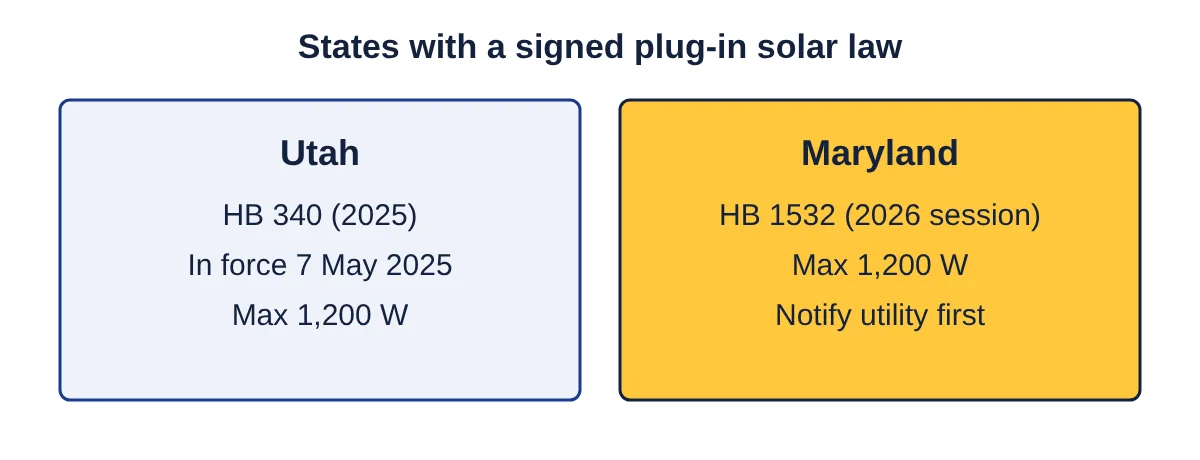
Balcony solar is legal in your state only if your state has passed a law that allows it. The states covered on this page are Utah and Maryland. Both laws allow a plug-in kit of up to 1,200 watts that is certified by a recognized safety testing laboratory.
The states with a law covered here
| Utah | Maryland | |
|---|---|---|
| Bill | HB 340 (2025) | HB 1532 (2026 session) |
| Output cap | 1,200 W | 1,200 W |
| Safety certification | UL or equivalent nationally recognized lab | UL or equivalent nationally recognized lab |
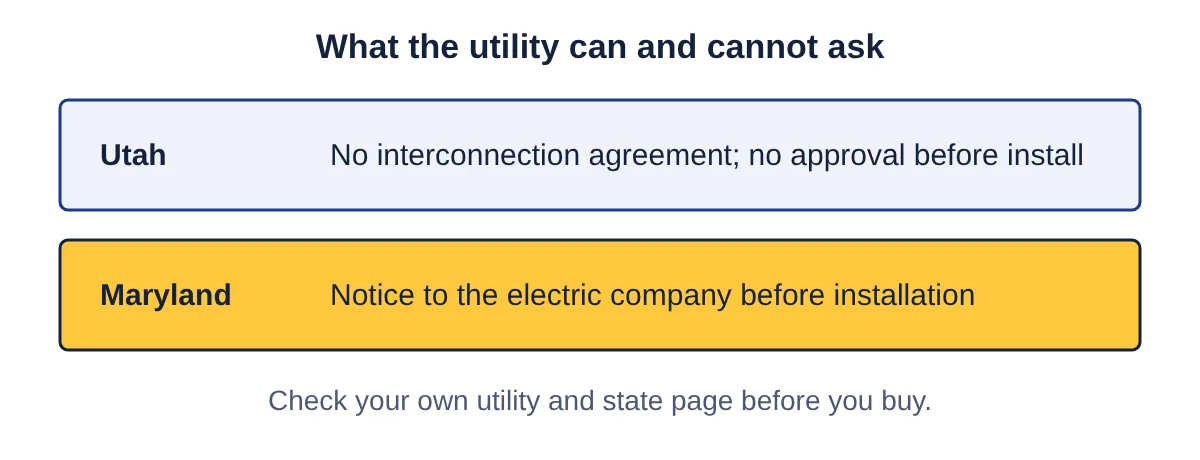
| Utility | No interconnection agreement; no approval before installation | Notice before installation; no approval or fee |
| In force | May 7, 2025 | Not stated on the state page |
What the Utah law says
Utah’s HB 340 defines a “portable solar generation device” as one with a maximum power output of not more than 1,200 watts. The system must also meet the most recent version of the National Electrical Code and be certified by Underwriters Laboratories or an equivalent nationally recognized testing laboratory.
Section 54-15-601 of the Utah Code exempts qualifying devices from the interconnection agreement requirement. It also bars utilities from requiring their approval before a system is installed or used. The bill takes effect on May 7, 2025.
What the Maryland rules say
The Maryland Public Service Commission describes the rules this way:
- The device must not supply more than 1,200 watts.
- You may install one portable solar energy generating system per electric meter, for residential use only.
- The device must be certified by a nationally recognized testing laboratory, such as UL.
- You must notify your electric company before installation and provide a certification that describes the device’s safety features and maximum output.
- A utility cannot require approval, and it cannot charge a fee for the installation.
- Devices with a maximum output of 391 W or less are exempt from listing requirements that would change the building’s wiring or electrical panel.
What to do with your electric company
Whether you must contact your utility depends on your state. The two covered here are different:
- Utah: the utility cannot require approval before you install, and an interconnection agreement is not required for a qualifying device.
- Maryland: you must notify the electric company before installing, with the certification described above.
More states, one page each
Each of these states has its own page, built from the official text of its law or bill:
| State | Status (as of November 12, 2026) | Output cap | Page |
|---|---|---|---|
| Utah | HB 340, in force since May 7, 2025 | 1,200 W | See below on this page |
| Maryland | HB 1532, signed in 2026 | 1,200 W; 391 W exemption | See below on this page |
| Colorado | HB26-1007; most device rules from January 1, 2027 | 1,920 W | Colorado plug-in solar law |
| Virginia | § 56-596.8, in force January 1, 2027 | 1,200 W per customer | Virginia plug-in solar law |
| California | SB 868, signed September 30, 2026 (Chapter 985, Statutes of 2026), takes effect in 2027 | 1,200 W per home | California SB 868 |
| New Jersey | S2368, signed September 1, 2026; starts six months after enactment | 1,200 W | New Jersey Balcony Solar Act |
| Vermont | Act 149, in effect since July 1, 2026 | 1,200 W per meter | Vermont Act 149 |
| Maine, Connecticut, New Hampshire | Laws signed in 2026 | Varies | Maine, Connecticut and New Hampshire |
| New York | SUNNY Act passed both houses on May 28, 2026; not signed | 1,200 W in the bill | New York SUNNY Act |
If your state is not listed
If your state is not on this page, a plug-in kit may not have a clear legal route yet. Check three things before you buy:
- Your state legislature’s website, for current bills and any signed law.
- Your electric company’s page on distributed generation or interconnection.
- Your lease or homeowners association rules, if you rent or live in a condo.
For what that means in practice, read plug-in solar in a state with no law.
Renters and HOAs
A state law can allow a kit and still leave your landlord or homeowners association in control. Read balcony solar for renters and HOAs before you install a panel on a railing or wall.
How to check your own electric company
- Find your electric company’s name on your monthly bill.
- Search that company’s website for “distributed generation” or “interconnection.”
- Ask in writing whether a plug-in kit needs notice or approval under your state’s law.
- Keep the written answer with your purchase records.
What the 1,200 W cap means in practice
The cap limits the device’s maximum output, not your home’s total electricity use. A kit at that size produces power only while the sun shines on its panels, so it will cover part of your use on a sunny day, not all of it.
Because Utah and Maryland use the same figure, a kit rated at or below 1,200 W meets the cap in either state. The other conditions, such as certification and utility notice, still differ, so check each state’s rules separately.
How to read a state law
A bill has a few parts you should find before you rely on it:
- The bill number and year, such as HB 340 (2025) in Utah. This identifies the exact text.
- The output cap, the maximum power a qualifying device may supply.
- The certification, the testing laboratory whose listing the device must carry.
- The utility rule, whether you must notify the utility, or whether the utility may require approval.
- The effective date, the day the law takes force. A signed law may take effect later, so check this date.
If a summary gives a number you cannot find in the bill text, use the bill text. Summaries from news outlets and trackers can differ from the enacted law.
Questions to ask your landlord or HOA
- Does the lease or the association’s rules allow a panel on the balcony, railing or wall?
- Who handles the mounts, any damage and removal at the end of a tenancy?
- Can you get the answer in writing?
Keeping up with changes
State laws are amended, delayed and sometimes replaced. Before any purchase, reread the bill text, check its effective date and look at your electric company’s most recent notice. Set a reminder to check again each time you change lease, move or upgrade your kit.
Common mistakes
- Assuming a law in one state applies in another.
- Buying a kit without a UL or equivalent certification.
- Installing in Maryland without notifying your electric company first.
- Going by a headline count of states. Check the law text itself.
- Forgetting that a lease or HOA rule can still stop an installation.
Read the law itself
The bill text is the final word. For Utah, read HB 340 on the Utah State Legislature website. For Maryland, read the Public Service Commission page and the rules it describes. Laws can be amended, so check the current version before you buy.
Last checked November 11, 2026 against the Utah enrolled text and the Maryland Public Service Commission page.
Frequently asked questions
Is plug-in solar legal in my state?
Only if your state has passed a law that allows it. The states covered on this page are Utah and Maryland. Check your state legislature's website for newer bills before you install.
Which states allow balcony solar?
Utah and Maryland, based on the official law text checked for this page. Laws change, so confirm the current status before you buy a kit.
What if my state is not listed here?
This page does not list a law for your state. Check your state legislature's website for current bills and your electric company's rules before you install anything.
Do I need to tell my utility about plug-in solar?
In Maryland, yes: you must notify your electric company before installation. In Utah, the law bars utilities from requiring approval before a system is installed.
What is the maximum watts allowed for plug-in solar?
The Utah and Maryland laws both set a maximum of 1,200 watts for a qualifying device.
Does a plug-in kit need a safety certification?
Yes, in both states. The device must be certified by Underwriters Laboratories (UL) or an equivalent nationally recognized testing laboratory.