New Jersey Balcony Solar Act (S2368): Rules, Landlords and Start Date
New Jersey's Garden State Balcony Solar Act allows plug-in solar up to 1,200 W, bars utility approval and requires 14 days' written notice to landlords.
Some links are affiliate links: if you buy through them we earn a small commission at no extra cost to you. It does not change our recommendations.

New Jersey’s Garden State Balcony Solar Act (S2368/A4836) lets residents connect a small solar device to a standard outlet, up to 1,200 watts. Governor Mikie Sherrill signed the law on September 1, 2026. It takes effect six months after enactment, which puts the start date around March 1, 2027.
When the law starts
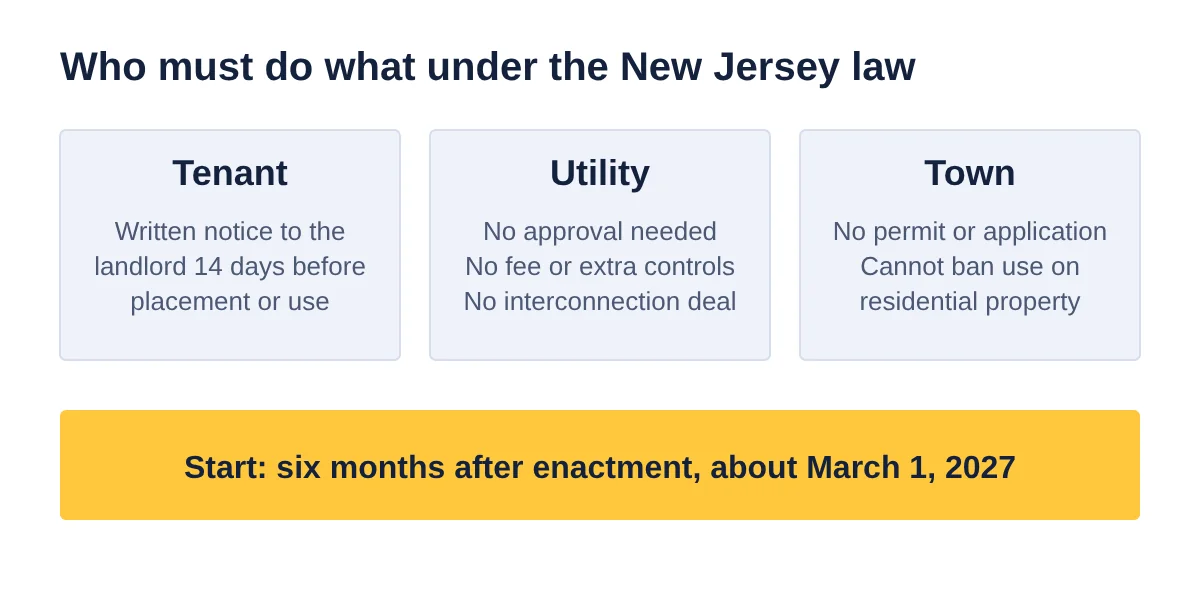
The law takes effect six months after enactment. The governor’s office announced the signing on September 1, 2026, so the start falls around March 1, 2027. The exact day depends on the enactment date in the signed law, which you can confirm on the New Jersey Legislature site. The law also lets the Board of Public Utilities take some steps before the start date.

The 1,200-watt limit
The device may produce at most 1,200 watts. The cap also applies to the whole home. Total output per service address or dwelling unit is limited to 1,200 watts unless the household first obtains an interconnection agreement. Two devices on one apartment do not add up to more than 1,200 watts without that agreement.
UL 3700 or a comparable standard
The device must be listed or certified to UL 3700, or to a comparable standard, by a nationally recognized testing laboratory. UL 3700 is the safety standard for plug-in photovoltaic systems. Read what UL 3700 covers before you compare kits. Ask the seller which listing covers the exact model, and check it before you buy.
What utilities and towns cannot require
The utility may not require prior approval, a fee, or extra controls beyond what is built into the device. The device is exempt from interconnection agreement and net metering requirements. The utility is also protected from civil liability for damage or injury caused by the device.
Towns follow separate rules. A municipality may not prohibit use on residential property. It may not require a permit, application, fee, license or other approval for placing or using the device.
Renters: the 14-day written notice
A tenant must give written notice at least 14 days before placing or using the device. The same notice goes to condominium, cooperative and homeowners’ associations. Landlords and associations may set reasonable limits on size and placement. They cannot bar a tenant who pays their own electricity from using a device on a balcony or patio. Association rules that prohibit exterior use cannot be enforced, and conflicting rules are void.
Common mistakes
- Assuming the law applies today. It takes effect about March 1, 2027.
- Waiting for utility approval. The law bars the utility from requiring it.
- Skipping the landlord notice. Tenants must give written notice at least 14 days before placing or using the device.
- Counting on more than 1,200 W. Total output above 1,200 W at one address requires an interconnection agreement first.
- Assuming a town permit is needed. Municipalities may not require a permit, application, fee or license for placing or using the device.
- Relying on a sales page. The law requires a listing or certification by a nationally recognized testing laboratory. A claim of compliance on a product page is not the same thing, so ask for the listing for the exact model.
For the national picture, see is balcony solar legal in your state. To compare notice rules across states, read do you have to tell your utility about plug-in solar. For the renter’s side, read balcony solar for renters and HOAs, and for a sample message, see how to ask your landlord or HOA. A state with a law already in force is Utah.
Frequently asked questions
Is balcony solar legal in New Jersey?
Yes, under the Garden State Balcony Solar Act (S2368/A4836), which Governor Mikie Sherrill signed on September 1, 2026. It takes effect six months after enactment, around March 1, 2027.
When does the New Jersey law start?
Six months after enactment. Because the governor signed it on September 1, 2026, the start date falls around March 1, 2027. Until the law takes effect, its rules do not apply yet.
Can my landlord refuse?
A landlord can set reasonable limits on size and placement, but cannot bar a tenant who pays their own electricity from using a device on a balcony or patio. The tenant must give written notice at least 14 days before placing or using the device.
Do I need a permit from my town?
No. Municipalities may not prohibit use on residential property and may not require a permit, application, fee, license or other approval for placing or using the device.
Does my utility have to approve it?
No. The utility may not require prior approval, a fee or extra controls beyond those built into the device.