Does Plug-In Solar Spin Your Meter Backwards? Net Metering, Exports and Credits
Plug-in solar feeds your appliances first. Utah, New Jersey, Vermont and the New York bill set the rules for extra power and bill credits.
Some links are affiliate links: if you buy through them we earn a small commission at no extra cost to you. It does not change our recommendations.

In the laws covered here, no. A plug-in solar system feeds the appliances that are running in your home first, so only the extra power goes out to the grid. That extra power does not earn a net metering credit. Utah and New Jersey exempt these devices from net metering, and Vermont’s law says exported power is not compensated.
Your home uses the power first
A plug-in kit has a microinverter that turns the panel’s output into 120-volt power and sends it into a standard outlet. Your appliances draw from that outlet. Whatever is running at that moment uses the solar power first.
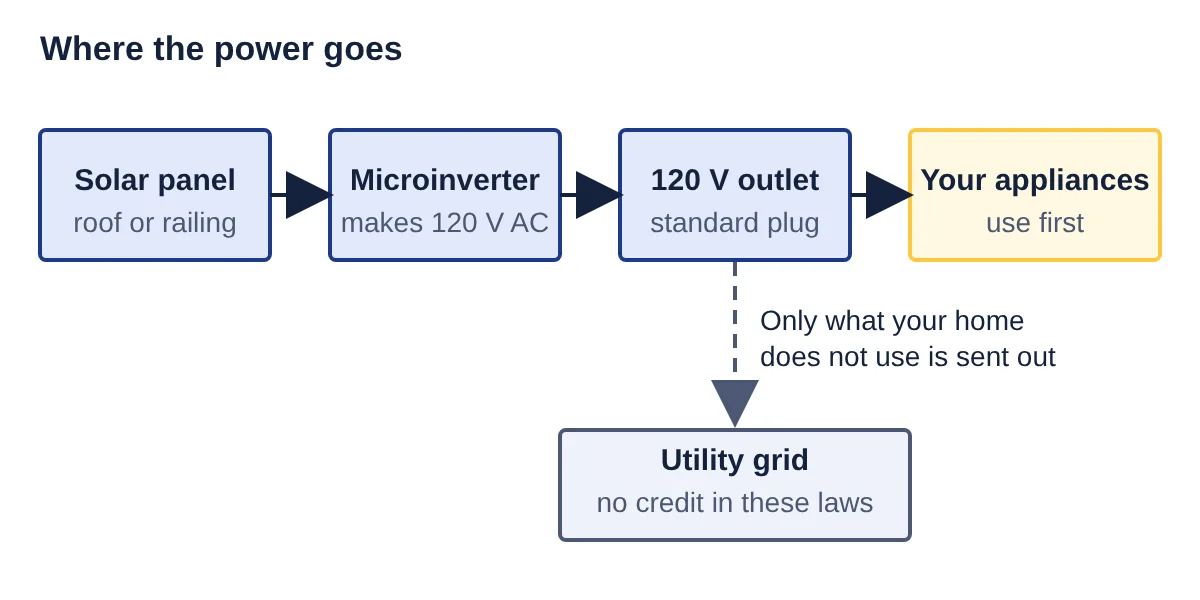
If the panels make more than the house uses, the extra goes out to the grid. That extra power is what the rules below cover.
What net metering is
Net metering is a utility program that credits a customer for power its system sends back to the grid. Each state sets its own rules, and most of them were written for rooftop systems. Plug-in devices are different, and the new laws say so directly.
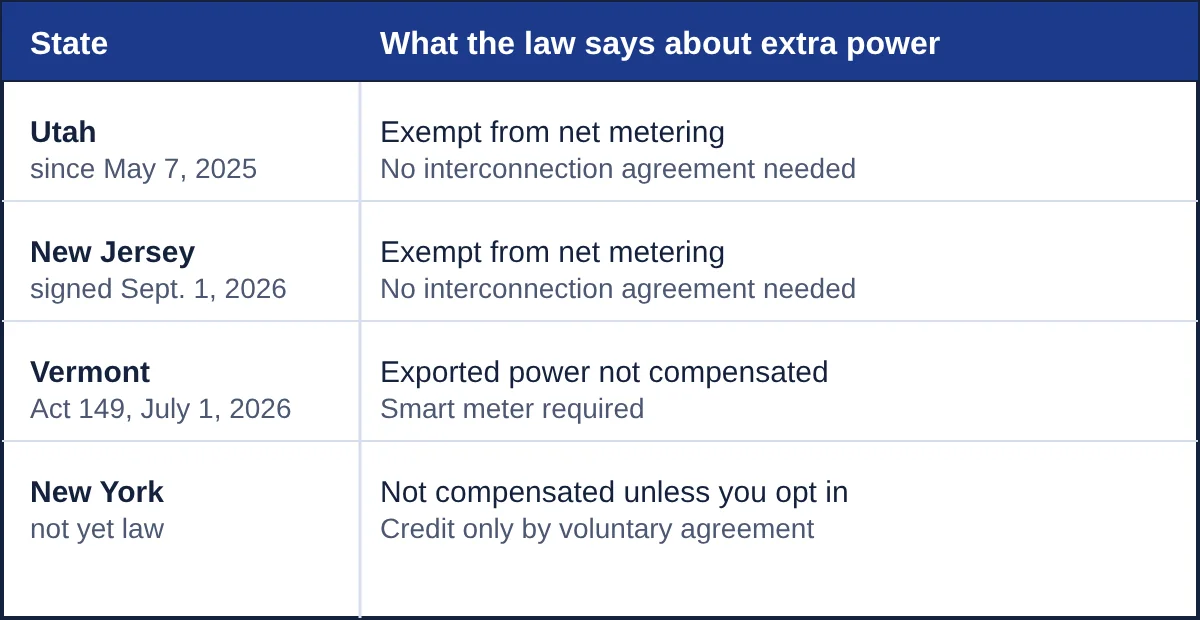
Utah’s law exempts a qualifying device from the interconnection requirements and from the net metering program. New Jersey’s law does the same: its text exempts a portable solar generation device from “net metering program requirements” under state law and from any requirement to sign an interconnection agreement before operating it.
What happens to the extra power
Two texts say what happens to the surplus. Vermont’s Act 149 is law. The New York SUNNY Act is a bill.
Vermont’s enacted text says: “Generation exported to the grid by a plug-in photovoltaic device shall not be compensated,” and that these devices are not eligible for net metering. It also says a customer on net metering may not add a plug-in device.
New York’s bill, version C, says that energy exported to the grid “shall be uncompensated” unless the owner chooses to enter a voluntary interconnection or net metering agreement. The same version caps the export at 1,200 watts of inverter output.
Smart meters
Vermont’s act sets a meter rule. It says plug-in photovoltaic devices “shall only be connected to systems using smart meters.” If you live in Vermont, check your meter with your utility before you buy.
What this means for your savings
Plug-in solar saves money on the power your home uses while the panels produce. It does not save money on the extra power, under the laws above. That is why the savings depend on how much your home uses in daylight. For the numbers, read how much balcony solar can save by state.
For the full picture of where plug-in solar is legal, read is balcony solar legal in your state. For the rules of each state, see the guides for Utah, Vermont, New Jersey and New York.
What to ask your utility
Before you install, ask your utility three questions in writing:
- Does my meter record the power I send to the grid, and does the utility bill for it?
- Does my state’s law require me to give notice, and is there a form?
- Does the utility offer a program that pays for exported power, and can a plug-in device join it?
The laws described above set a default: in Vermont’s act and in the New York bill, exported power is not compensated unless you sign a separate agreement. A utility program is a separate contract, so read its terms before you rely on it.
Common mistakes
- Expecting a credit for every kilowatt-hour you send out. Under the laws above, the extra power is not compensated.
- Assuming the meter will lower your bill. Your bill drops only by the power your home uses during the day instead of buying it.
- Using rooftop net metering rules. The laws exempt plug-in devices from net metering. Ask your utility how it treats them.
- Ignoring Vermont’s smart meter rule. It applies before you install.
Notice rules differ by state, so read do you have to tell your utility about plug-in solar before you buy.
Frequently asked questions
Do I get paid for extra power from plug-in solar?
Under the state laws described below, no. Vermont's Act 149 and the New York bill say exported power is not compensated, and Utah and New Jersey exempt these devices from net metering. Your utility may run its own program, so ask it directly.
Can my meter run backwards?
Whether a meter counts power you send out depends on the meter and on your utility's billing. Ask your utility which meter you have before you install anything.
Do I need a smart meter for plug-in solar?
In Vermont, yes. Act 149 says plug-in photovoltaic devices may only be connected to systems that use smart meters. Check the rules in your own state with your utility.
Does plug-in solar lower my bill?
It can. Power that your appliances use while the panels produce is power you do not buy from the utility. Under the laws cited here, the extra power does not earn a net metering credit.
Do I need to notify my utility about plug-in solar?
It depends on the state. Utah's law sets no notice requirement, and Maryland's requires notice to the utility before you install. Check your state's rules before you buy.
Does plug-in solar affect my bill credit?
Not through net metering under the laws cited here. It can reduce what you buy from the utility during daylight hours, because your appliances run on solar first.
Sources
- Vermont General Assembly – Act 149 (S.202), as enacted, 2026
- New Jersey Legislature – S2368, third reprint (Garden State Balcony Solar Act)
- New York State Assembly – A9111-C (SUNNY Act), text
- City & State New York – where key legislation stands (November 9, 2026)
- Utah Legislature – HB 340 (2025), enrolled copy