Do You Have to Tell Your Utility About Plug-In Solar? State-by-State Notice Rules
Approval, notice and registration are different. See what each state's plug-in solar law says about telling your utility, as of November 12, 2026.
Some links are affiliate links: if you buy through them we earn a small commission at no extra cost to you. It does not change our recommendations.

It depends on the state, and the answer is usually notice rather than permission. The laws in this guide bar utilities from requiring approval for a compliant device. Some states require notice before you install, some after, some let the utility ask for it, and some set no utility notice at all. The table below gives each state’s rule as of November 12, 2026.
Approval, notice and registration are different
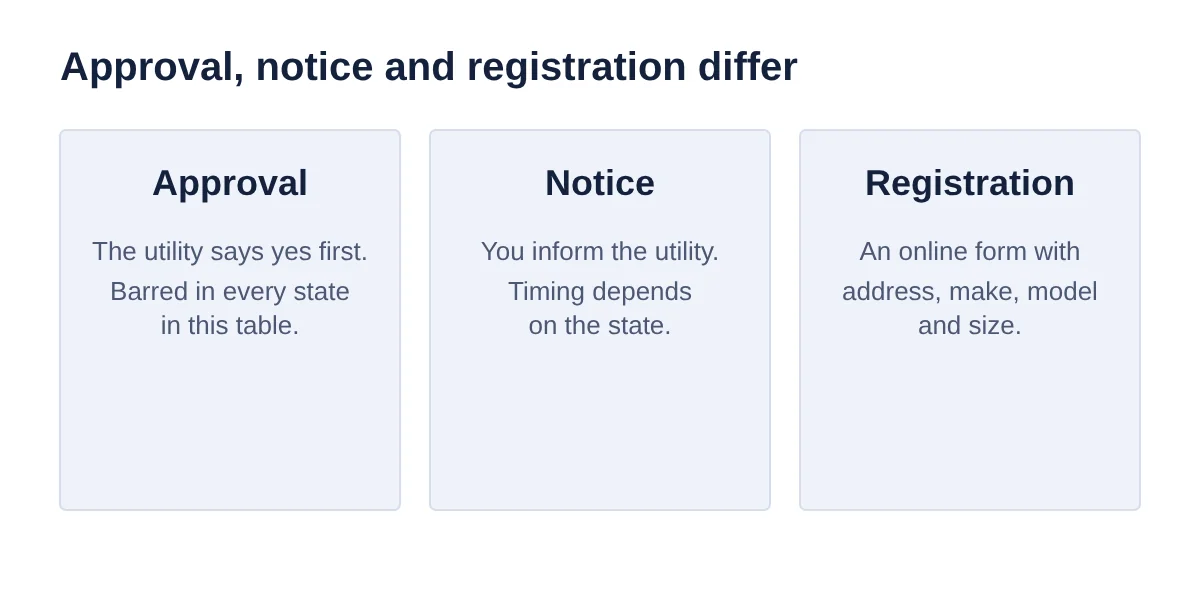
Approval means the utility says yes before you install. Notice means you inform the utility. Registration means you fill in an online form with details about the device. The laws in this guide bar the first. They differ on the other two.
State by state
| State | Law | Notice to the utility |
|---|---|---|
| Utah | HB 340, in effect since May 7, 2025 | None |
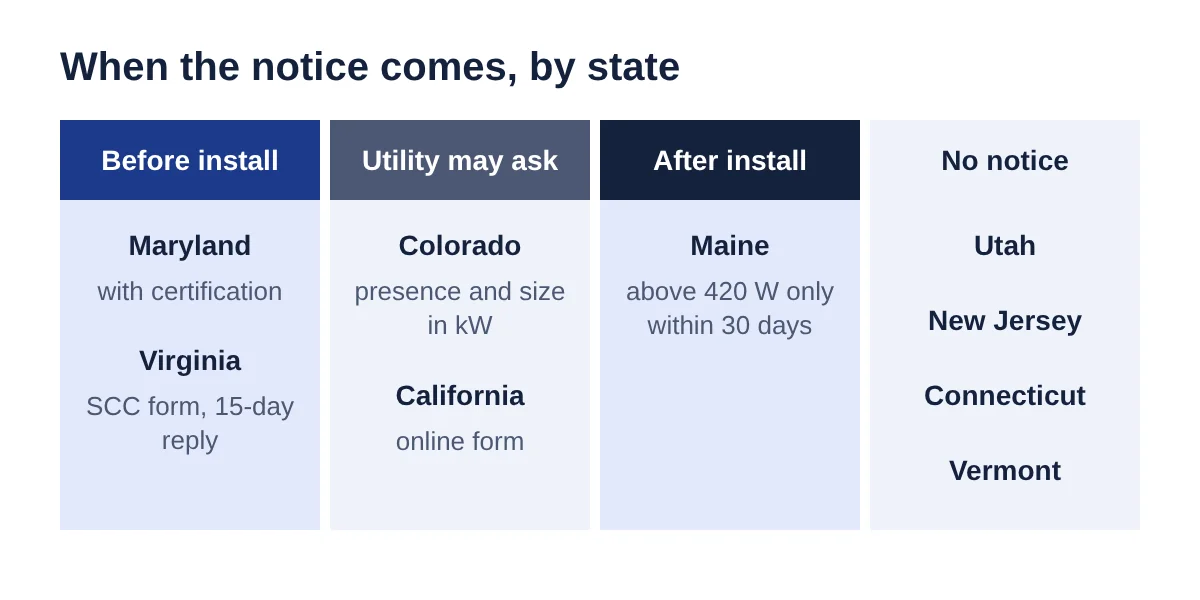
| Maryland | HB 1532, Public Utilities § 7-321 | Before installation, with a certification of the device’s safety features and maximum capacity |
| Virginia | HB 395, from January 1, 2027 | State Corporation Commission form, sent before installing; the provider has 15 days to respond |
| Colorado | HB26-1007, most device rules from January 1, 2027 | The utility may require notice of the device’s presence and its size in kilowatts |
| Vermont | Act 149, in effect since July 1, 2026 | No notice step in the Act |
| New Jersey | S2368/A4836, six months after enactment | None to the utility; tenants give the landlord written notice 14 days ahead |
| Maine | Public Law chapter 644, enacted April 6, 2026 | Only above 420 W: within 30 days after installation, on the commission’s form |
| Connecticut | Public Act 26-127, device rules from October 1, 2026 | None set out in the device rules |
| California | SB 868, protections until January 1, 2030 | The utility may ask for an online form with address, make, model and size |
New York is not in the table because its bill was not yet law. It is covered below.
Maryland: notice before you install
Maryland requires you to notify the electric company before installation. The notice includes a certification describing the system’s safety features and its maximum generating capacity. The Maryland Public Service Commission publishes a balcony solar page that links to each utility’s forms and contacts. Send the notice before the installation day, not after.
Virginia: the SCC form and 15 days
Virginia’s section, effective January 1, 2027, uses a form set by the State Corporation Commission. You can send it online or by mail. The provider has 15 days to respond about any deficiencies. If the provider does not respond within 15 days, the notice requirement is treated as met.
Colorado and California: the utility may ask
Colorado lets the utility require notice of the device’s presence and its size in kilowatts. The utility cannot require approval or charge a fee for the device. California’s SB 868 works differently. Until January 1, 2030, utilities cannot require approval, fees or extra controls for a compliant device. They may ask you to fill in an online form with your address and the device’s make, model and size.
Maine: notice only above 420 watts
Maine’s statute sets no notice for systems up to 420 watts per service address. For systems above 420 watts, up to 1,200 watts, the customer must notify the utility within 30 days after installation. A licensed Maine electrician must install the system on a dedicated circuit. The Maine guide covers the full Maine, Connecticut and New Hampshire rules.
Utah, Vermont, New Jersey and Connecticut: no notice to the utility
Utah’s HB 340 sets no notice requirement to the utility. Vermont’s Act 149 bars the utility from requiring approval, a fee or extra controls, and it sets no notice step. New Jersey’s law sets no notice to the utility. Tenants, however, give the landlord written notice at least 14 days before placing or using a device. Connecticut’s device rules set no notice to the utility, and they bar approval before installation.
New York: still pending
City & State listed the SUNNY Act as pending on November 9, 2026. If the governor signs it, the bill would require notice to the utility within 30 days after installation. Until it is signed, the notice rule does not apply. The New York guide explains the details.
What a notice usually asks for
The notices differ, but they ask for similar facts. Maryland asks for a certification of the device’s safety features and its maximum capacity. Colorado asks for the device’s presence and its size in kilowatts. California’s online form asks for your address and the device’s make, model and size. Maine asks for the service address, the inverter capacity and a statement of compliance. Virginia uses the form set by the State Corporation Commission, so use that form’s fields.
Common mistakes
- Treating notice as approval. Under these laws, the utility cannot make you wait for a yes.
- Installing before the notice. Maryland and Virginia require the notice before you install.
- Missing the 30-day window in Maine. It applies above 420 watts.
- Assuming New York’s bill is law. It was still pending on November 9, 2026.
For the legal picture in your state, see is balcony solar legal in your state. For state detail, read Maryland’s law, Virginia’s law, Colorado’s law and the New Jersey Balcony Solar Act.
Frequently asked questions
Do I need my utility's permission for plug-in solar?
No, under the laws in this guide. Each law bars the utility from requiring approval before a compliant device is installed or used. Some laws still require a notice or a registration.
What is the difference between notice and approval?
Notice means you inform the utility, sometimes before and sometimes after installation. Approval means the utility must say yes first. The laws in this guide bar approval, but several require notice.
Will my utility charge a fee?
Under these laws the utility cannot require a fee for a compliant device. The Connecticut act makes an exception for charges the system incurs through its use.
Do I need to tell my utility in Utah?
No. HB 340 sets no notice requirement to the utility. It bars the utility from requiring approval, a fee or extra equipment for a qualifying device.
Which states need notice before installing?
Maryland requires notice before installation, with a certification. Virginia requires the State Corporation Commission form before installing, and the provider has 15 days to respond.
Sources
- Maryland General Assembly – HB 1532 (2026), enrolled text, Public Utilities § 7-321
- Code of Virginia § 56-596.8 (updated text, effective January 1, 2027)
- Colorado General Assembly – HB26-1007 session law (approved May 7, 2026)
- Utah Legislature – HB 340 (2025), Solar Power Amendments, enrolled copy
- New Jersey Legislature – S2368, Garden State Balcony Solar Act (third reprint)
- Vermont General Assembly – Act 149 (S.202) as enacted, 2026
- Maine Legislature – Title 35-A, section 3475, plug-in photovoltaic and battery systems
- Connecticut General Assembly – Public Act 26-127 (HB 5340), 2026
- CalMatters Digital Democracy – SB 868 (2025-2026), status and summary
- City & State New York – where key legislation stands, November 9, 2026