Virginia Plug-In Solar Law (HB 395): Start Date, Notification Form and Limits
Virginia's HB 395 takes effect January 1, 2027. It allows up to 1,200 W per customer after a notice on a State Corporation Commission form. Rules and limits.
Some links are affiliate links: if you buy through them we earn a small commission at no extra cost to you. It does not change our recommendations.

Virginia’s HB 395 takes effect on January 1, 2027. From that date, a customer may install a small portable solar generation device of up to 1,200 watts per customer, after notifying the electric service provider on the form set by the State Corporation Commission (SCC). The notice can be sent online or by mail, and the provider has 15 days to respond.
What the device must meet
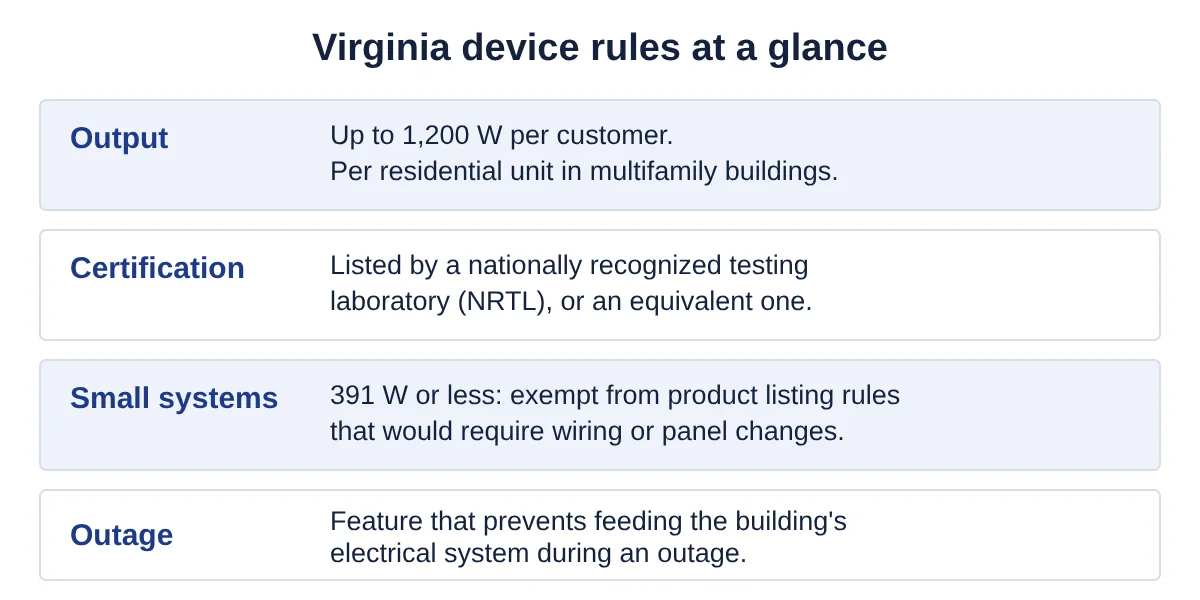
Under § 56-596.8, a small portable solar generation device is a movable photovoltaic device that:
- has a maximum output of not more than 1,200 watts per customer,
- plugs into a building’s electrical outlet and sits on the customer’s side of the meter,
- is intended mainly to offset part of the customer’s electricity use,
- meets the current National Electrical Code, and
- includes a feature that prevents it from feeding power to the building’s electrical system during an outage.
The device must also be certified by a nationally recognized testing laboratory, as defined in federal workplace safety rules (29 C.F.R. § 1910.7), or an equivalent one.
The notice: a form and 15 days
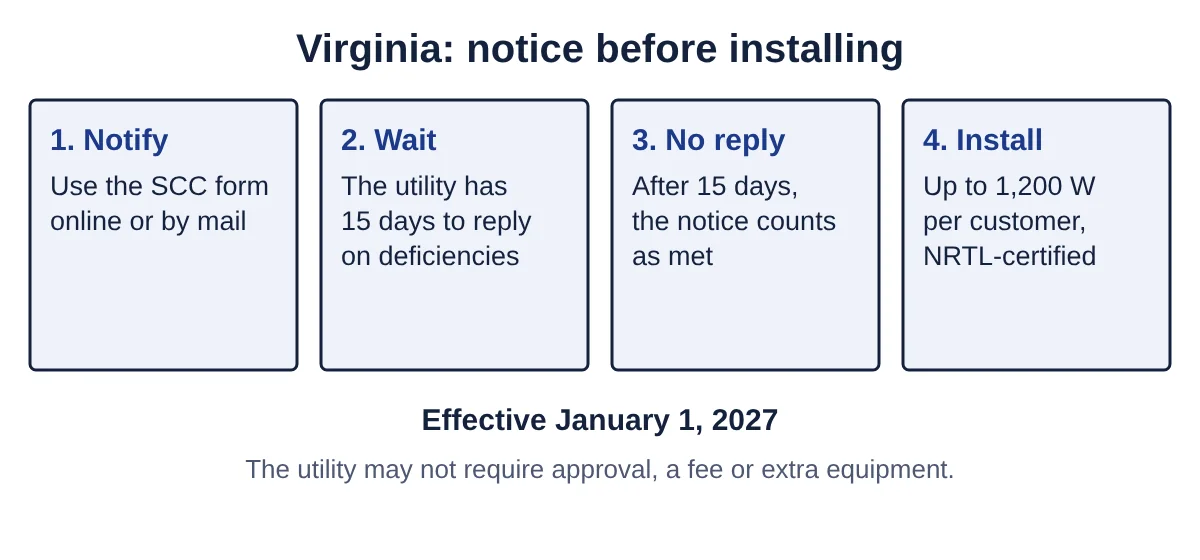
- Notify before installing. Submit the form the SCC establishes, online or by mail.
- The provider has 15 days. It reviews the form and responds about any deficiencies.
- No response counts as met. If the provider does not respond within 15 days, the notice requirement is treated as met and you may install the device.
The notice gives the provider a chance to flag problems. It does not require approval. The utility may not require approval before installation or use, impose any fee or charge, or require additional controls or equipment beyond what is integrated with the device.
The 391-watt exemption
A device with a maximum output of 391 watts or less is exempt from product-listing provisions that would require changes to the building’s premises, wiring or electrical panels.
Utility rights and liability
A utility may install an automatic, locking disconnect switch where a property has more than one device or where the distribution circuit requires it. Investor-owned, municipal and cooperative utilities are not liable for damage, injury or service interruptions caused by these devices.
How Virginia differs from Maryland
Maryland and Virginia both set a 1,200-watt limit and a 391-watt exemption from certain listing rules. They differ in the notice step. Maryland requires notice before installation with a certification of the system’s safety features and capacity. Virginia requires the SCC form, and the provider has 15 days to respond about deficiencies. Virginia’s notice also counts as met if the provider stays silent for 15 days. For the Maryland detail, read Maryland plug-in solar law.
Renters and multifamily buildings
In multifamily housing, the 1,200-watt limit applies per residential building unit. The section does not apply to a rental unit billed through a ratio utility billing system, as defined in § 55.1-1212. For leases and association rules, read balcony solar for renters and HOAs.
Before you install
- Wait for January 1, 2027. Under this section, the rules apply from that date.
- Fill in the SCC form and send it before the installation day.
- Check the certification of the exact model with the seller.
- Use a licensed electrician if your outlet or panel needs any work.
Common mistakes
- Waiting for the utility’s approval. The section requires notice, not approval.
- Assuming a 2026 start date. The section takes effect January 1, 2027.
- Counting the 1,200 W limit per apartment building. In multifamily housing it applies per residential unit.
For the national picture, see is balcony solar legal in your state. For the other state laws, read Maryland’s law, Utah’s law and Colorado’s law. To compare notice rules, see do you have to tell your utility about plug-in solar.
Frequently asked questions
When does plug-in solar become legal in Virginia?
Section 56-596.8 of the Code of Virginia, which covers small portable solar generation devices, takes effect January 1, 2027. Before that date, these rules do not apply.
Do I have to notify my electric provider in Virginia?
Yes. You must notify your electric service provider before installation, using the form the State Corporation Commission establishes. The provider has 15 days to respond about any deficiencies.
Is there a form?
Yes. The State Corporation Commission establishes the notice form, and you can submit it online or by mail.
Can the utility require approval before I install?
No. The utility may not require approval before installation or use, impose a fee or charge, or require additional controls or equipment beyond what is integrated with the device.
What does the 391-watt exemption cover?
A device with a maximum output of 391 watts or less is exempt from product-listing provisions that would require changes to the building's premises, wiring or electrical panels.
Does the 1,200 W limit apply in an apartment building?
Yes, but in multifamily housing the limit applies per residential building unit. The section does not apply to a rental unit billed through a ratio utility billing system.