Vermont Plug-In Solar Law (Act 149): UL 3700, Smart Meters and the Rules
Vermont's Act 149 has applied since July 1, 2026. It allows up to 1,200 W per electric meter and requires UL 3700 or an equivalent listing and a smart meter.
Some links are affiliate links: if you buy through them we earn a small commission at no extra cost to you. It does not change our recommendations.

Vermont’s Act 149 (S.202) allows a plug-in solar device with a combined inverter capacity of up to 1,200 watts per electric meter. The governor signed the Act on June 16, 2026, and it has applied since July 1, 2026. The device must meet UL 3700 or an equivalent certification, be installed and operated under IEEE 1547-2018, and connect only to a smart meter.
What the Act requires
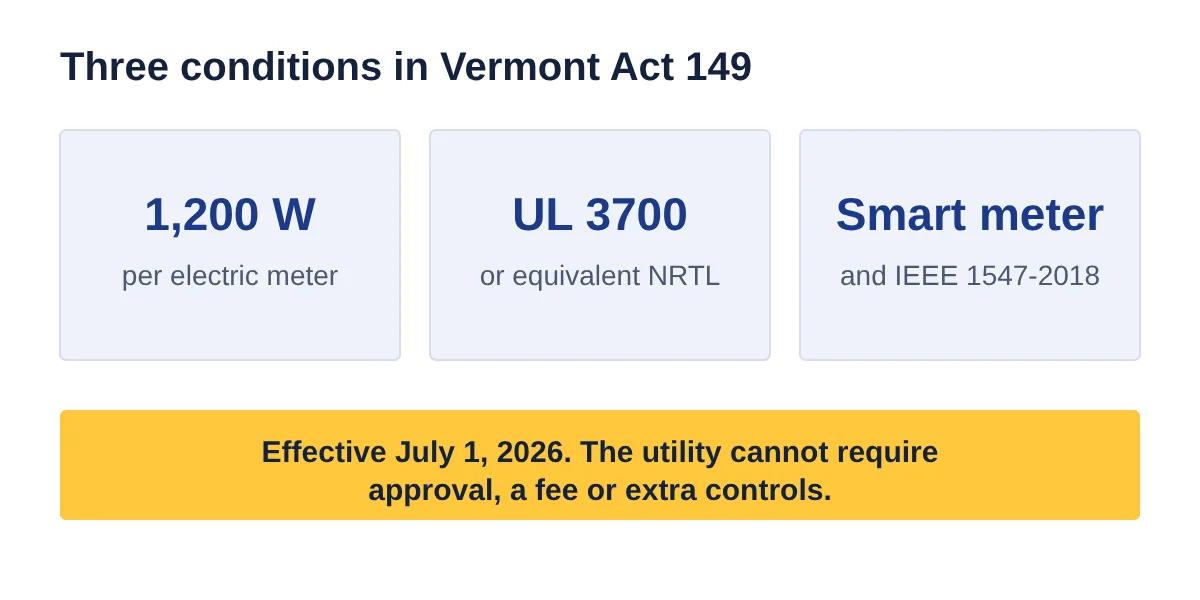
Act 149 sets four conditions for a plug-in photovoltaic device: the power limit, the certification, the smart meter and the installation standard. Each one is explained below.
1,200 watts per meter
The limit applies to each electric meter, and it measures inverter capacity, not the rated power of the panels. Inside that limit you can install one or more devices, as long as their combined inverter capacity stays at or below 1,200 watts.
UL 3700 or an equivalent certification
The device must comply with UL 3700 for plug-in photovoltaic systems by UL Solutions. An equivalent certification from an equivalent nationally recognized testing laboratory also meets the Act. Read what the UL 3700 standard covers. Ask the seller for the listing that covers your exact model before you buy.
Smart meter and IEEE 1547-2018
A plug-in device may only be connected to systems that use smart meters. The device must also be installed and operated in line with IEEE 1547-2018 and any successor standard. If your home has an older meter, ask your utility what it needs before you plan the installation.
What the utility can and cannot do
The utility cannot require you to get its approval before you install or use a compliant device. It cannot charge a fee related to installing the device, and it cannot require controls or equipment beyond what the device already includes.
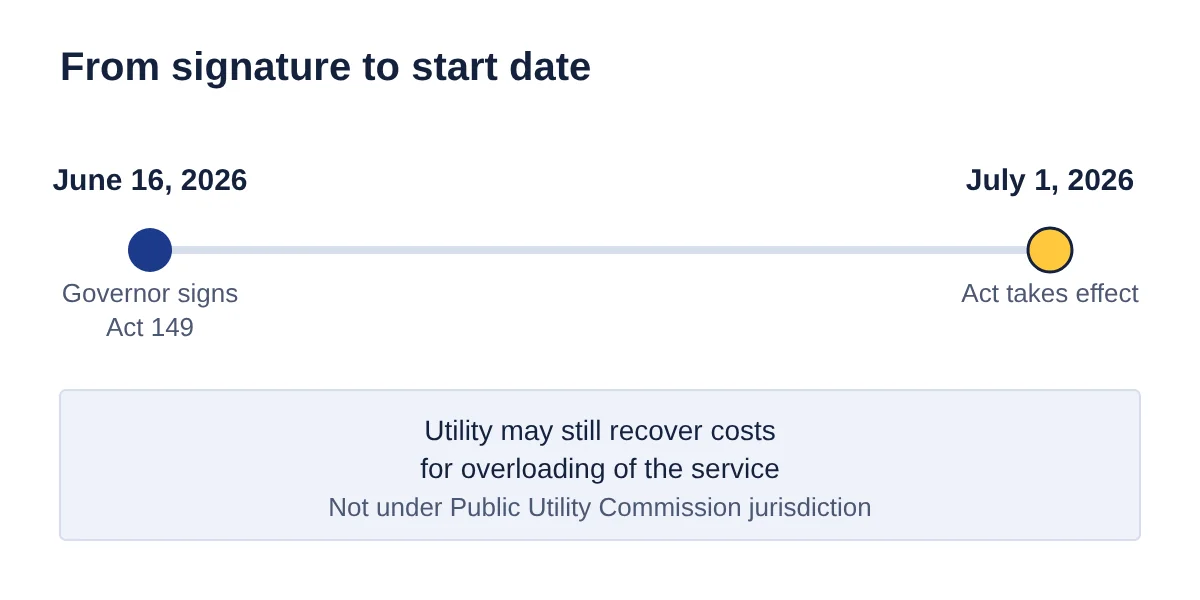
The utility keeps two rights. It may still recover the costs of overloading the service caused by the device. A compliant device is also exempt from the interconnection agreement requirement and is not under the jurisdiction of the Public Utility Commission.
When the Act applies
The governor signed the Act on June 16, 2026. It took effect on July 1, 2026.
Mounting: temporarily but securely attached
The Act requires that a customer ensure the device is temporarily but securely attached to the ground or a structure. For a balcony or railing, the question is how the mount holds the device safely. See balcony solar mounts for the options.
Common mistakes
- Expecting the utility’s approval. The Act bars it for a compliant device.
- Counting panels instead of inverter capacity. The limit is 1,200 W of combined inverter capacity per meter.
- Ignoring the smart meter. Devices may only connect to systems with smart meters.
- Buying without a listing. Without UL 3700 or an equivalent certification, the device does not meet the Act.
- Assuming wattage is enough. The device must also meet the certification and the IEEE 1547-2018 installation standard.
- Forgetting the overload costs. The utility may still recover the costs of overloading the service caused by the device.
If you rent or live in a shared building, check your lease and association rules too. The Act sets the limits on the device and the utility, and those limits apply per electric meter.
For the national picture, see is balcony solar legal in your state. For New Jersey’s law, which starts later, read the New Jersey Balcony Solar Act. For the three New England laws, see Maine, Connecticut and New Hampshire. To compare notice rules, read do you have to tell your utility. For output in cold climates, see how much balcony solar produces by city.
Frequently asked questions
Is plug-in solar legal in Vermont?
Yes. Act 149 was approved on June 16, 2026 and took effect on July 1, 2026. It allows a plug-in device of up to 1,200 watts per electric meter that meets the Act's listing and installation rules.
Do I need a smart meter?
Yes. Under the Act, plug-in photovoltaic devices may only be connected to systems that use smart meters.
Does the utility have to approve my device?
No. The utility cannot require approval before you install or use a compliant device. It also cannot charge a fee for installing the device or require controls beyond those built into it.
Can I use more than one panel kit?
Yes, as long as the combined inverter capacity on the meter stays at or below 1,200 watts.
What certification does the device need?
The device must comply with UL 3700 for plug-in photovoltaic systems by UL Solutions, or hold an equivalent certification from an equivalent nationally recognized testing laboratory.
Is UL 3700 the only accepted certification?
No. The Act also accepts an equivalent certification from an equivalent nationally recognized testing laboratory, and the device must still meet IEEE 1547-2018 and the smart meter rule.