California Plug-In Solar Law (SB 868): What Changes in 2027
California's SB 868 allows plug-in solar up to 1,200 watts from 2027. What the law requires, how registration changes and what to check before you buy.
Some links are affiliate links: if you buy through them we earn a small commission at no extra cost to you. It does not change our recommendations.
California’s SB 868, signed by Governor Gavin Newsom on September 30, 2026 (Chapter 985, Statutes of 2026), creates a legal route for plug-in solar. A qualifying device can put out up to 1,200 watts per home, must be certified by a safety testing laboratory and must have a feature that stops power from flowing back to the grid during an outage. The law takes effect in 2027 and sunsets on January 1, 2030.
What SB 868 changes
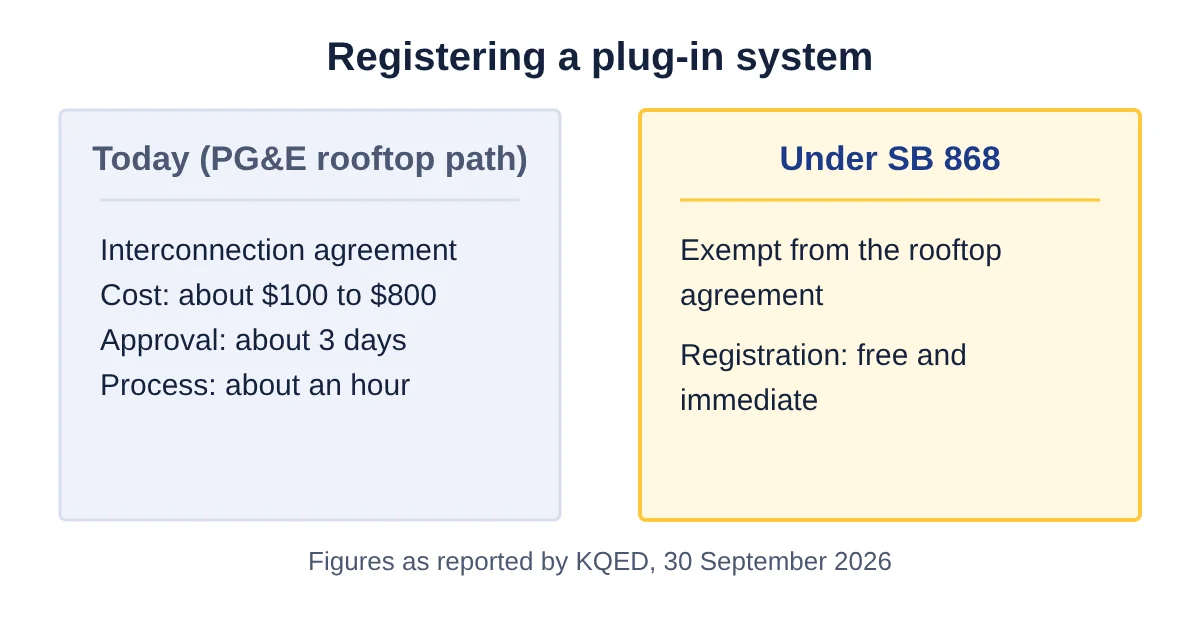
Until SB 868, a California homeowner or renter who wanted to connect a rooftop-style system to the grid had to go through a utility interconnection agreement. The new law carves out a separate path for small plug-in devices. Until January 1, 2030, utilities cannot require approval, fees or controls beyond those built into a compliant device. They may require an online form with the address and the device’s make, model and size.
The new path does not change the rules for a roof system that is wired to the building’s electrical panel.
Key dates
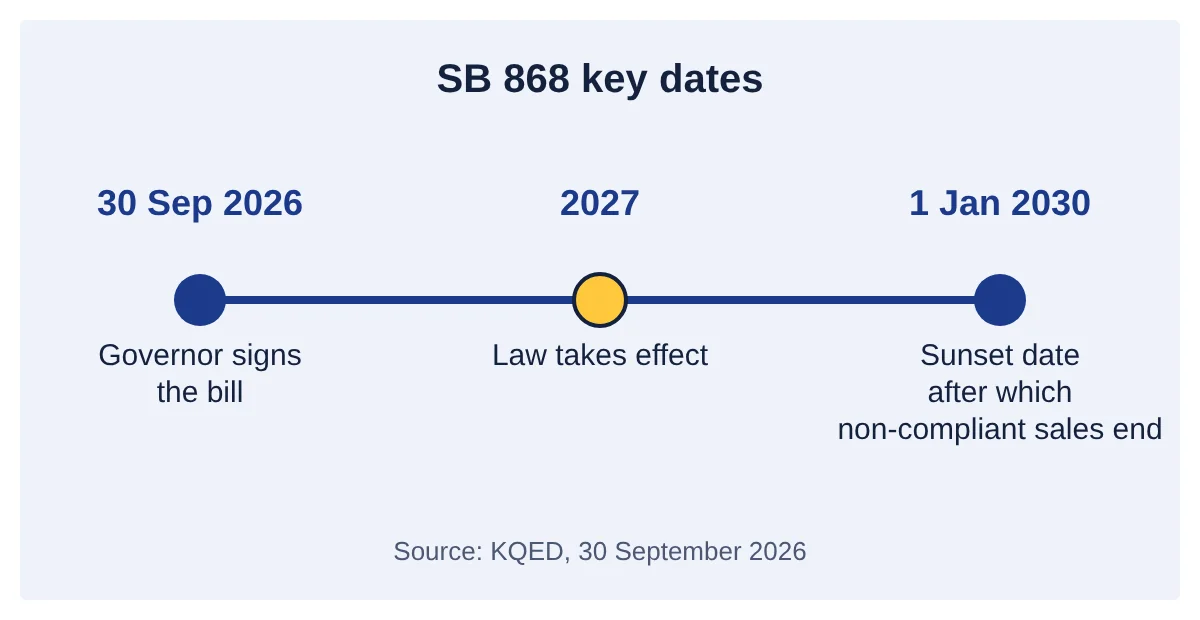
KQED’s report on the signing gives three dates. The first is the signing itself. The second is the start of the new rules in 2027. The third is the sunset on January 1, 2030, after which the sale of non-compliant systems becomes illegal.
Until then, the practical question is when compliant products will be sold. KQED reports that companies expect them in 2027, and its article gives two timings, spring and mid-2027. Plan for the later date.
What the device must have
SB 868 sets these requirements for the device:
- Output limit. The device may output no more than 1,200 watts of alternating current to the home’s electrical system. KQED describes this as 1,200 watts per home.
- Certification. The device must be certified as a plug-in photovoltaic system by Underwriters Laboratories (UL), or by an equivalent nationally recognized testing laboratory.
- Outage isolation. The device must have a feature that isolates it from the building’s wiring during an outage, so it does not feed power back onto the grid.
- Electrical codes. The device must meet the current National Electrical Code and California Electrical Code.
A California Assembly committee analysis of the bill states that no commercial system had yet completed full UL certification.
Utility registration: from agreement to free sign-up
Under today’s process, KQED reports that an interconnection agreement with PG&E costs about $100 to $800 and takes about an hour to complete, with approval typically in about three days. For compliant devices, SB 868 replaces that step with, at most, a free online registration form.
Products that do not meet the new requirements must still register as rooftop solar. That is the rule you should expect for any device you buy before it is certified.
Renters and HOAs in California
KQED quotes the bill’s author, Senator Scott Wiener, saying that the panels will give everyone, including renters, relief from high bills. The legislative analyses of SB 868 describe rules for devices and utilities; they list no landlord or homeowners association provision.
So do not read the law as a right to install in a rental or in an association: your lease and the association’s rules still apply. Treat your lease and association rules as separate from the state law. For a step-by-step approach to that conversation, read balcony solar for renters and HOAs.
What to do before 2027
- Wait for a certified product. A device without UL or an equivalent certification will not meet the law’s conditions.
- Ask the seller for the certification number. Check it in the testing laboratory’s online directory before you buy.
- Check the output rating. The limit is 1,200 watts for the device, so a kit rated above that figure does not fit the law’s device limit.
- Get your landlord’s answer in writing. Keep it with your records before you install anything.
Common mistakes
- Reading the 2027 start date as the day products appear in stores.
- Assuming a sale or listing means the device meets the state rules.
- Treating the law as permission from your landlord or HOA.
- Confusing the 1,200-watt device limit with the amount of electricity your home uses.
For the basics of how these devices work, see what balcony solar is. For a state-by-state overview, read is balcony solar legal in your state. For the safety standard that certified products must meet, read UL 3700 explained.
Frequently asked questions
Is balcony solar legal in California?
California's SB 868, signed on September 30, 2026, allows plug-in solar systems that meet its conditions. The law takes effect in 2027, so the new rules do not apply before then.
When can I buy plug-in solar in California?
The law takes effect in 2027. KQED reports that manufacturers expect compliant models in 2027, in spring or mid-2027.
Do I need PG&E approval for plug-in solar?
No. Until January 1, 2030, utilities cannot require approval, fees or extra controls for a compliant device. They may ask you to fill in an online form with your address and the device's make, model and size. Products that do not meet the rules must still go through the usual interconnection process.
Does SB 868 apply to renters?
The official analyses of SB 868 describe rules for devices and utilities, not a landlord-consent rule. Read your lease and ask your landlord in writing before you mount anything on a balcony or wall.
What happens to non-compliant plug-in systems in 2030?
According to KQED, the law sunsets on January 1, 2030, and after that date the sale of non-compliant systems becomes illegal.
Sources
- CalMatters Digital Democracy – SB 868 (2025-2026), status and bill summary: Chapter 985, Statutes of 2026
- KQED – California officially legalizes balcony solar (Sep 30, 2026)
- California Senate Committee on Energy, Utilities and Communications – analysis of SB 868 (March 2026 amended version)
- California Assembly Committee analysis of SB 868