Plug-In Solar in a State With No Law: What Are the Risks?
In a state with no plug-in solar law, no rule sets a route for these devices. Learn what utilities argue, the safety concern and the risks to weigh.
Some links are affiliate links: if you buy through them we earn a small commission at no extra cost to you. It does not change our recommendations.
In a state with no plug-in solar law, no state rule sets a route for these devices. The rules that apply are the general ones for connecting generation to the grid, and utilities argue that those rules should cover plug-in panels too. The main risks are a dispute with your utility, a safety issue on the grid and an unclear position with your insurer and landlord.
Which states have no bill
The Bright Saver tracker lists 16 states that have yet to introduce a plug-in solar bill: Alabama, Arkansas, Florida, Kansas, Kentucky, Louisiana, Mississippi, Montana, Nebraska, Nevada, North Dakota, South Dakota, Tennessee, Texas, West Virginia and Wisconsin. Bright Saver states that the tracker is updated daily.
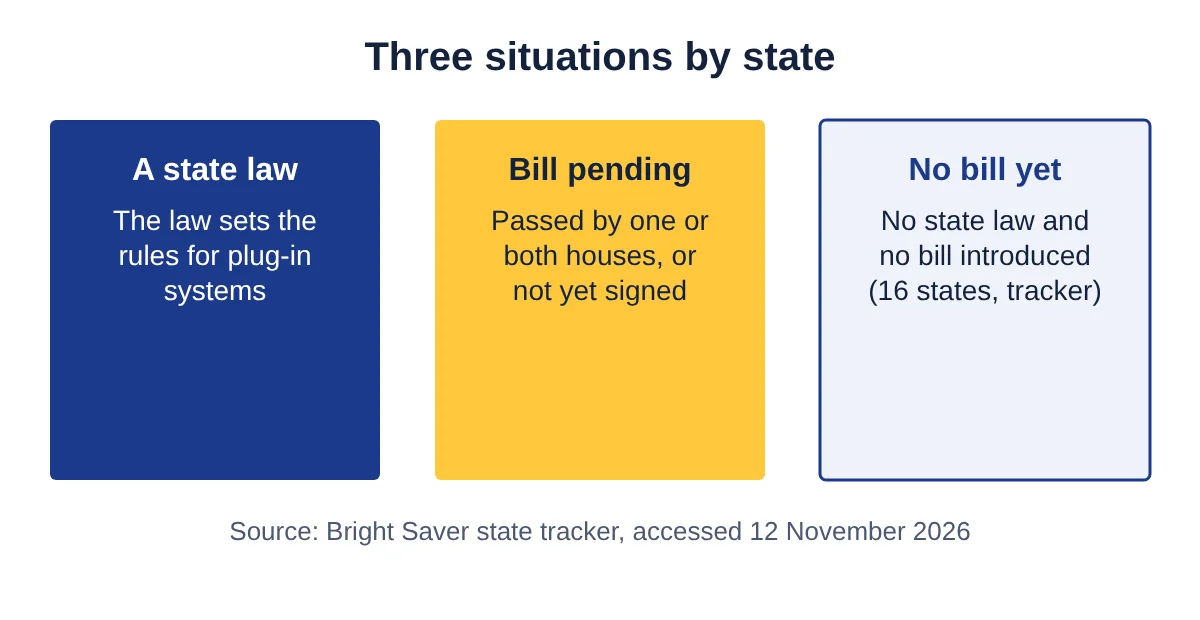
Bright Saver says it is working with local advocates to introduce bills in states without one. That means a state on the list can change, but a bill that has not been introduced has no effect yet.
What a missing law means in practice
Bright Saver states that in states that have passed plug-in solar legislation, utilities are explicitly prohibited from requiring approval, fees or extra controls. That prohibition exists only where a law has been passed. In the other states, no law addresses it.
NPR’s March 2026 report on the issue says most utilities argue that plug-in solar should be subject to the same connection agreements that larger rooftop systems need. Similar bills have been delayed in Arizona, New Mexico, Washington and Wyoming, according to the same report.
So the gap is not a yes or no answer. It is a question your utility answers under its own rules, and the answer may differ from one utility to the next.
The safety concern
Utilities put safety first. NPR quotes a utility’s testimony that the safety of its line workers is a reason to oppose such a bill. The concern is backfeed. A panel can keep generating and send power through the home’s wiring and back out to the grid.
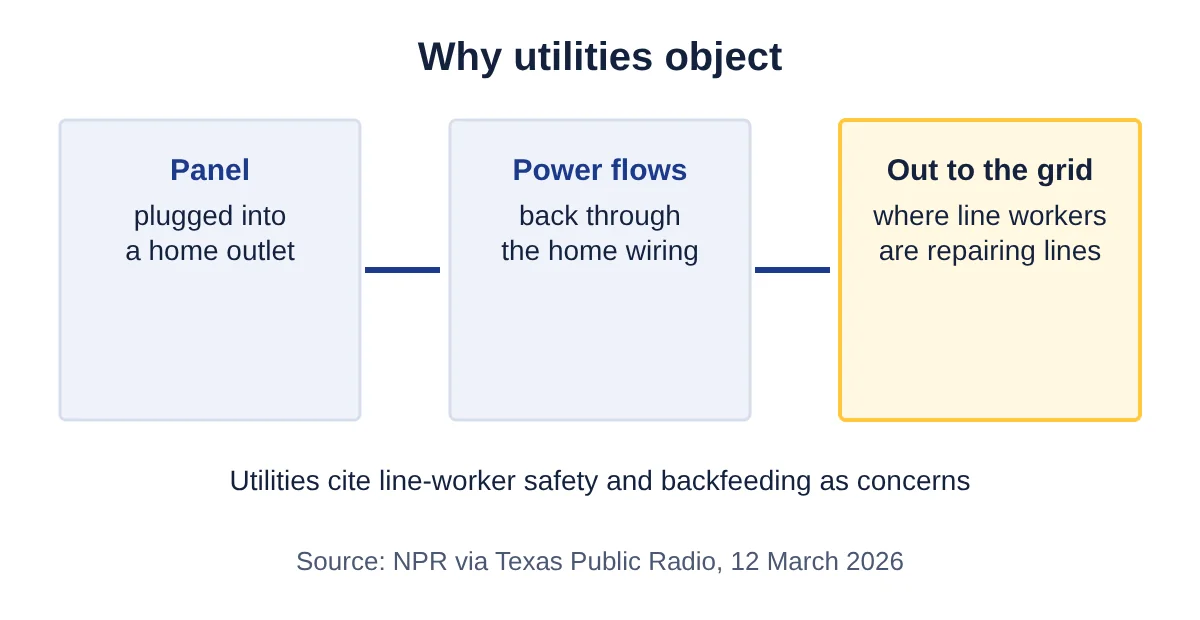
NPR also reports a utility attorney’s point that the company would not know where these devices are located.
The risks to weigh
- A conflict with your utility. If your utility applies its standard connection terms to any generator on your home, an unregistered device may breach them. Ask in writing before you connect.
- Safety for others. Backfeed is the concern utilities name, and it reaches the line workers the utilities are protecting.
- Insurance. Ask your insurer whether an unregistered generating device is covered before you install one. Read the insurance question for plug-in solar for the questions to put to them.
- Your lease or association. A landlord or association can still refuse a device, whatever your state’s law says.
- A future law may set different rules. A device installed now may need to be changed when a state law takes effect.
Safer options while you wait
- Wait for a state law and a certified product. Read the state-by-state notice rules for the states that have one.
- Use a battery power station that is not connected to the home’s wiring. It is a different category of product from a grid-connected plug-in system, and the comparison of the two explains the differences.
- Ask your utility for a written answer on whether a plug-in device needs a connection agreement, notice or approval.
Questions to ask your utility
- Does a plug-in solar device on my home need a connection agreement?
- Do I need to give you notice, and in what form?
- Can you confirm your answer in writing?
Keep the reply with your records. If your utility says no agreement is needed, the written answer is the proof you will want later. For the states that have passed a law, read is balcony solar legal in your state. For the renter’s side of the question, read balcony solar for renters and HOAs.
Frequently asked questions
Can I use plug-in solar in Texas?
Texas is on the Bright Saver tracker's list of states with no plug-in solar bill. No state law sets a route for plug-in devices there, so ask your utility for its written connection rules before you connect anything.
Is plug-in solar legal in Florida?
Florida is also on that tracker's list of states with no bill, so no state law sets a route for plug-in devices. Ask your utility and your state regulator for a written answer about your specific situation.
What happens if I plug in solar without telling my utility?
Utilities argue that their standard connection agreements should apply to plug-in devices. An unregistered system could therefore conflict with your utility's terms. Ask before you connect anything.
Why do utilities object to plug-in solar?
Utilities cite the safety of line workers and the risk that a panel sends power back through the home's wiring and out to the grid. A utility's lawyer has also said the utility would not know where such devices are located.
Can I put a panel on my balcony in a state with no law?
Only with your landlord's or association's agreement and within your utility's rules. No state law sets a route for these devices in a state with no bill, so read your lease first.