New York SUNNY Act: Plug-In Solar Rules and Status
The New York SUNNY Act passed the Legislature but was still awaiting the governor on November 9, 2026. What the bill sets out and what to do now.
Some links are affiliate links: if you buy through them we earn a small commission at no extra cost to you. It does not change our recommendations.
The New York SUNNY Act would allow plug-in solar panels in the state, but it is not law yet. Both houses passed it on May 28, 2026. As of November 9, 2026, City & State listed it as pending, with Governor Kathy Hochul yet to sign or veto it. Until she acts, no state rule permits a plug-in panel on a window or balcony.
Where the bill stands
City & State’s November 9, 2026 update lists the SUNNY Act among the bills still waiting for a decision. The same article notes that bills left without action at the end of January 2027 are vetoed automatically. On November 12, 2026, the bill’s official page on nysenate.gov still showed no signature or veto: its last action is the passage on May 28, 2026.
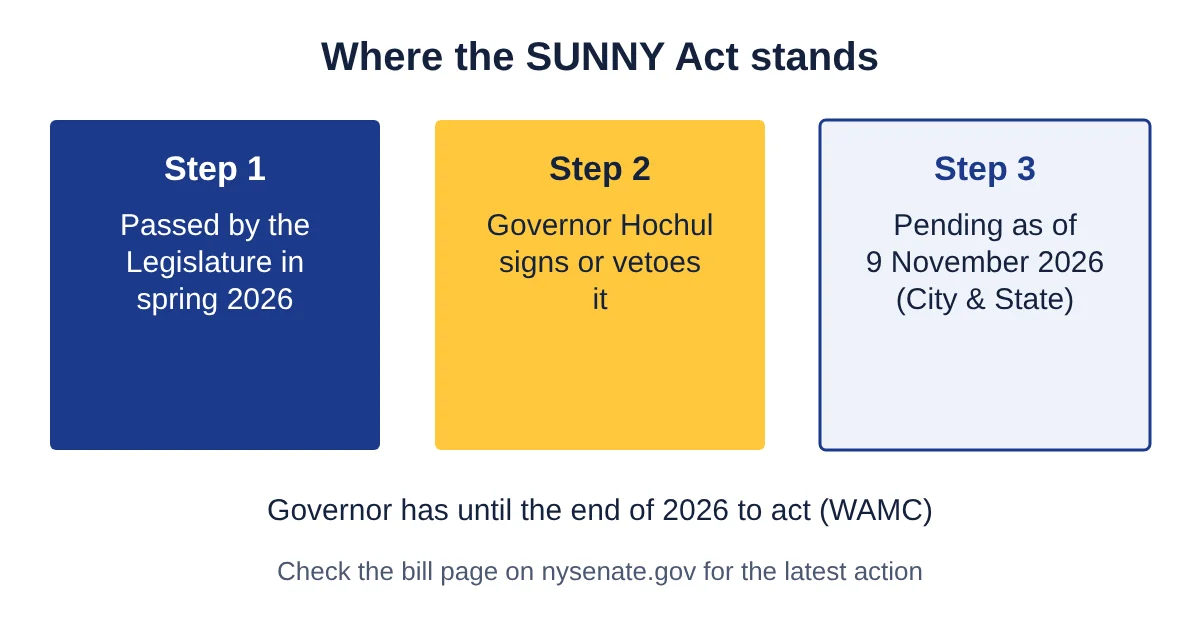
Pending status means the bill is not yet law. A signed bill can still have a later start date, and the final text sets it. Check the bill page on the New York State Senate website before you buy any device.
What the SUNNY Act would require
The bill text as passed (A9111C) sets three main conditions:
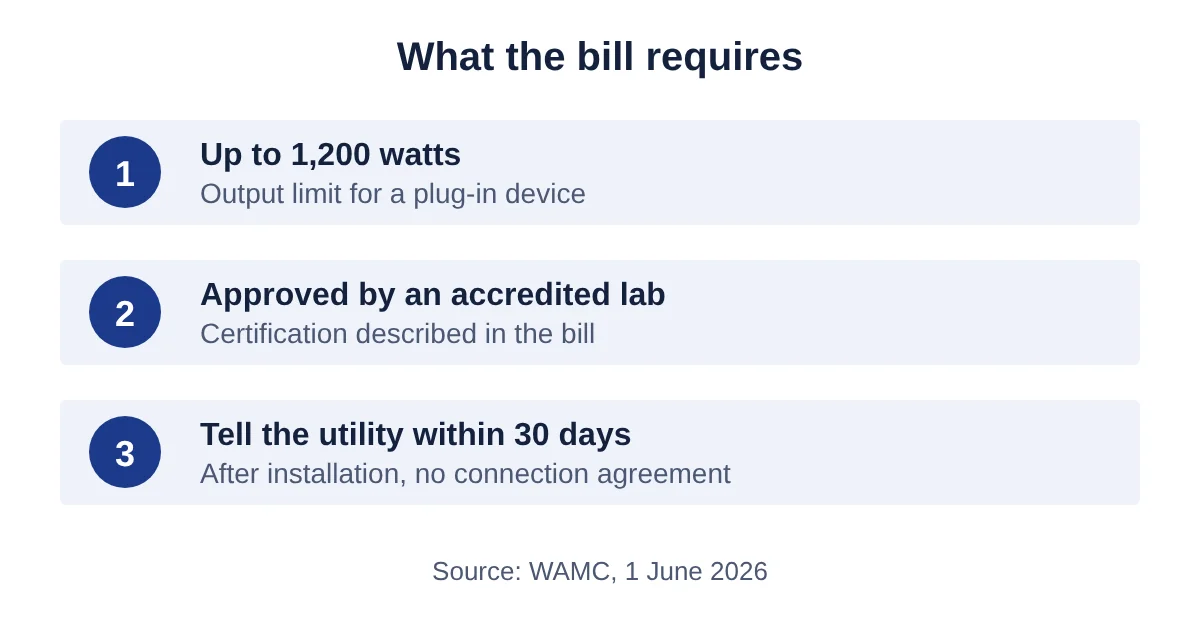
- Output limit. The bill would authorize plug-in panels that put out up to 1,200 watts.
- Listing. The device must be listed or certified by an accredited nationally recognized testing laboratory. The bill does not name a specific standard such as UL 3700.
- Utility notice. The device is not subject to interconnection or net metering rules, and the utility cannot require its approval, fees or extra equipment. The owner must notify the utility within 30 days of installation, using a simple form that asks for contact details, address, account number, make, model and size.
Exported electricity is not paid for unless the customer chooses to sign a compensation agreement. If signed, the act takes effect on the 90th day after it becomes law.
WAMC also reports that panels must comply with fire codes, which applies to any placement on a balcony or fire escape.
The 1,200-watt figure is a limit on what the device can output. It is not a measure of what your home uses. A panel produces power only while the sun shines on it, so on a sunny day it covers part of a household’s use, not all of it.
What the bill would not do
The bill has no provision on landlords, tenants, co-ops or homeowner associations, so it does not require them to permit plug-in panels. A tenant or owner in a building would still need the building’s agreement, or the terms of the lease or association rules, before mounting a panel on a railing, a window frame or a wall.
That gap is the most important practical point for New York City renters. A state law can allow a device and still leave the building in control. For renters and condo owners, read balcony solar for renters and HOAs before you approach your landlord.
What to do now
- Check the status before you act. The bill’s status can change. Look at the bill page on nysenate.gov and the governor’s news releases.
- Do not buy on the strength of the bill. Passing the Legislature is not the same as signature.
- Ask for permission in writing. Keep a copy of your request and the answer.
- Look for a certified product. Ask any seller for the testing laboratory’s listing before you buy.
- Gather the building’s rules first. Have your lease, the association’s rules and your utility account details in hand before you talk to a seller or installer.
Common mistakes
- Reading “passed the Legislature” as “signed into law.”
- Assuming the bill overrides your lease or your condo or co-op rules.
- Installing a device on a fire escape or in a stairwell without checking the building’s rules.
- Treating a news summary as the final text. Check the bill itself.
For the basics of plug-in devices, read what balcony solar is. For how other states have handled the same questions, read is balcony solar legal in your state. For the standard certified products must meet, read UL 3700 explained.
Frequently asked questions
Is balcony solar legal in New York?
Not yet under a signed law. The SUNNY Act passed both houses of the state Legislature on May 28, 2026, but as of November 9, 2026 it was still waiting for Governor Kathy Hochul to sign or veto it.
Did Hochul sign the SUNNY Act?
Not as of November 9, 2026, according to City & State. Check the bill page on nysenate.gov for any action taken after that date.
Can I put solar panels on my window in NYC?
Not under a law yet. The bill, if signed, would allow a plug-in device of up to 1,200 watts that is approved by an accredited testing laboratory. Until a law is signed, a plug-in panel on a window or balcony has no state permission.
Do I need utility approval for plug-in solar in New York?
No. The bill bars utilities from requiring approval, fees or extra equipment. It would require you to notify the utility within 30 days after installation.
Can my landlord stop me from using plug-in solar?
The bill has no provision on landlords, tenants, co-ops or homeowner associations. Your lease and the building's or association's rules still decide that question.
Sources
- New York State Legislature – Assembly Bill A9111C (SUNNY Act), bill text
- New York State Senate – A9111 bill page and action history (passed Senate and Assembly, May 28, 2026)
- WAMC – New Yorkers can soon hang solar panels from their windows, if Gov. Hochul approves (Jun 1, 2026)
- City & State – Here's where key legislation stands with Gov. Kathy Hochul (Nov 9, 2026)
- New York State Senate – SUNNY Act passes the Legislature (press release, 2026)