Plug-In Solar Laws in Maine, Connecticut and New Hampshire (2026)
Maine, Connecticut and New Hampshire signed plug-in solar laws in 2026. Maine sets a 420 W threshold, and Connecticut caps devices at 1,200 W with a UL listing.
Some links are affiliate links: if you buy through them we earn a small commission at no extra cost to you. It does not change our recommendations.

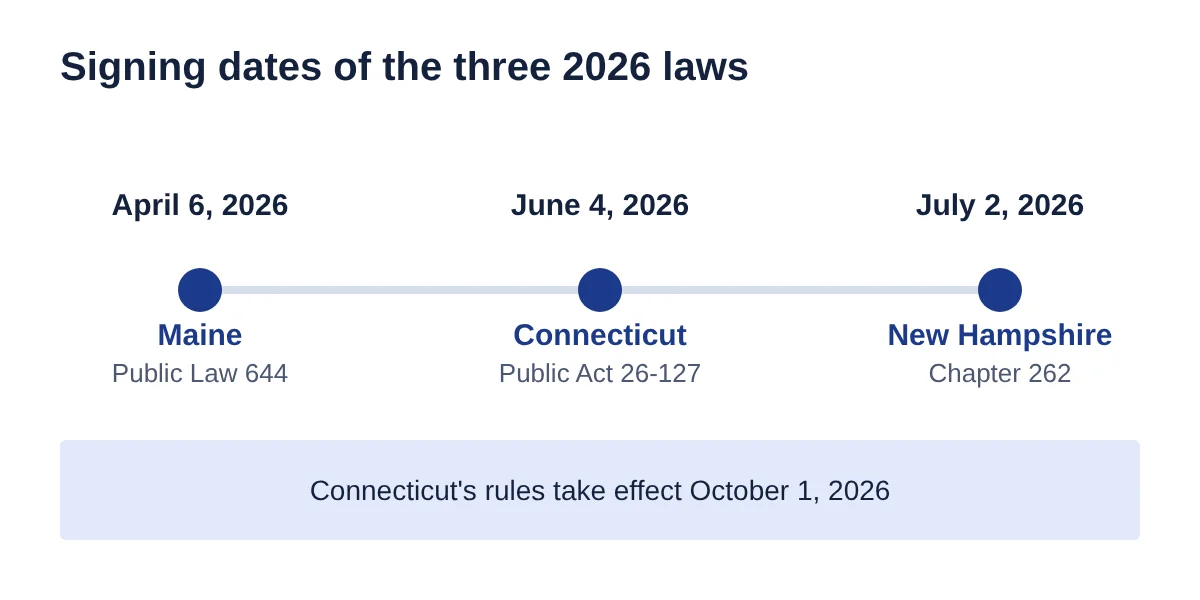
Three New England states signed plug-in solar laws in 2026, and their rules are not the same. Maine’s law was enacted on April 6, 2026 as Public Law chapter 644. Connecticut’s Public Act 26-127 was approved on June 4, 2026. New Hampshire’s SB 540 was signed on July 2, 2026 as Chapter 262.
Maine: the 420-watt line
Maine’s rules are in section 3475 of Title 35-A of the Maine Revised Statutes, which covers plug-in photovoltaic and battery systems. An eligible system has an export capacity of 1,200 watts or less. It must also meet one of three conditions: it is listed or certified to UL 3700 or a comparable standard by a nationally recognized testing laboratory, it holds an equivalent certification from such a laboratory, or it is set up under the National Electrical Code.
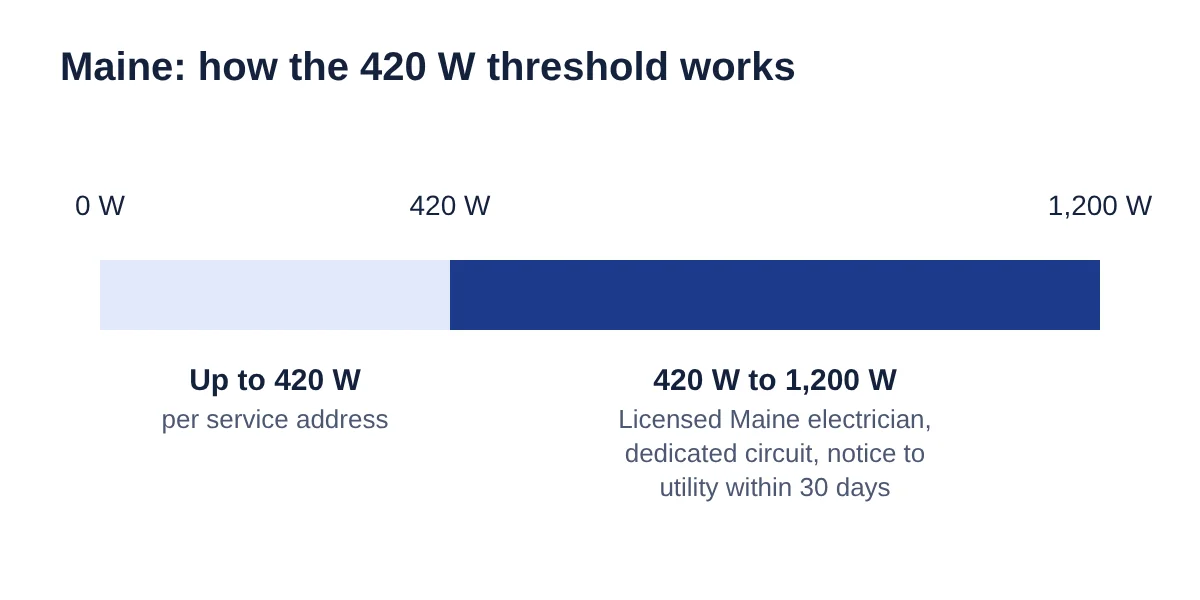
Up to 420 watts of inverter output per service address carries no extra step in the statute. Output above 420 watts, up to 1,200 watts, requires a licensed Maine electrician to install each system on a dedicated circuit with a single outlet. The customer must also notify the utility within 30 days of installation, using the form the state commission prescribes. The notice includes the service address, the inverter capacity and a statement of compliance.
A utility may not deny the installation of a compliant system. It cannot require approval, an interconnection application or agreement, an interconnection study, a fee or extra controls. It is not liable for damage or injury caused by a compliant system. Systems installed under this section cannot be used for net energy billing. For buildings the customer does not own, the installation must not compromise the structure or break building, fire or zoning codes, and the customer must restore the structure when the system is removed.
Connecticut: 1,200 W, a UL listing and a 120-volt outlet
Public Act 26-127 (HB 5340) defines a portable solar generation device with a maximum power output of 1,200 watts. It must be certified by UL or an equivalent nationally recognized testing laboratory and meet UL Standard 1741, as amended. The device must not be permanently affixed to a structure. It plugs into a standard 120-volt outlet behind the customer’s meter, and it must include a feature that stops it from energizing the building’s electrical system during an outage.
The act also requires a consumer warning that excess generation is charged as usage unless the customer has a net-metering meter. Only one such device may be used behind a customer’s meter. Electric distribution companies cannot require approval before installation or use. They cannot charge a fee, except for charges the system creates through its use. They cannot require extra controls or equipment beyond what the device includes. The utility is not liable for damage or injury caused by the device. The device rules take effect October 1, 2026.
New Hampshire: signed as Chapter 262
The New Hampshire General Court’s bill status page for SB 540 lists the governor’s signature on July 2, 2026, and Chapter 262 of the 2026 laws. For the device rules and the dates that apply to them, read the chapter on the state’s site before you plan an installation.
What the laws have in common
Maine and Connecticut both cap a device at 1,200 watts, and both bar utilities from requiring approval, a fee or extra controls for a compliant device. Both also rely on certification from a nationally recognized testing laboratory. Beyond that, each law sets its own steps, so the rules from one state do not carry over to another.
Common mistakes
- Assuming one state’s threshold applies elsewhere. Maine’s 420 W line is a Maine rule.
- Missing Maine’s 30-day notice. It applies to systems above 420 watts.
- Mounting a Connecticut device permanently. The device must not be permanently affixed to a structure.
- Expecting a utility approval step in Connecticut. The act bars utilities from requiring approval.
For the national picture, see is balcony solar legal in your state. For the steps each state requires from you, read do you have to tell your utility about plug-in solar. For Vermont’s rules, see Vermont’s Act 149. For California, read the California law (SB 868). For output in cold weather, see balcony solar in winter.
Frequently asked questions
Is plug-in solar legal in Maine?
Yes. Maine's law, Public Law chapter 644, was enacted on April 6, 2026. It sets rules for systems of up to 1,200 watts, with extra steps above 420 watts.
Does Connecticut limit plug-in solar to 1,200 W?
Yes. Public Act 26-127 defines a portable solar generation device with a maximum power output of 1,200 watts, certified by UL or an equivalent nationally recognized testing laboratory.
Do I need an electrician in Maine?
Above 420 watts, yes. A licensed Maine electrician must install the system on a dedicated circuit with a single outlet. Systems up to 420 watts per service address do not carry that requirement.
Does Connecticut require notice to the utility?
The device rules set no notice step. The utility cannot require approval before you install or use a compliant device.
Is New Hampshire's plug-in solar law signed?
Yes. The governor signed SB 540 on July 2, 2026, and it became Chapter 262 of the 2026 laws.
Sources
- Maine Legislature – Title 35-A, section 3475, plug-in photovoltaic and battery systems
- Maine Legislature – LD 1730 bill status (Public Law chapter 644, signed April 6, 2026)
- Connecticut General Assembly – Public Act 26-127 (HB 5340), 2026
- New Hampshire General Court – SB 540 (2026) bill status, Chapter 262