Maryland Plug-In Solar Law: Rules, Notice to Your Utility and the 391-Watt Exemption
Maryland's HB 1532 allows plug-in solar up to 1,200 W with UL or NRTL certification and notice to your utility before you install. What the law says.
Some links are affiliate links: if you buy through them we earn a small commission at no extra cost to you. It does not change our recommendations.

Maryland allows a portable solar system of up to 1,200 watts to feed a home’s electrical system, as long as the system is certified and you notify your electric company before you install it. The rules come from HB 1532 (2026), which added Public Utilities § 7-321 to Maryland law. This guide explains what that section says, step by step.
What § 7-321 defines
Under the section, a portable solar energy generating system is a movable photovoltaic device that:
- connects to the building’s electrical system through a standard electrical outlet,
- is primarily meant to offset part of the building’s electricity use,
- supplies no more than 1,200 watts back to the building’s electrical system, and
- is certified by Underwriters Laboratory or an equivalent nationally recognized testing laboratory.
Notify your electric company before you install
The customer must notify the electric company that serves the territory “before installation.” The notice includes a certification describing the system’s safety features and its maximum generating capacity. The Maryland Public Service Commission (PSC) publishes a balcony solar page that links to each utility’s forms and contacts.
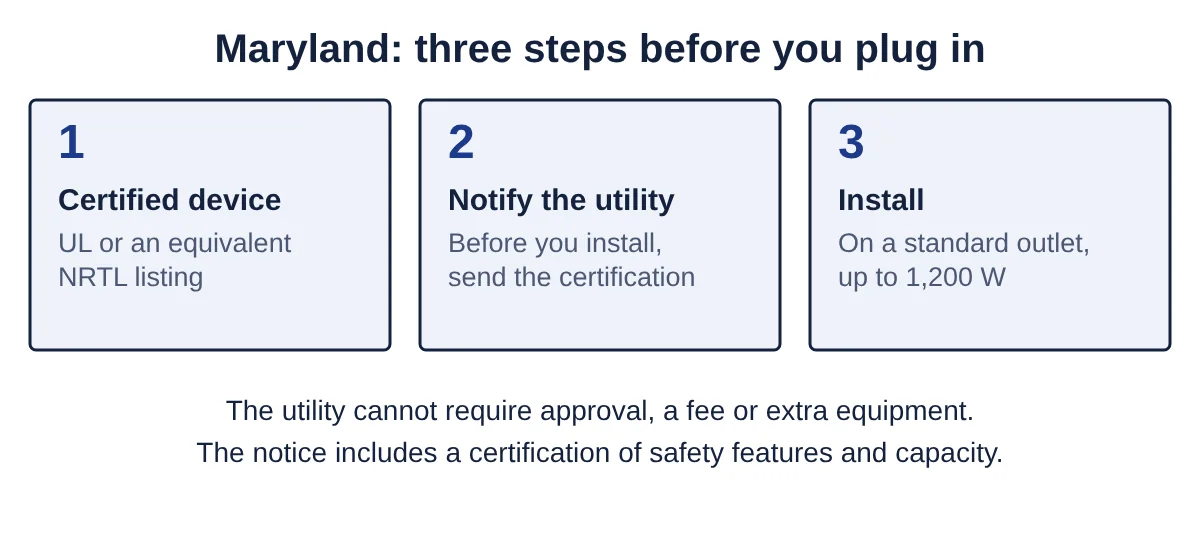
- Choose a certified device. Check the UL or NRTL certification in the product documents before you buy.
- Find your electric company. The PSC page links to the utility contacts and forms.
- Send the notice and the certification. Do this before you install, not after.
- Install on a standard outlet. Have a licensed electrician check any work on your wiring or electrical panel.
What the utility cannot require
The electric company may not require you to:
- get its approval before you install or use the system,
- pay a fee or charge for feeding electricity back to the grid, or
- add controls or equipment beyond what the system already includes.
The company is also not liable for damage the system causes. If an automatic, locking disconnect switch is required, you pay for its installation.
The 391-watt exemption
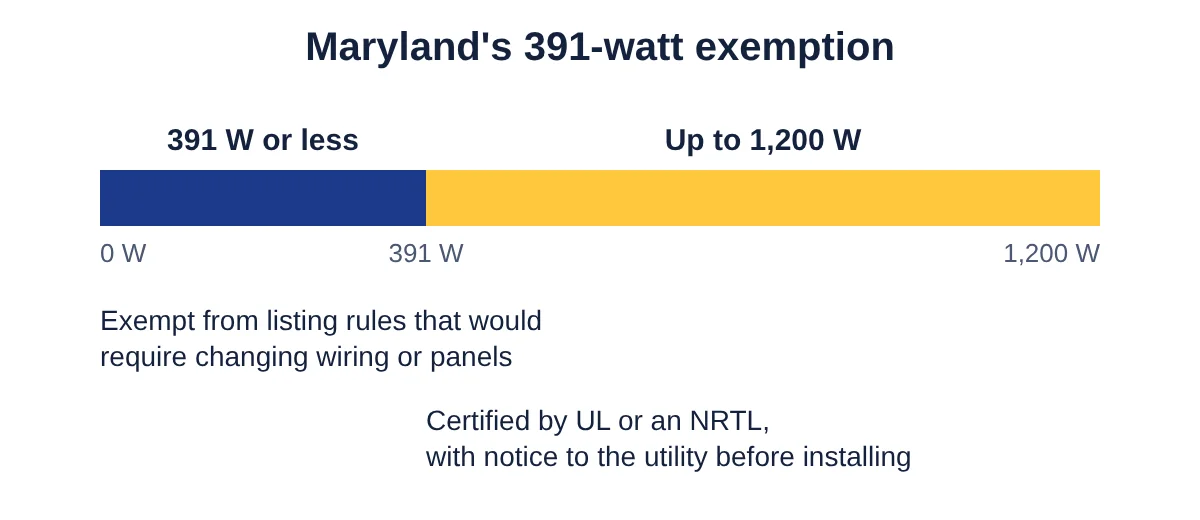
A system rated at 391 watts or less is exempt from product-listing provisions that would require changes to the building’s premises, wiring or electrical panels. Above 391 watts, the exemption does not apply.
Renewable energy credits
The law says these systems may not generate renewable energy credits of any type.
Renters and condo owners
Section 7-321 sets the rules for the system and the electric company. Leases and condo rules are a separate question, covered in balcony solar for renters and HOAs.
What to check before you buy
- The certification. Ask the seller for the UL or NRTL listing of that exact model.
- The output. The system may not supply more than 1,200 watts back to the building.
- The start date. Check the effective-date clause of HB 1532 before you order.
- The notice. Have your electric company’s form ready before the installation day.
Common mistakes
- Installing first and notifying the utility later. The law requires notice before installation.
- Reading the 391-watt exemption as an exemption from certification. It only covers listing rules that would require wiring or panel changes.
- Treating 1,200 watts as the power for your whole home. It is the limit on what the system feeds back to the building.
For the national picture, see is balcony solar legal in your state. To compare notice rules across states, read do you have to tell your utility about plug-in solar. For the outage question, read does plug-in solar work during a power outage, and for the safety standard that certified products use, read UL 3700 explained.
Frequently asked questions
Do I have to tell my electric company before plugging in solar in Maryland?
Yes. Maryland law requires you to notify your electric company before installation, with a certification of the system's safety features and maximum capacity. The company cannot require approval or charge a fee for the system.
Is plug-in solar legal in Maryland?
Yes, under HB 1532 (2026), for a residential portable system of up to 1,200 watts on one electric meter, certified by Underwriters Laboratory (UL) or an equivalent nationally recognized testing laboratory.
What is the 391-watt exemption?
A system rated at 391 watts or less is exempt from product-listing rules that would require changes to the building's wiring or electrical panels. Systems above 391 watts do not get this exemption.
Can my utility charge me to connect a portable solar system?
No. The law bars the electric company from requiring approval before installation or use, charging a fee for power sent back to the grid, or requiring controls or equipment beyond what the system includes.
Do I get credits for the power my system sends back to the grid?
No. The law says these systems may not generate renewable energy credits of any type.