Utah Plug-In Solar Law (HB 340): What the First State Allows
Utah's HB 340 allows a portable solar device up to 1,200 W on a standard 120-volt outlet. What the law requires and what utilities cannot require.
Some links are affiliate links: if you buy through them we earn a small commission at no extra cost to you. It does not change our recommendations.
Utah was the first state to allow portable solar generation devices. HB 340, Solar Power Amendments, took effect on May 7, 2025. It allows a device of up to 1,200 watts that plugs into a standard 120-volt outlet, and it limits what the utility can require before you use it.
What counts as a portable solar generation device
Under the law’s definition in Utah Code § 54-15-102, the device:
- has a maximum power output of not more than 1,200 watts,
- is designed to connect to the building’s electrical system through a standard 120-volt alternating current outlet,
- is certified by Underwriters Laboratories or an equivalent nationally recognized testing laboratory, and
- meets the standards of the most recent version of the National Electrical Code.
Requirements for the device
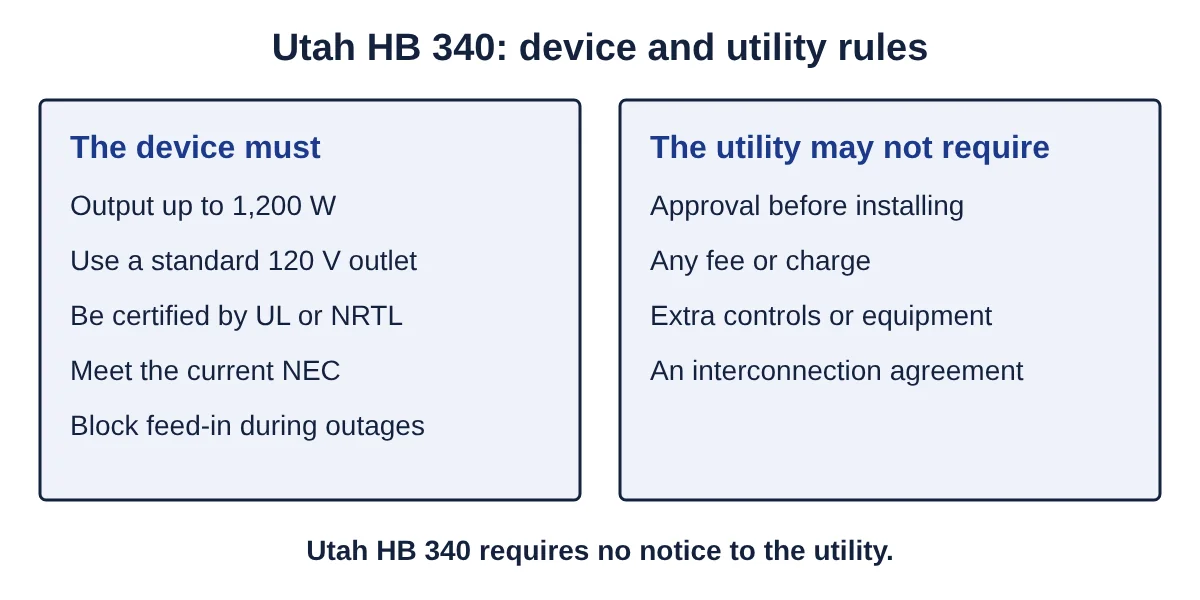
The device must include a feature that prevents it from energizing the building’s electrical system during a power outage. For what that means in practice, read does plug-in solar work during a power outage.
What the utility cannot require
Under section 54-15-601, the electrical corporation may not require you to:
- get its approval before installing or using the system,
- pay any fee or charge related to the system, or
- install additional controls or equipment beyond what is built into the system.
The utility is not liable for damage or injury caused by a portable solar generation device.
Notice to the utility
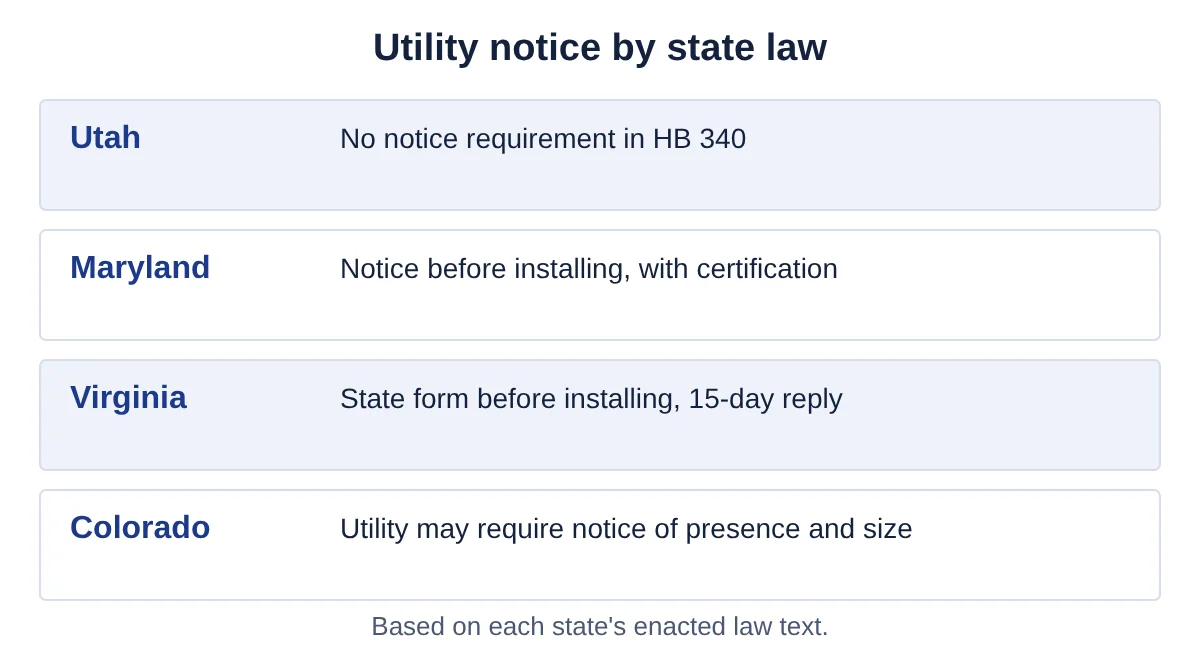
Utah’s law contains no notice requirement. Compare that with the other state laws in this series, which set different steps.
For the state-by-state detail, read do you have to tell your utility about plug-in solar.
Why the outage feature matters
The outage requirement is written into Utah’s law. Colorado’s law and Virginia’s law include the same kind of requirement. It is a safety rule for the grid and the building’s wiring, not a backup power source. A plug-in device does not keep your home running when the power goes out, which is why the feature shuts the device’s feed off during an outage.
What to check before you buy
- The certification. Ask the seller for the UL or NRTL listing of that exact model.
- The output. The device must not exceed 1,200 watts.
- The outlet. The device is designed for a standard 120-volt outlet. If an outlet or panel needs work, use a licensed electrician.
- Your lease. For landlord permission and shared-building rules, read balcony solar for renters and HOAs.
Utah compared with later laws
Utah passed the first of these laws, and later states passed their own. Maryland requires notice before installation, Virginia uses a state notice form with a 15-day reply, and Colorado allows a higher limit of 1,920 watts. For the full map, see is balcony solar legal in your state.
Common mistakes
- Looking for a notice form in Utah. HB 340 requires no notice to the utility, while other states do.
- Buying a device above 1,200 watts. Above that output, the device does not match the law’s definition.
- Assuming the utility can add an approval step or a fee. The law bars both for a qualifying device.
Frequently asked questions
Is plug-in solar legal in Utah?
Yes. Utah's HB 340, in effect since May 7, 2025, allows a portable solar generation device of up to 1,200 watts that meets the law's requirements, including certification by UL or an equivalent nationally recognized testing laboratory.
Do I have to notify my utility in Utah?
No. HB 340 sets no notice requirement to the utility. It does bar the utility from requiring approval, fees or extra equipment for a qualifying device.
Can a utility stop me from using a portable solar device in Utah?
No, not for a qualifying device. The law bars the utility from requiring approval before you install or use it, from charging a fee related to it, and from requiring additional controls or equipment.
What safety feature does the device need?
It must prevent the system from energizing the building's electrical system during a power outage. The device must also meet the most recent version of the National Electrical Code.
Does the law apply to renters?
The law sets requirements for the device and for the utility. For your landlord's permission and any shared-building rules, check your lease and read the renters guide before you install anything.