How Much Can Balcony Solar Save? Real Math by State
Balcony solar saves what your home uses while the sun shines. A state table with 2024 EIA prices and PVGIS output for 360, 800 and 1,200 W kits.
Some links are affiliate links: if you buy through them we earn a small commission at no extra cost to you. It does not change our recommendations.

A balcony kit saves money only on the power your home uses at the same moment the panels make it. Using 2024 average residential prices and a south-facing vertical railing, an 800 W kit could save at most about 107 to 273 dollars a year across the ten states in the table below. The real figure is lower.
The formula
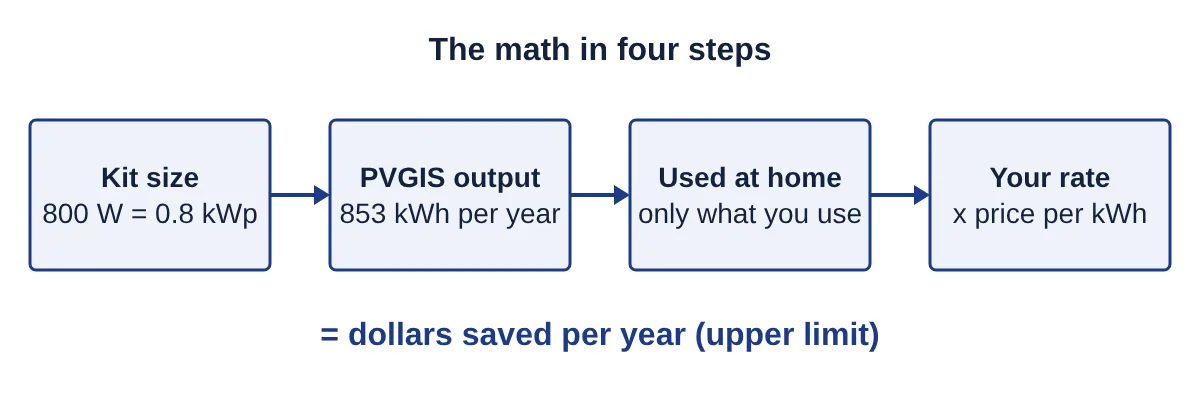
You can recalculate the numbers for your own city in four steps:
- Kit size. An 800 W kit is 0.8 kilowatts (kWp).
- Output. Multiply 0.8 by the yearly output per kWp for your city. The table below uses the JRC PVGIS 5.3 tool.
- Use. Count only the kWh your home consumes at the same time the panels run.
- Rate. Multiply the kWh by the price you pay per kWh on your bill.
Savings table by state
The table uses one city per state, because the output depends on local sun. Prices are the EIA 2024 average residential price. Output is the yearly kWh for one kWp on a vertical panel facing south, with 14 percent system losses and no shading from nearby buildings.
| State | City used | 2024 price (cents/kWh) | 360 W per year | 800 W per year | 1,200 W per year |
|---|---|---|---|---|---|
| California | Los Angeles | 31.97 | $123 | $273 | $409 |
| Connecticut | Hartford | 28.75 | $99 | $220 | $329 |
| Maine | Portland | 24.29 | $89 | $197 | $296 |
| New York | New York City | 24.43 | $83 | $184 | $275 |
| Vermont | Burlington | 21.90 | $70 | $156 | $234 |
| Colorado | Denver | 14.92 | $67 | $150 | $224 |
| New Jersey | Newark | 19.34 | $67 | $148 | $222 |
| Maryland | Baltimore | 17.86 | $60 | $133 | $200 |
| Utah | Salt Lake City | 12.22 | $53 | $118 | $178 |
| Virginia | Richmond | 14.41 | $48 | $107 | $161 |
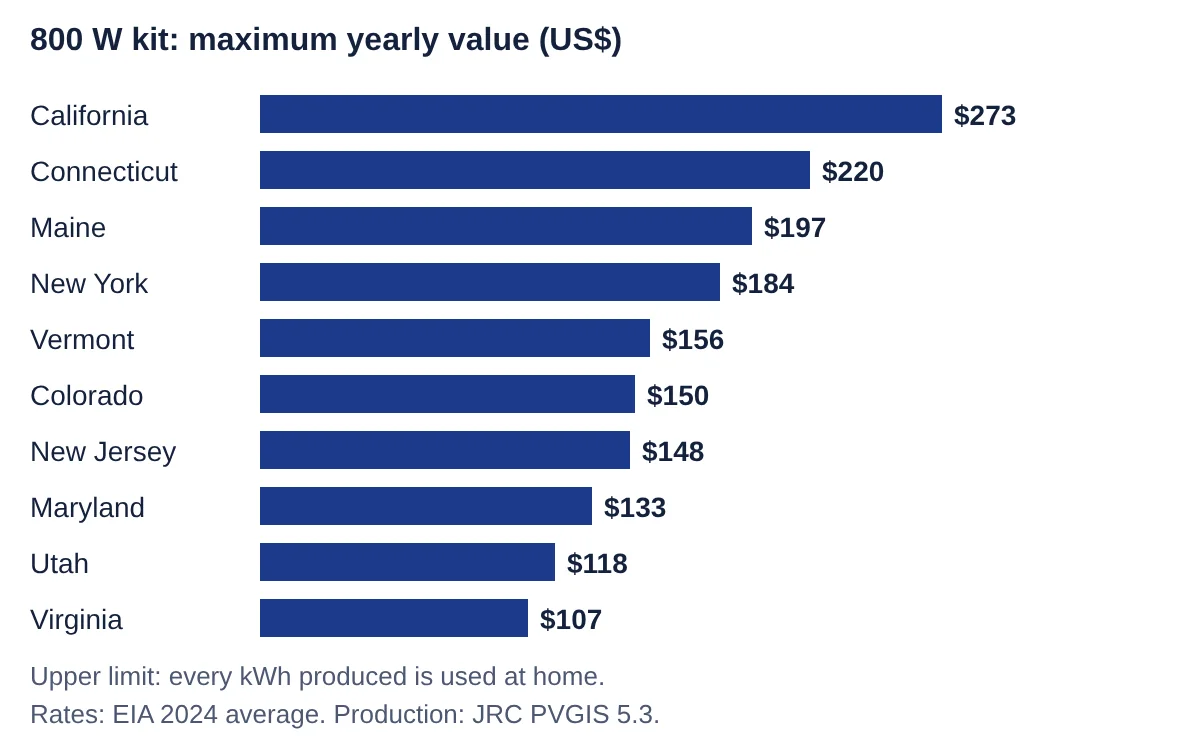
Two points explain most of the spread. The 2024 average price in California was more than two and a half times the price in Utah. Sun also differs: Denver makes about 1,002 kWh a year from an 800 W vertical kit, while Richmond makes about 743 kWh.
Why self-consumption matters
A kit saves money only when your home is using power at that moment. If the panels make power at noon and nobody is home, that power is not used, and the table does not count it.
Your daytime use decides how much of the kit’s output you keep. A fridge, a router or a fan that is already running during daylight uses power the panels make. Do not run anything you would not normally run just to save money.
Payback for 360 W, 800 W and 1,200 W kits
Payback is the number of years it takes for the savings to equal the price of the kit. Use the formula, not a fixed number, because kit prices change and vary by brand:
Payback in years = kit price ÷ yearly savings for your state
For an 800 W kit in Maryland, the yearly figure in the table is $133. A 1,200 W kit in the same state saves $200 a year. Divide the price you find on the product page by the figure for your size and state. Remember that the savings count only the power you use.
What changes with a battery
A battery can store midday power for the evening, which lifts the share of the kit’s output that you use. It also adds cost and needs compatible equipment. Read plug-in solar with a battery: what works and what does not before you add one.
What the numbers do not include
- Shade. The PVGIS estimates do not include nearby buildings, trees or a balcony roof. Shade can cut output a lot.
- Orientation. A vertical panel facing east or west makes less than one facing south. In Los Angeles, a vertical east panel gives about 858 kWh per kWp, against 1,066 kWh facing south.
- Federal tax credit. The residential solar credit (25D) does not apply to expenditures made after December 31, 2025. See is there a federal tax credit for plug-in solar in 2026.
- Price changes. The EIA average is for 2024, and local rates can be higher or lower. Check your own bill for the price per kWh.
- Exported power. The table does not count any credit for power you send to the grid. For how that works, read does plug-in solar spin your meter backwards.
For a broader view of what each kit size can run, read what 400, 800 and 1,200 watts of plug-in solar can power. To see how much electricity a city produces over a full year, read how much electricity balcony solar produces in the US.
If you are still deciding whether a kit fits your home, start with what balcony solar is and check your state’s rules in is balcony solar legal in your state.
Frequently asked questions
How much electricity does a 400 W plug-in solar system produce?
On a south-facing vertical railing, about 360 to 500 kWh a year, depending on the city. In Los Angeles the estimate is about 426 kWh, and in Denver about 501 kWh. These are estimates without shading from nearby buildings.
Is plug-in solar worth it in California?
California had the highest 2024 average residential price in the table, 31.97 cents per kWh, so each kWh your home uses from the kit is worth more there. Whether the kit pays back depends on its price, which varies by brand.
How long does it take for balcony solar to pay for itself?
Divide the kit's price by the yearly savings for your state. For example, a kit that costs 600 dollars and saves 150 dollars a year pays back in four years. The price is only an example, not a quote.
Does the table use current electricity prices?
No. It uses the EIA average residential price for 2024, which is the year shown in the source table. Your own bill gives the price that applies to you.
Do I get paid for extra power I send to the grid?
The savings figures do not count any payment for exported power. Whether exported power earns a credit depends on your utility and your state, so check your utility's rules before you buy.