Is Plug-In Solar Safe? Backfeeding, Overloads and What Experts Say
Plug-in solar can overload a shared circuit and send power back through an outlet. What the UL and IAEI guidance and the state laws say about these risks.
Some links are affiliate links: if you buy through them we earn a small commission at no extra cost to you. It does not change our recommendations.
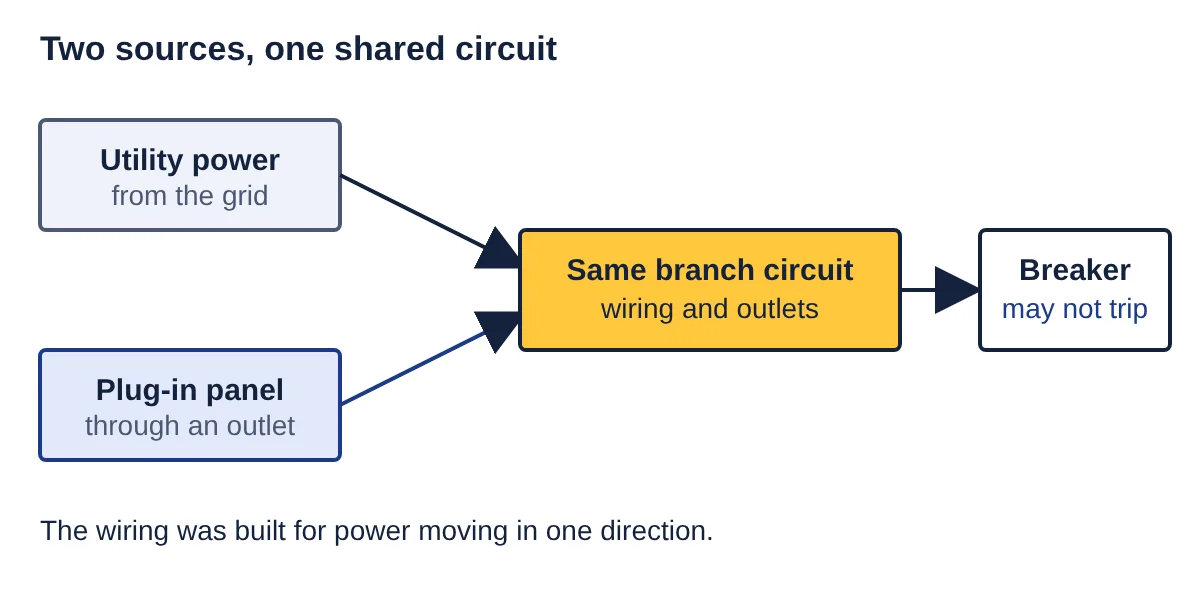
Plug-in solar can be safe when the equipment is certified and checked, but the risks are specific and the rules are new. A device that feeds power into an ordinary outlet can push a shared circuit past its rated current, and it can send power backward through wiring that was built for one-way flow. Certified equipment and a check by a licensed electrician reduce those risks. Neither removes them.
The three real risks
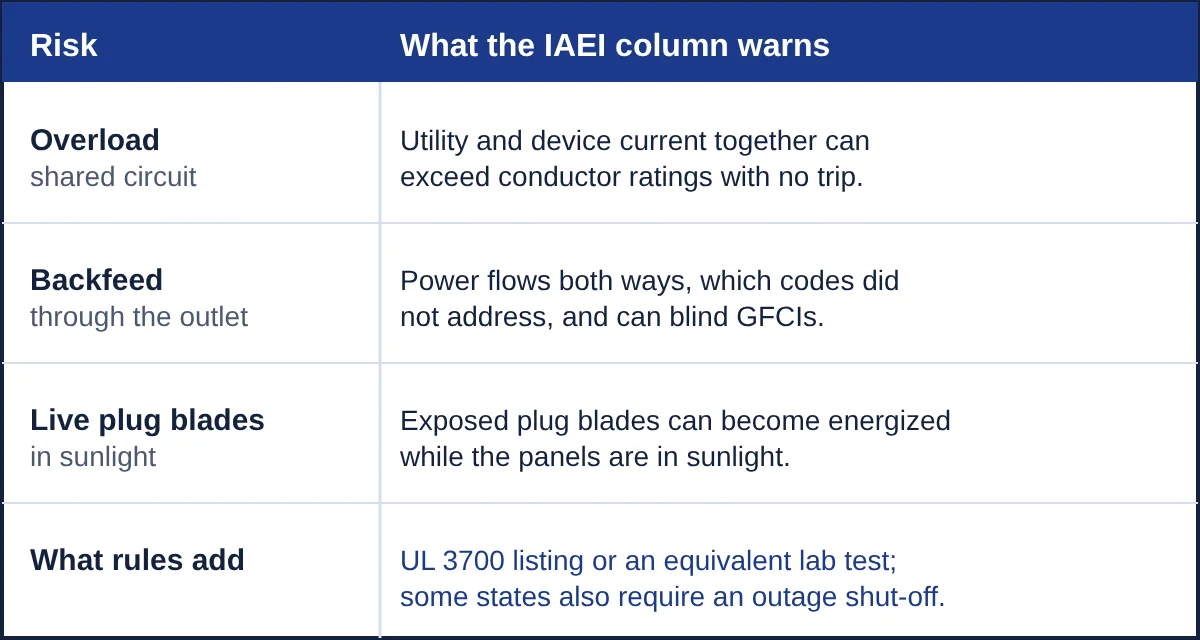
The IAEI Magazine column on plug-in photovoltaic systems, published July 1, 2026, lists the main concerns. Three of them matter most for a home.
Overload of a shared circuit. The outlet is on a branch circuit that already serves other loads. The column warns that “the combined current from the utility and PIPV source can exceed conductor ratings without tripping the circuit breaker.” The breaker is the device that protects the wiring from overheating, so this is the risk to take most seriously.
Backfeed through the outlet. Plug-in equipment sends power back into existing circuits through ordinary receptacles. The column says this creates “scenarios not addressed by current codes.” It also says the reverse flow can affect ground-fault protection, because it introduces “bidirectional flow, potentially blinding GFCIs and leaving circuits unprotected.”
Live plug blades. The column notes that plug blades a person can touch may become energized when the panels are in sunlight. It also says grid-interactive inverters are not evaluated for contact with the user. That is why a plug-in system should never be treated like a lamp or a phone charger.
What UL 3700 tries to fix
UL 3700 is an Outline of Investigation, the document UL Solutions uses to test and list interactive plug-in PV equipment and systems. UL announced its testing and certification framework on January 8, 2026. The IAEI column describes the standard as defining “safety requirements for this emerging technology.”
An outline is not a product approval. A product is safe in this sense only when a lab has tested that exact model and listed it. The column also points readers to UL’s Product iQ database, under the category “Plug-In Photovoltaic – PIPV – Equipment and Systems.”
What state laws require for safety
Several state laws put safety conditions into the law itself:
- Utah requires the device to be certified by UL or an equivalent nationally recognized lab, to meet the most recent National Electrical Code, and to prevent energizing the building during an outage. Read the Utah law.
- Vermont requires UL 3700 or an equivalent certification from a nationally recognized lab. Read the Vermont law.
- New Jersey requires that the device be listed or certified to UL 3700. Read the New Jersey law.
How to lower the risk
- Buy a listed product. Ask the seller for the UL or equivalent listing of that exact model. A claim such as “UL 3700 compliant” is not the same as a listing.
- Check the circuit first. Ask a licensed electrician which circuit the outlet is on and what else shares it. The IAEI column names dedicated circuits as one of the fixes under discussion.
- Keep the outlet and plug in good condition. A loose, hot or damaged outlet is not a place for a power source.
- Follow the outage rule. Do not connect a plug-in device in a way that could power the house during a grid outage. For the reasons, read does plug-in solar work during a power outage.
For the installation steps and their limits, read how to install balcony solar safely.
When not to do it
Do not use a plug-in device when you cannot identify the circuit the outlet is on, when the outlet or plug looks damaged, warm or loose, or when the panel or wiring is old and no electrician has checked it. In a rental, get the landlord’s approval first, and read plug-in solar in a state with no law if your state has not passed one.
Common mistakes
- Treating a plug-in kit like a lamp. It is a power source that works in both directions.
- Trusting the breaker. The IAEI column warns it may not trip for this kind of overload.
- Buying on a claim. “Utility approved” or “UL 3700 compliant” does not prove a listing.
- Skipping the check of the circuit. Plugging in first and asking later is the wrong order.
For the basics of what the product is, read what is balcony solar.
Frequently asked questions
Can plug-in solar start a fire?
It can, if the circuit is overloaded. The IAEI column on plug-in PV warns that combined current can exceed conductor ratings without tripping the breaker, which is why certified equipment and a careful check of the circuit matter.
Will plug-in solar trip my breaker?
Not necessarily. The IAEI column warns the breaker may never trip, even when the wiring carries more current than it is rated for. A breaker is not a safety check for this kind of overload.
Is backfeeding dangerous?
Power flowing back through an outlet is one of the risks UL and IAEI describe. It can affect ground-fault protection, and the IAEI column notes that current codes did not address these flows.
Do I need an electrician?
For any work on the outlet, the circuit or the panel, use a licensed electrician. Ask the electrician to check the circuit before you connect a plug-in device.
What does UL 3700 mean on a product?
UL 3700 is the Outline of Investigation UL Solutions uses to test and list interactive plug-in PV equipment. Check for a listing of the exact model, because a claim of compliance is not a listing.
Does plug-in solar meet the National Electrical Code?
The NEC does not define plug-in solar yet. NFPA has proposed temporary amendments that are still pending approval, so ask an electrician how a local inspector will treat your installation.
Sources
- IAEI Magazine – UL Question Corner: Safety considerations for plug-in PV systems (July 1, 2026)
- UL Solutions – testing and certification framework for plug-in solar (January 8, 2026)
- Vermont General Assembly – Act 149 (S.202), as enacted, 2026
- New Jersey Legislature – S2368, third reprint
- Utah Legislature – HB 340 (2025), enrolled copy
- NFPA – Proposed TIA 1955 to NFPA 70 (NEC), 2026