Does Plug-In Solar Work During a Power Outage? (No, and Why)
Plug-in solar switches off when the grid goes down. Learn what anti-islanding means, what the state laws require and how to get backup power safely.
Some links are affiliate links: if you buy through them we earn a small commission at no extra cost to you. It does not change our recommendations.

No. A plug-in kit switches off when the grid goes down, and that is the intended behavior. Its panels can still be in the sun, but the kit does not send power into your outlets during a blackout.
What anti-islanding means
An “island” is a piece of the grid that keeps running without the utility. If a solar system keeps feeding one, the lines can stay live while utility crews assume they are dead. Anti-islanding is the inverter’s safeguard against this. The microinverter in a kit watches the grid, and when it no longer detects it, it stops producing power.
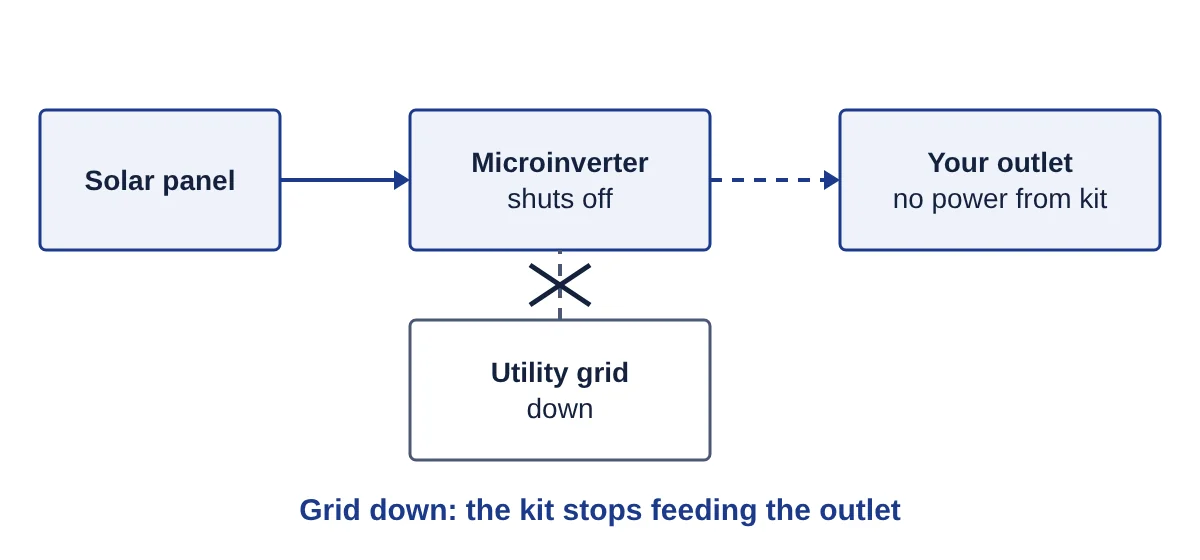
What happens in an outage
- The grid goes down.
- The microinverter senses that the grid is gone.
- The kit’s output shuts off.
- The kit stays off until the grid returns.
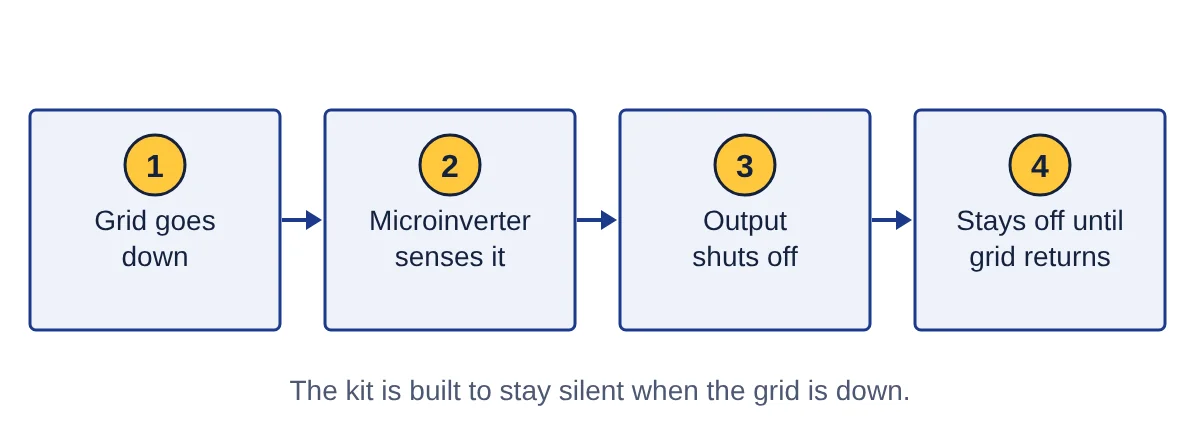
What the laws require
Several states now write the outage rule into law:
- Utah. HB 340 defines a portable solar generation device with a 1,200 W maximum output. It requires the device to be certified by a recognized testing laboratory and to not energize the building during an outage.
- California. The Assembly analysis of SB 868 describes a rule that the device must isolate during a blackout, along with a UL or equivalent listing as a plug-in PV device.
- Vermont. Act 149 requires the device to meet UL 3700 or an equivalent certification, and IEEE 1547-2018, the standard for how inverters connect to the grid.
The laws differ on the details, so read the text for your state before you buy. The article on which states allow balcony solar lists the states covered on this site.
What UL 3700 tests
UL 3700 is an outline of investigation for interactive plug-in photovoltaic equipment and systems. UL Solutions published it as a testing framework for plug-in solar in the United States. It covers construction, performance and labeling, and it addresses the risks at the plug and socket, including overloads and power flowing back into the wiring. It also requires protection against contact with live parts.
UL 3700 is not a list of approved products. To see whether a specific kit is listed, search UL’s product directory (Product iQ) for the listing, and do not rely on a “UL compliant” claim alone. The article on UL 3700 explained covers the standard in more detail.
How to get backup power instead
If you need power during a blackout, do not connect a kit to your home to make it work. Use one of these options instead:
- A portable power station with its own solar input and its own outlets. It is a separate device and is not wired into your home. Compare the options in balcony solar vs a solar generator.
- A permanent backup system installed by a licensed electrician, with the utility’s approval if your state or utility requires it.
Never connect a generator or a kit to a household outlet to feed the house. That can send power back into the wiring and endanger people who work on the lines.
Common mistakes
- Assuming a sunny day means power. During an outage the kit is off even when the sun is out.
- Trusting a “backup” label. A seller’s word is not a listing. Check the product’s specifications and its certification.
- Adding a second source to an outlet. Plugging a generator, power station or kit into a household outlet to “combine” them is unsafe, even if it seems to work.
Plug-in solar with a battery
A battery can store midday power for later use, but a battery does not make every kit work in an outage. Read the product’s specifications for backup output, and confirm that the battery system is listed for backup use before you rely on it. For the options, read plug-in solar with a battery: what works and what does not.
For the safety rules that apply to balcony solar in general, read is plug-in solar safe.
Frequently asked questions
Will my balcony solar panel power my fridge if the grid is down?
No. A plug-in kit must switch off when the grid goes down. Utah's law requires a plug-in device that cannot energize the building during an outage.
Is plug-in solar dangerous for utility workers?
The shutdown rule exists for that reason. A kit that kept feeding power into a home during an outage could send electricity onto lines that workers expect to be dead.
Can I use plug-in solar with a generator?
Do not connect a generator or a kit to your home's outlets to combine them. Ask a licensed electrician about any backup system that connects to your wiring.
What is anti-islanding?
Anti-islanding is the ability of an inverter to detect that the grid has gone down and stop feeding power into the wiring. It stops the system from powering an isolated part of the grid.
Can a battery make a kit work in an outage?
Only if the battery product is designed and listed for backup use. Check the manufacturer's specifications for backup output before you rely on it.