What Is Balcony Solar? A U.S. Guide to Plug-In Solar (2026)
Balcony solar is a small plug-in solar kit. Learn how it works, the 1,200 W cap in state laws, safety listings and what to check before you buy.
Some links are affiliate links: if you buy through them we earn a small commission at no extra cost to you. It does not change our recommendations.

Balcony solar, also called plug-in solar, is a small kit with one or more solar panels that connects to a standard outlet. The power it makes is used by the home it is connected to. In the state laws covered on this site, output is capped at 1,200 watts, and the kit must be certified by a recognized safety testing laboratory such as UL.
How a plug-in kit works
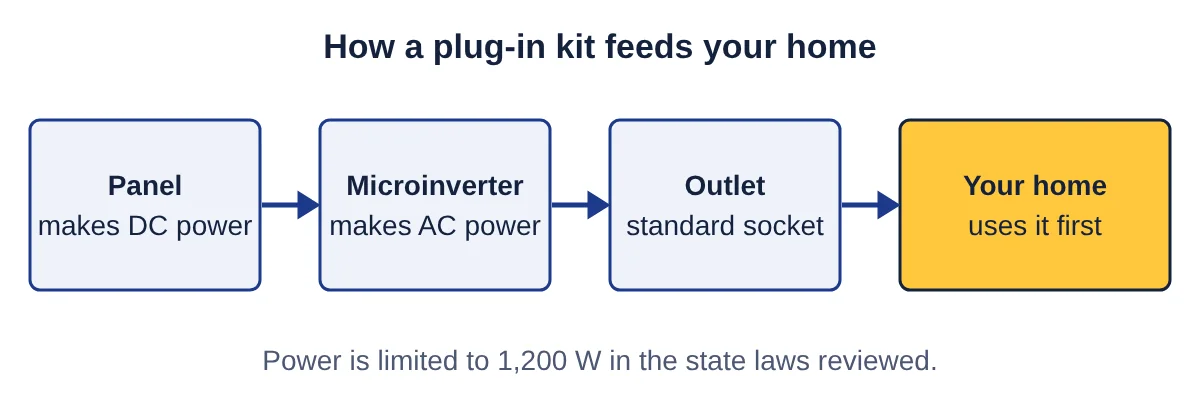
Solar panels make direct current (DC) when sunlight hits them. A microinverter converts that power to alternating current (AC), which is the type your home uses. The kit then feeds that power into a standard outlet, and the appliances in your home use it first.
Why the 1,200 W limit matters
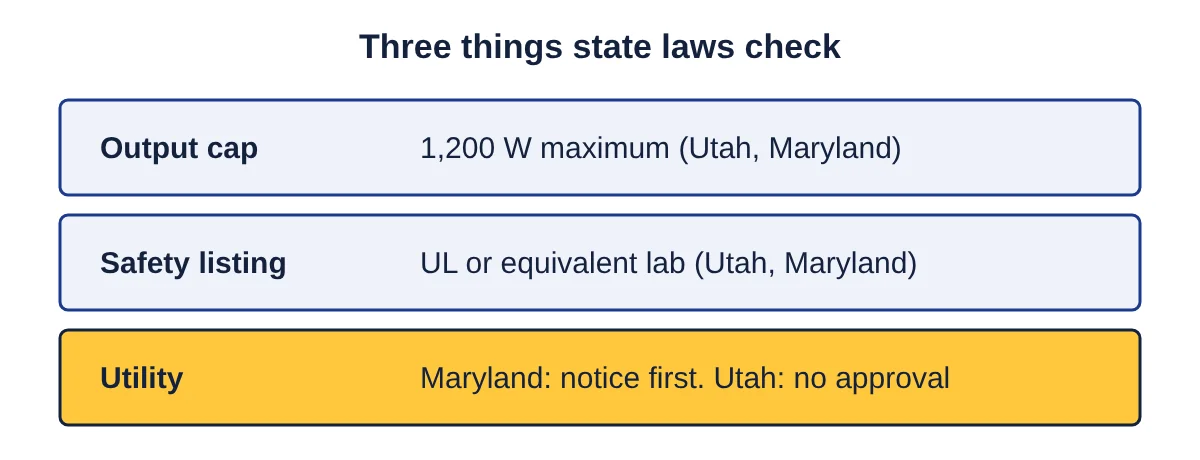
Utah’s HB 340 defines a “portable solar generation device” as one with “a maximum power output of not more than 1,200 watts.” Maryland’s rules use the same 1,200 W figure and say a device must not supply more than that amount.
A kit of this size can offset part of a home’s electricity use during daylight. It will not power the whole home. Shade, the direction the panels face and the time of year all change how much a kit produces.
What the law says about the utility
Utah’s law exempts qualifying devices from the interconnection agreement requirement, and it bars utilities from requiring approval before a system is installed or used. Maryland takes a different approach: you must notify your electric company before installation, and the utility cannot require approval or charge a fee for the installation.
Your state’s rules decide which applies to you. The state-by-state guide lists the states covered on this site and the details of each law.
Safety certification
Utah’s law requires a portable solar generation device to meet the most recent version of the National Electrical Code and to be certified by Underwriters Laboratories or an equivalent nationally recognized testing laboratory. Maryland’s rules also require a certification from a nationally recognized testing laboratory, such as UL.
Look for the certification on the product itself or in the maker’s listing records. A claim on a product page is not enough on its own.
What you can buy today
Plug-in kits are sold by manufacturers and online retailers. Before you buy, check four things: the output rating in watts, whether the kit carries a UL or equivalent listing, whether it is sold for use in your state, and whether the mounting method suits your railing or wall.
Search on AmazonFor a step-by-step checklist, see our guide to choosing a plug-in solar kit.
Who balcony solar suits
Balcony solar suits people with a sunny balcony, a small yard or a sunny wall who want to cut part of their own electricity use. It is often used by renters and condo owners, but a lease or a homeowners association can still restrict what you install. Read balcony solar for renters and HOAs before you start.

What balcony solar cannot do
- Back up your home. A plug-in kit is not a backup supply. Read what happens in a power outage.
- Replace a full rooftop system. A kit is far smaller than a rooftop array. See balcony solar vs. rooftop solar.
- Work the same everywhere. Output depends on sun, shade and angle.
Reading a kit’s specification
A kit’s specification sheet gives three numbers worth comparing: the output in watts, the number of panels and the panel rating. The output is the figure the state laws cap at 1,200 W. The panel rating is the power the panels can produce in full sun under test conditions. Real output on a balcony is lower because of angle, shade, dust and heat.
When you read a specification, look for the output figure first and confirm it is at or below the cap in your state. Then check the other figures to see whether the kit fits your space.
Steps before you buy
- Find your state on the state-by-state guide and read the law text.
- Check your electric company’s rules. If your state requires notice, prepare it before installation.
- Choose a kit whose output is 1,200 W or less and that has a UL or equivalent listing.
- Measure your balcony, railing or wall, and confirm the mounts fit.
- Read your lease or homeowners association rules in writing before you install anything.
Reading your electricity bill
Your electricity bill lists use in kilowatt-hours (kWh), the unit that matches the energy a kit produces over time. A kit’s output in watts is its maximum rate. To compare the two, look at how much you use during daylight hours, when the panels produce power. That daytime use is the part a balcony kit is most likely to offset.
If your bill is hard to read, call your electric company and ask for a breakdown of your usage by month. Keep that record with your kit’s specification sheet.
When waiting makes sense
If your state has no signed law, or your lease does not allow a mount on the railing or wall, waiting may be the better choice. Watch the state guide for changes, and check your lease before you spend money on a kit.
Common mistakes
- Assuming any panel with a plug is legal to install.
- Buying a kit with a higher output than your state allows.
- Skipping the certification check.
- Forgetting the utility notice in states that require it, such as Maryland.
- Plugging the kit into an extension cord or a power strip.
How the rules change
State laws change often. A law that is signed may not take effect until a later date, and some states have rules that depend on the utility. Check the official text of your state’s law and your utility’s page before you buy. We update this guide when a law we cover changes.
Frequently asked questions
What is balcony solar?
Balcony solar, also called plug-in solar, is a small kit of one or more solar panels with a microinverter and a cord that plugs into a standard outlet. The power it makes is used by the home it is connected to.
Is balcony solar legal in the United States?
It depends on the state. Utah and Maryland have signed laws that allow plug-in kits up to 1,200 watts. Check your state's current rules before you buy or install.
How many watts is balcony solar?
The state laws covered on this site cap output at 1,200 watts. Utah's HB 340 sets that limit in its definition of a portable solar generation device.
Will balcony solar power my house during a blackout?
No. A plug-in kit is not a backup supply, so do not rely on it to run anything during a power cut.
Do I need to tell my utility about balcony solar?
In Maryland, yes: you must notify your electric company before installation. Utah's law bars utilities from requiring approval before installation.
Does a balcony solar kit need a safety certification?
Under the Utah and Maryland laws, yes. The system must be certified by Underwriters Laboratories (UL) or an equivalent nationally recognized testing laboratory.