Best Angle for Balcony Solar: Vertical Railing vs Tilted Mount in the US
Vertical railing or tilted mount? In 11 U.S. cities a 35-degree tilt facing south makes the most energy. See the numbers by city and season.
Some links are affiliate links: if you buy through them we earn a small commission at no extra cost to you. It does not change our recommendations.
For most balconies the best yearly output comes from facing south at a 35-degree tilt. In all 11 U.S. cities in the PVGIS model, a 35-degree panel facing south made more energy per year than a vertical one, by 42 to 67 percent. A vertical panel on a railing is still a sound choice where a tilt is not possible, and it does better in winter than a tilted one does.
Orientation comes first
The compass direction the panel faces sets the baseline. In the vertical position, a south-facing panel beats east and west in every city in the table. East and west differ by city, so check your balcony’s direction before you choose the angle.
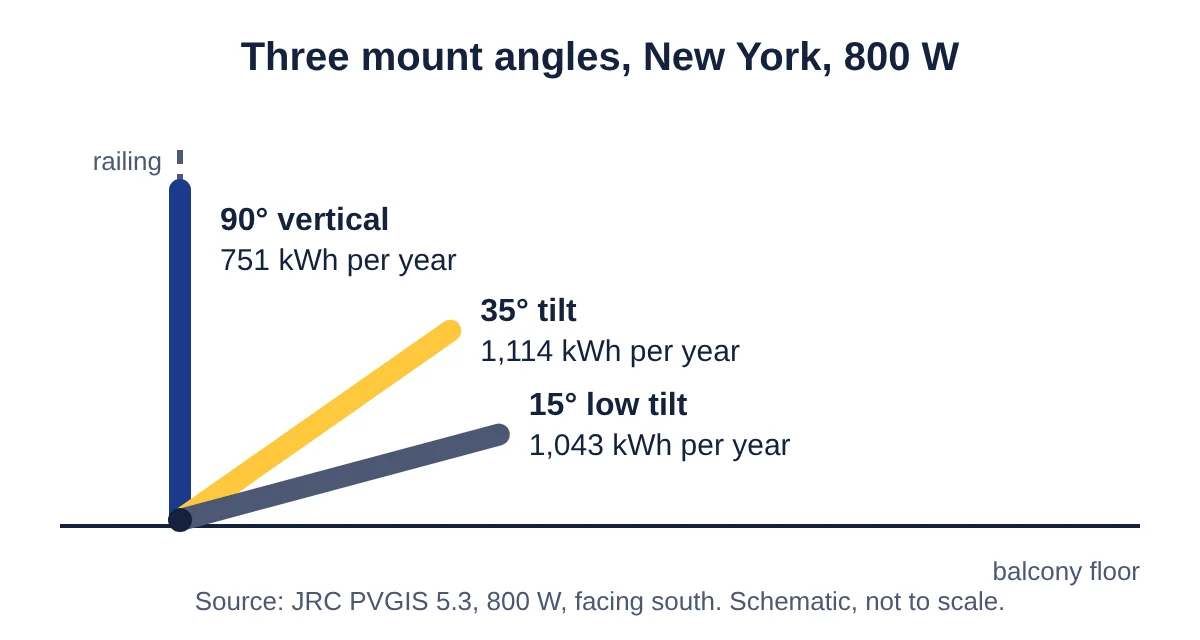
For New York, 800 W, here is how the options compare, in kWh per year:
| Mount and facing | kWh per year |
|---|---|
| 35° tilt, facing south | 1,114 |
| 15° tilt, facing south (balcony floor) | 1,043 |
| Vertical, facing south | 751 |
| Vertical, facing east | 550 |
| Vertical, facing west | 448 |
Source: JRC PVGIS 5.3, values for 800 W, rounded to the nearest kWh.
The east and west figures are close to each other in some cities and far apart in others. In New York, east (550) beats west (448). In San Francisco, west (683) beats east (612). In Los Angeles the two are almost equal (686 and 682). The north-facing case is not in the table: run it through PVGIS for your city if your balcony faces north.
Vertical or tilted: the gap depends on latitude
The vertical share of the tilted output falls as you move south in the country. Across the three cities below, a vertical panel facing south gives:
- Portland, Maine (about 43.7° N): 811 kWh against 1,150 kWh at 35 degrees, about 70 percent.
- New York (about 40.7° N): 751 against 1,114, about 67 percent.
- Los Angeles (about 34.0° N): 853 against 1,424, about 60 percent.
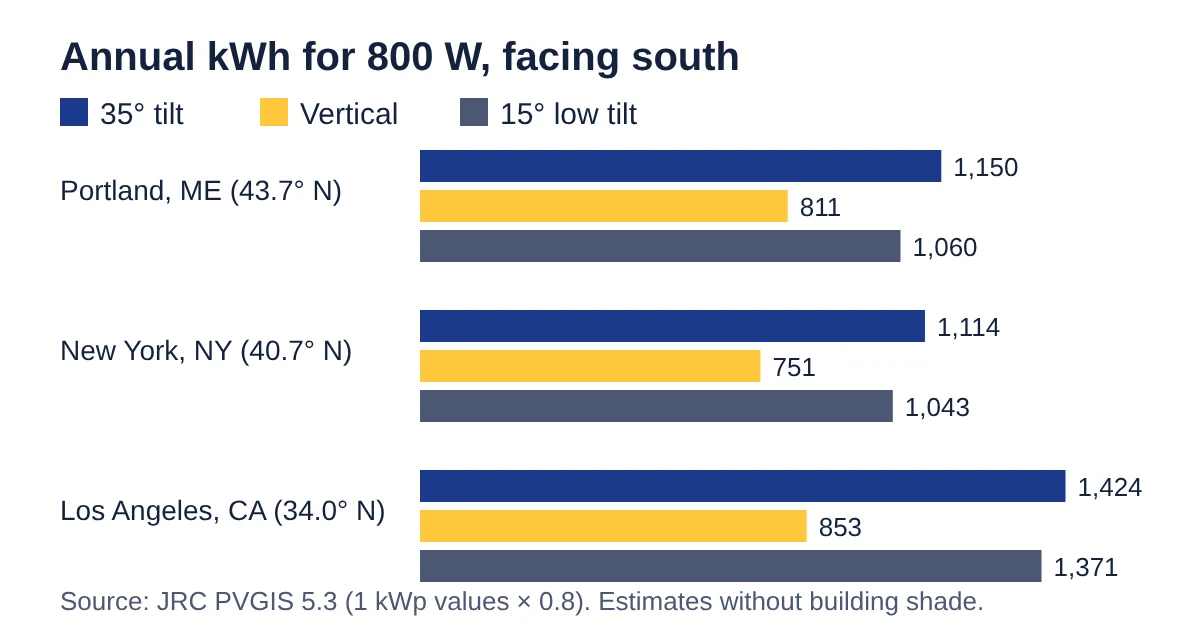
The reason is the sun’s path. A vertical panel keeps a larger share of the tilted output in the north, where the sun sits lower for more of the year. The other eight cities in the table fall between these values, from about 62 percent in San Francisco to about 69 percent in Denver.
Balcony floor: a low tilt is close to the best
A panel on the balcony floor sits at about 15 degrees. It does not use the railing, and it keeps most of the output:
- Portland: 1,060 kWh against 1,150 at 35 degrees, about 92 percent.
- New York: 1,043 against 1,114, about 94 percent.
- Los Angeles: 1,371 against 1,424, about 96 percent.
A floor mount needs room, and it can be shaded by the railing above it. If the floor is clear and the building allows it, it is a simple way to keep most of the 35-degree output without a steep bracket.
Seasons: the trade-off
A tilted panel is strongest in spring and summer, and a vertical panel is strongest in winter. In New York, the vertical panel makes 37 kWh in June and 83 kWh in January. The 35-degree panel makes 102 kWh in June and 80 kWh in January.
For a household that wants the most output over the whole year, a tilt wins. For a household that wants power in the cold months, a vertical panel gives a steadier profile. The winter article shows the same pattern for four cold cities.
Mounts and wind
The angle is only useful if the mount holds it. Ask the seller for the rated load and the wind rating, and check your railing’s limit before you buy. A tilted panel can put different loads on a bracket than a vertical one, so check the rating for the angle you choose. For mount types and what to check, see balcony solar mounts, and for the wiring and safety steps, see how to install balcony solar safely.
Search on AmazonCommon mistakes
- Choosing the angle before the direction. Tilt does not fix a bad direction. Check the facing first.
- Forgetting shade. The table assumes none. A railing or neighbor’s wall can cut output for hours.
- Tilting past what the mount is rated for. A higher angle can raise the load on the mount.
- Ignoring the lease. Your building may restrict what hangs from a balcony, whatever the angle. See renters and HOA rules.
Who should choose which
If your balcony faces south, your railing allows a tilt and the mount is rated for it, a 35-degree tilt gives the most energy. If the railing is the only option, a vertical panel is still a sound choice, especially if winter output matters most to you. If your balcony faces north, check the output for your city before you buy any mount. For the yearly figures by city, see how much electricity balcony solar produces.
Frequently asked questions
Can I hang a panel vertically on a railing?
Yes. A vertical panel on a south-facing railing makes about 60 to 71 percent of a 35-degree tilt's yearly output in the 11 cities of the PVGIS table. It may be the only mount your balcony allows, and it does better in winter than in summer.
What if my balcony faces north?
The PVGIS figures here cover south, east and west only. Run your city on the JRC PVGIS site with a north orientation to get a number for your balcony before you buy.
Is adjustable tilt worth it?
It helps most if your balcony faces south and your railing or floor allows a tilt. The 35-degree figures are higher in every city than vertical. Check the mount's rated load and wind rating before you pay for the adjustment.
Does shade change the best angle?
Yes. The PVGIS figures assume no shade from nearby buildings or railings. If a railing or a neighboring wall shades your panel, the tilt that clears the shade can matter more than the table suggests.
Is 35 degrees always the best tilt?
In every one of the 11 cities in the PVGIS table, 35 degrees facing south made more energy per year than a vertical panel facing south. That is the best yearly result in the table, not a guarantee for every site.