Balcony Solar vs. Rooftop Solar: Which Fits Your Home?
Plug-in kits and rooftop systems differ in size, utility paperwork, federal credit and who can install them. Here is how to choose between them.
Some links are affiliate links: if you buy through them we earn a small commission at no extra cost to you. It does not change our recommendations.

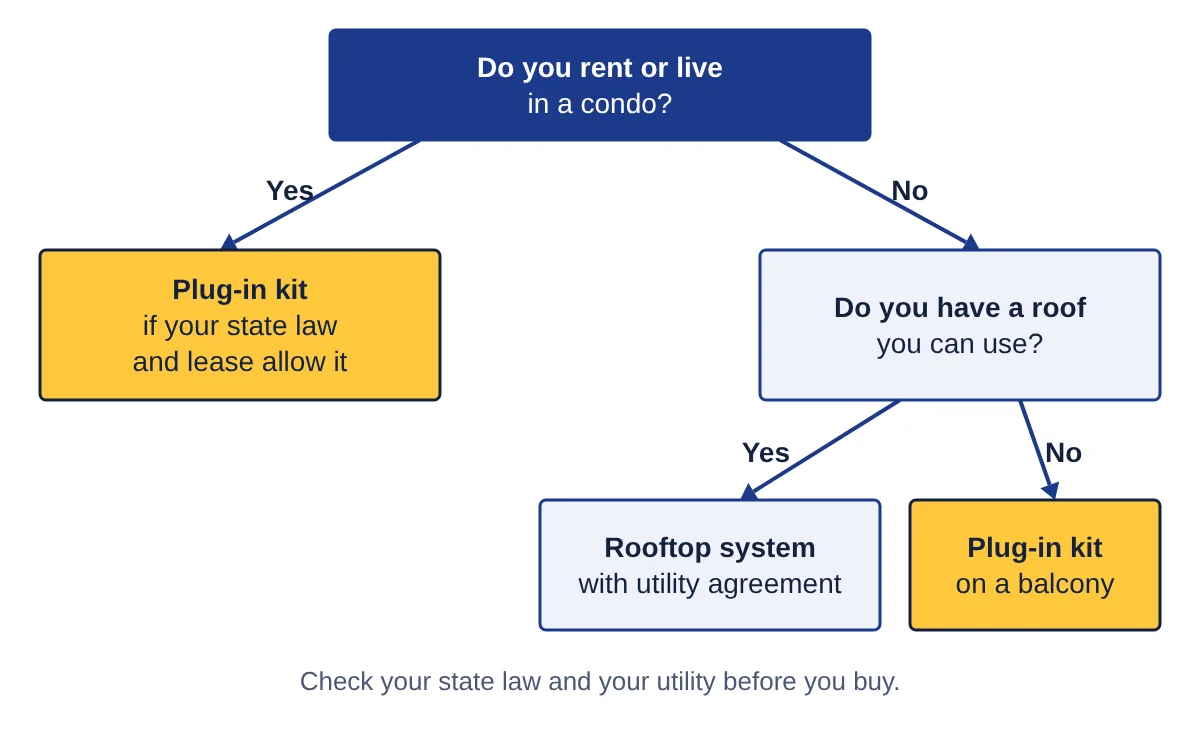
A plug-in kit fits a renter, a condo owner or anyone with a balcony or railing and no roof access. A rooftop system fits a homeowner with a suitable roof who wants to produce a larger share of the home’s power. The two are different products, and the choice depends on where you live, not only on price.
Size and what it can power
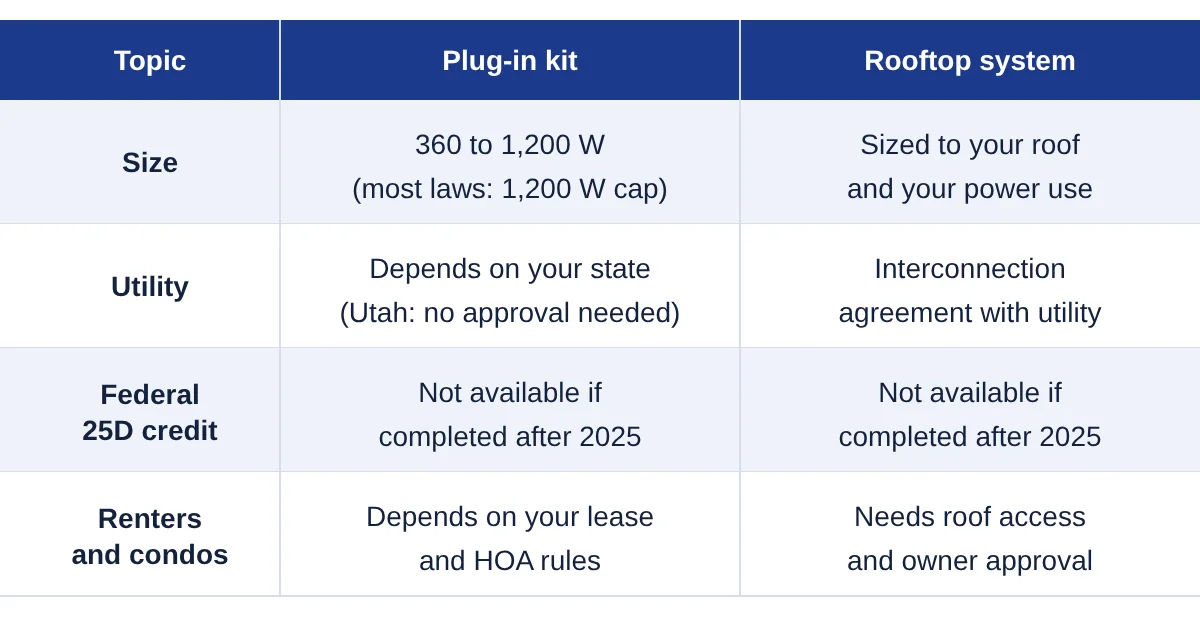
A plug-in kit is sized in a few hundred watts. Most of the state laws on plug-in devices cap output at 1,200 W, and that cap applies only to those devices. A kit can therefore power a few appliances or reduce the daytime load on a circuit, but it will not cover a whole house.
A rooftop system is sized to the roof and to the home’s use. That is why it can produce much more power, and why it costs much more up front.
Utility paperwork and timing
The two options follow different utility processes:
- Plug-in kits. Utah’s law exempts a qualifying device from the interconnection agreement requirement, and it bars utilities from requiring approval before a system is installed or used. In Maryland, you must notify your electric company before installation and provide a certification of the device’s safety features and maximum output. The utility cannot require approval or charge a fee for it.
- Rooftop systems. A rooftop system is normally connected to the grid under an interconnection agreement with the utility. Expect a more involved process than for a kit.
The rules differ by state, so check the current law for your state before you buy. The article on which states require you to notify your utility has the details.
Tax credits after 2025
The residential clean energy credit, known as 25D, does not apply to expenditures made after December 31, 2025. The IRS says that an expenditure counts as made when the original installation is completed. If the installation was completed after that date, the credit is not allowed, whether the system is a kit or a rooftop array.
This means that a plug-in kit bought or installed in 2026 does not qualify for 25D, and neither does a rooftop system completed in 2026. Some states, utilities and local programs offer their own incentives, and these change often. This article does not list any. For a full answer on the federal credit, read is there a federal tax credit for plug-in solar in 2026.
Renters and condo owners
If you rent or live in a condo, a rooftop system is usually out of reach, because you cannot change the roof. A plug-in kit may be possible, but only if your state allows it and your lease or homeowners association rules permit it. Check your lease or association rules before you buy. The article on renters and HOAs explains what to ask.
When a plug-in kit does not make sense
A plug-in kit may not be the right choice in these cases:
- Your state has no law. Without a law, a kit may have no clear legal route. See plug-in solar in a state with no law.
- You need backup power. A plug-in kit shuts off when the grid goes down. Read does plug-in solar work during a power outage.
- You cannot mount it safely. A railing, wall or ground stand has to hold the panel. Check the mount’s rating before you install it.
- You want the most output per home. A kit is small. If the goal is a large share of your home’s power, a rooftop system is the better match.
When a rooftop system makes sense
A rooftop system fits a homeowner who has a roof that gets good sun, and who is ready for the utility process and the cost of a larger installation. It also suits anyone who wants more output than a kit can give, even if the federal credit no longer applies.
Can you do both?
Yes, in some cases, but check first. A kit must meet the state’s listing and notice rules, and the utility’s rules for an existing system may limit what you can add. Ask your utility before you add anything to a home that already has panels.
To estimate what a kit would save on your bill, use the math in how much balcony solar can save by state. For the basic definition of a plug-in kit, read what balcony solar is.
Frequently asked questions
Is plug-in solar a replacement for rooftop solar?
Not in most homes. A plug-in kit is small, usually 360 to 1,200 W, and is meant for a balcony, railing or wall. A rooftop system is sized to the roof and to how much power the home uses.
Can I add plug-in solar if I already have rooftop panels?
Possibly, but check your state's rules and your utility's rules first. A kit has to meet the state's listing and notice requirements, and your existing interconnection may affect what you can add.
Do I need to tell my utility about a plug-in kit?
It depends on the state. In Maryland you must notify your electric company before installation. In Utah the utility cannot require approval before a qualifying device is installed.
Which is cheaper per watt?
Price per watt changes with kit and installer pricing and varies by brand. Compare quotes for the same size, with the installation cost included.
Do I need an electrician for plug-in solar?
Read the installation guide and your state's rules before you decide. Use a licensed electrician when your local rules or your utility require one, and when you are unsure about outlets or circuits.