How to Ask Your Landlord or HOA About Plug-In Solar (With a Sample Letter)
A sample letter to ask your landlord or HOA about plug-in solar, with the notice periods in New Jersey and Vermont and what to do if the answer is no.
Some links are affiliate links: if you buy through them we earn a small commission at no extra cost to you. It does not change our recommendations.

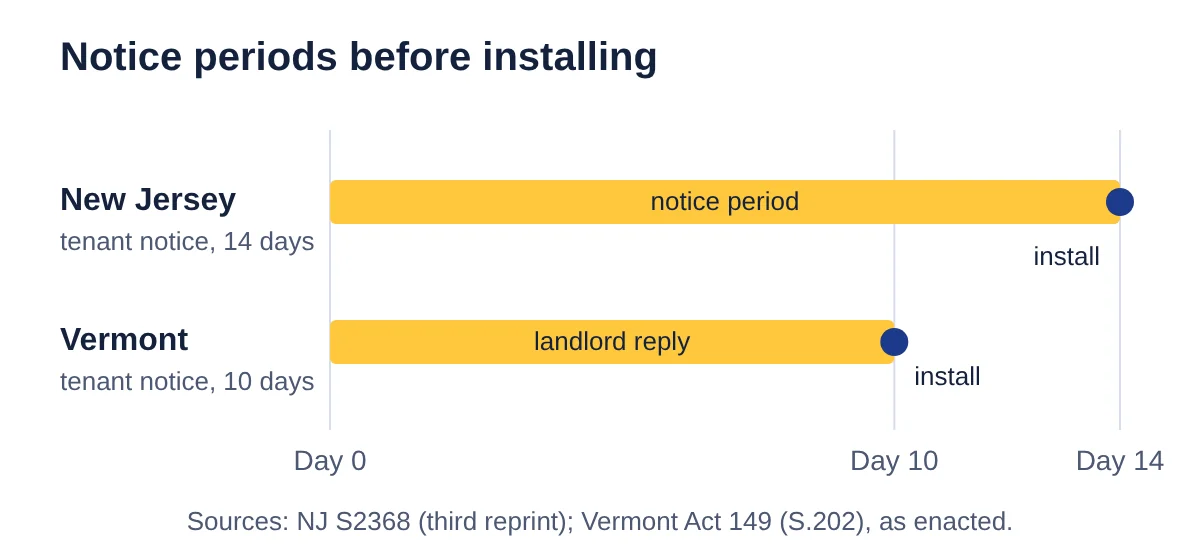
To ask your landlord or HOA about plug-in solar, put the request in writing. Name the device, its rated watts and the exact spot, and give the notice period your state requires. New Jersey’s law requires written notice at least 14 days before a tenant places or uses a device. Vermont’s law requires at least 10 days’ notice before installing. Where no state rule applies, your lease and the association’s documents decide. The letter below is a starting point.
Check the rule for your state first
The state rule sets the notice period and what the landlord may do with it. Read the state’s page before you write:
- New Jersey. Under the act’s text, a tenant gives written notice to the landlord, and to the association where one applies, at least 14 days before placing or using the device. The landlord may reply with reasonable restrictions on size, placement or manner. The act takes effect six months after enactment, which puts the start around March 2027.
- Vermont. Act 149 took effect on July 1, 2026. A tenant gives at least 10 days’ notice before installing. The landlord must respond within 10 days with any reasonable restrictions on the installation. The notice covers installation, not ongoing use. The Vermont page sets out the rest of the law.
- Other states. Check the state guide and the renters and HOA page, then your lease. If your state has no law, see plug-in solar in a state with no law.
What the letter must include
A clear letter answers the questions a landlord or board will ask. Include:
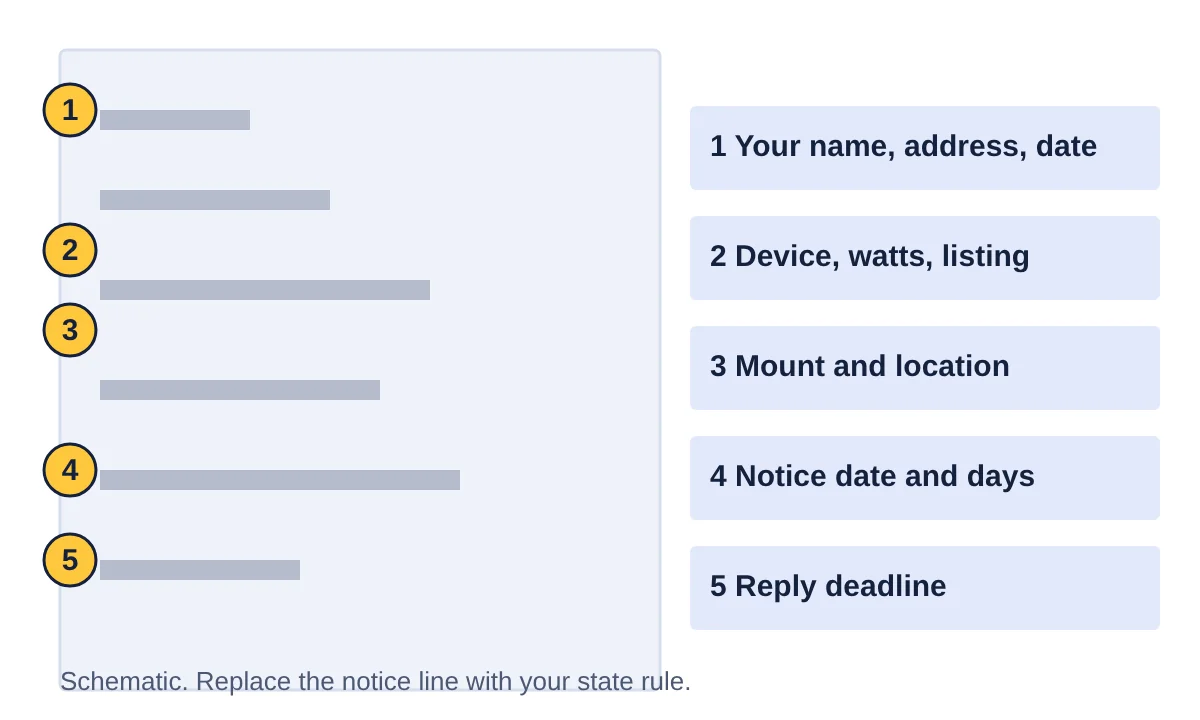
- Your name, the unit address and the date.
- The device: maker, model, rated AC output in watts, and the testing laboratory listing.
- The location and the mount, such as a railing clamp or a floor stand.
- How the device will be removed when you move out.
- The planned installation date, set after the notice period ends.
- The reply deadline, if your state sets one.
Attach the maker’s spec sheet and the certification listing. A seller’s claim is not enough on its own.
Sample letter
[Your full name] [Unit address, city, state, ZIP] [Phone] · [Email]
[Date]
[Landlord or property manager name] [Address]
Re: Request and notice to install a plug-in solar device at [unit address]
Dear [Name],
I am writing to request permission to install a plug-in solar device on my [balcony / patio / railing] at [unit address]. This letter is also my written notice under [state law, for example New Jersey S2368 or Vermont Act 149], given at least [14 / 10] days before I place or install the device.
The device details are:
- Make and model: [make, model]
- Rated AC output: [watts]
- Certification: [testing laboratory listing for the device]
- Mount: [railing clamp or floor stand], attached to [location on the balcony]
- Removal: [how I will remove it and restore the mount points when I move out]
- Planned installation date: [date, after the notice period ends]
The device will plug into a standard household outlet, and I will not change the building’s wiring. I will cover any damage the device causes to the unit. The maker’s spec sheet and the certification listing are enclosed.
Please reply in writing by [reply deadline] if you have reasonable restrictions on the size, placement or installation of the device.
Sincerely,
[Your name]
If your state has no plug-in solar law, delete the law reference and the notice-period phrase, and keep the rest. Your lease and the association documents still apply.
If your landlord says no
Start with the reason, in writing. Then work through the options in this order:
- Reread the lease and the building rules. Look for clauses on balconies, exterior fixtures and alterations.
- Check whether the state rule applies. In New Jersey, a landlord cannot bar a tenant who pays the electric bill from using the device. The landlord may only set reasonable limits on size, placement or manner.
- Offer a different mount. A removable railing clamp or a floor stand can answer a concern about holes or fixings. The mount options cover each type.
- Ask for the restriction in writing. Vague refusals are hard to defend. A specific rule is easier to discuss.
- Get help. A tenant rights group or an attorney can read the lease with you.
HOA and condo boards
In New Jersey, the act’s text says an association cannot enforce a provision that bars devices on a unit owner’s or tenant’s exterior premises. It can still set reasonable limits. Send the same letter to the association’s manager or board, and keep the same dates. Check the governing documents before you send the letter, because association rules can add conditions that the state law does not address.
Keep proof
Keep the following in one folder:
- Dated copies of the letter and proof of delivery, such as an email receipt or a signed copy.
- Any reply, including a refusal or a list of conditions.
- The spec sheet and the certification listing you sent.
- Photos of the installed mount, taken with a date.
Common mistakes
- Installing before the notice period ends. In New Jersey and Vermont the timing is set by the law, not by the landlord.
- Giving notice by phone only. A verbal notice is hard to prove.
- Leaving out the device details. A vague request gets a vague answer.
- Forgetting the damage clause. Under the New Jersey text, the tenant is responsible for damage the device causes to the unit.
- Using the letter without checking the state rule. The notice period differs by state, and some states have no rule at all.
This page explains the state texts and offers a template. It is not legal advice on your own lease or association.
Frequently asked questions
Can my landlord say no to plug-in solar?
In New Jersey, a landlord cannot bar a tenant who pays the electric bill from using a device on balconies or patios, but may set reasonable limits on size, placement or manner. In Vermont, the landlord may set reasonable restrictions on installation. Elsewhere, the lease decides.
Do I need written permission?
Not in every state, but a written notice is the safe step. New Jersey requires written notice at least 14 days before placing or using the device. Vermont requires at least 10 days' notice before installing.
What is the notice period in Vermont?
At least 10 days before installing. The landlord must reply within 10 days with any reasonable restrictions on the installation. Under the enacted text, if the landlord does not reply, the tenant may go ahead.
What if my state has no law?
The lease, the building rules and the association documents decide. Ask in writing anyway and keep the reply. The state page on plug-in solar with no law explains the risks.
Is this letter legal advice?
No. It is a template to start the conversation. For advice about your own lease or association, a tenant rights group or an attorney can help.