Is There a Federal Tax Credit for Plug-In Solar in 2026?
The federal 25D solar credit does not apply to plug-in kits completed after December 31, 2025. Here is what the IRS says and what it means for a kit.
Some links are affiliate links: if you buy through them we earn a small commission at no extra cost to you. It does not change our recommendations.

No. The federal residential solar credit, known as 25D, does not apply to plug-in solar kits installed in 2026. The IRS says the credit “will not be allowed for any expenditures made after December 31, 2025,” so a kit that is completed in 2026 cannot claim it.
What changed and when
The federal tax law passed in July 2025, Public Law 119-21, changed the rules for residential clean energy credits. The IRS FAQ on those changes explains the cutoff for section 25D. It states that the credit will not be allowed for any expenditures made after December 31, 2025.
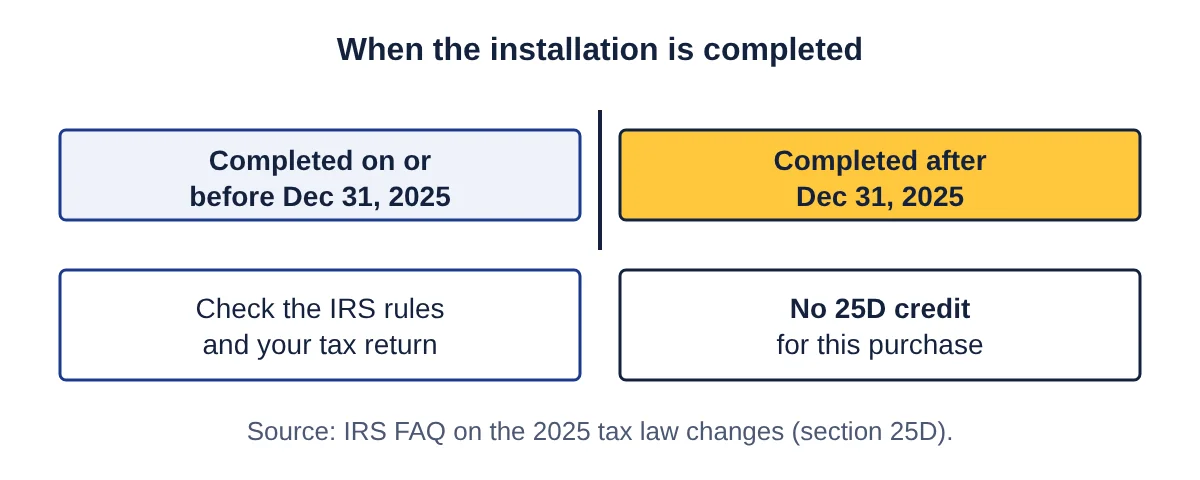
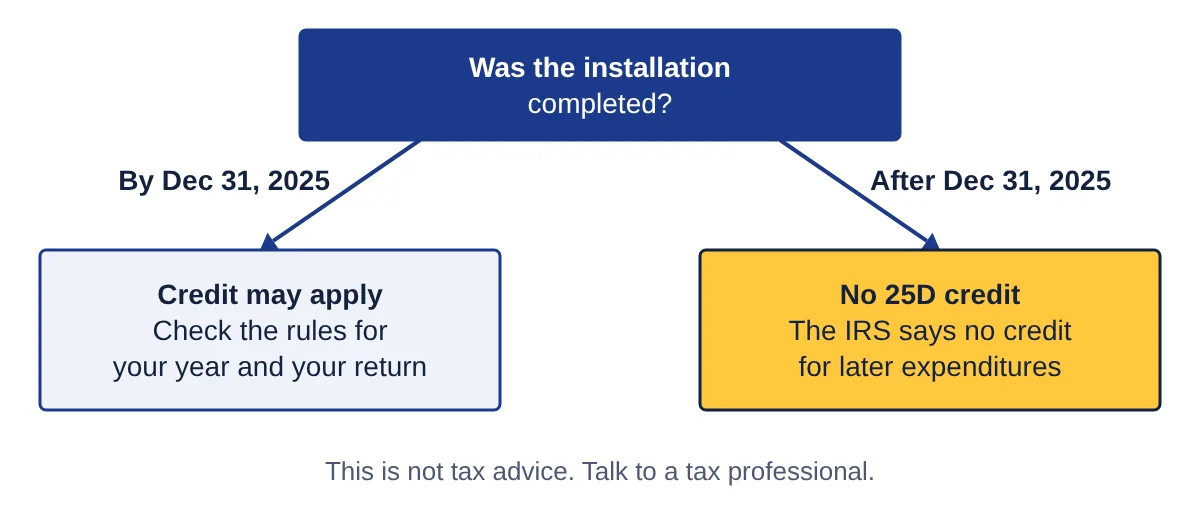
The IRS also explains when an expenditure counts as made. Under section 25D, an expenditure for an item is treated as made when the original installation of that item is completed. If the installation is completed after December 31, 2025, the expenditure is treated as made after that date, and the credit is not allowed.
Does it matter for a small kit?
The size of the kit does not change the answer. The same IRS timing rule applies whether the system is a small balcony kit or a large rooftop array. A plug-in kit whose installation is completed in 2026 cannot claim the credit.
The date that matters is when the installation is completed, as the IRS defines it. Keep a record of that date with your purchase and setup paperwork.
Common mistakes
- Relying on an old guide. Articles written before 2026 may describe the 25D credit as available. Check the IRS text, not a summary.
- Assuming a sale price settles the question. Discounts and promotions do not change the completion rule.
- Keeping no records. If you ever need to show when an installation was completed, a dated invoice, an installation receipt or a setup record helps.
- Treating a tax tip as a ruling. A tip from a seller or a forum does not decide your return.
How to check the dates for your own kit
Start with the paperwork from the seller and the installer. Look for the date the work was finished, not only the order date. If you set up the kit yourself, write down the date it was completed and keep a photo or a note with it.
Then compare that date with the cutoff. An installation completed on or before December 31, 2025 may fall under the 25D rules for that year. One completed after that date does not get the credit under the IRS rule quoted above. If the dates are close to the cutoff, the exact completion date matters, so confirm it before you file.
What may still exist: state, local and utility incentives
The federal credit is not the only possible help. Some states, cities and utilities run their own incentive programs for home solar. Those programs have their own rules, budgets and deadlines, and they change often.
To find out what applies to you, check your state energy office, your local government and your electric utility’s website. Confirm the program’s current status and its eligibility rules before you buy, because a program may have closed or been changed.
Why this is not tax advice
The rule described here is the federal rule the IRS published. It does not decide how that rule applies to your return, your income or your home. A tax professional can look at your full situation, including any earlier installation or any other credit you might claim.
Where to go next
If the credit is not available, the savings question is what matters. The article on how much balcony solar can save by state uses the EIA 2024 average price and PVGIS output, and it does not count any credit. For a comparison with a larger system, read balcony solar vs rooftop solar.
Whether a kit is allowed at all depends on your state and your lease, not on the federal credit. Start with is balcony solar legal in your state and what balcony solar is.
Frequently asked questions
Is there a federal tax credit for balcony solar?
Not for installations completed in 2026. The residential solar credit, 25D, does not allow expenditures made after December 31, 2025, according to the IRS.
Did the 25D solar tax credit expire?
Yes, for expenditures made after December 31, 2025. The IRS says that an expenditure is treated as made when the original installation is completed.
Can I claim plug-in solar on my taxes?
Only if your situation qualifies under the rules in force for your tax year. This is not tax advice, so ask a tax professional about your own return.
Does the purchase date or the completion date matter?
The IRS ties the timing to the completion of the original installation. Keep records of the purchase and the installation so you can show when the work was completed.
Are there state incentives for plug-in solar?
Some states, utilities and local programs offer their own incentives, and they change often. Check your state energy office and your utility's website for the programs that apply to you now.