Does Balcony Solar Work in Winter? Snow, Short Days and Cold Climates
Balcony solar still makes power in winter. See December output for four cold U.S. cities, why a vertical panel holds up, and how to handle snow safely.
Some links are affiliate links: if you buy through them we earn a small commission at no extra cost to you. It does not change our recommendations.

Yes, balcony solar works in winter, though the total falls. In the PVGIS model, a vertical 800-watt panel facing south makes about 70 kWh in December in Portland, Maine, and that is more than the same panel tilted at 35 degrees, which makes about 62 kWh. Winter output is lower than summer output for a tilted panel, but for a vertical panel the gap runs the other way: the same Portland panel makes about 42 kWh in June.
Why winter output falls, and what helps
Winter brings fewer hours of sun and a lower sun in the sky. A panel tilted at 35 degrees faces the low winter sun less squarely than it faces the high summer sun, so it loses more output than a panel on a vertical railing. A vertical panel facing south meets the low sun at a steeper angle, which is why it holds up better in the cold months.
The vertical panel still gives less over the year than a tilted one. The question is the season. If you want power in the cold months, the vertical mount does the most work. For the full yearly comparison, see the angle guide.
December in four cold cities
The table gives monthly output for an 800 W panel, in kWh, from the JRC PVGIS model.
| City | Nov, vertical | Dec, vertical | Jan, vertical | Feb, vertical | Dec, 35° tilt |
|---|---|---|---|---|---|
| Portland, ME | 75 | 70 | 82 | 86 | 62 |
| Burlington, VT | 60 | 50 | 70 | 74 | 46 |
| Hartford, CT | 75 | 70 | 83 | 82 | 65 |
| Denver, CO | 109 | 110 | 118 | 110 | 102 |
Source: JRC PVGIS 5.3, values for 800 W, facing south, rounded to the nearest kWh.

Denver has the highest winter numbers in the table in every month shown, and Burlington has the lowest. The vertical advantage in December holds in all four cities.
Portland, Maine, across the year
Portland shows the seasonal trade-off clearly. A vertical 800 W panel facing south makes its best months in February and March, at about 86 and 90 kWh. It makes its lowest in June, at about 42 kWh. The 35-degree tilt does the opposite: about 105 kWh in June and about 62 kWh in December.
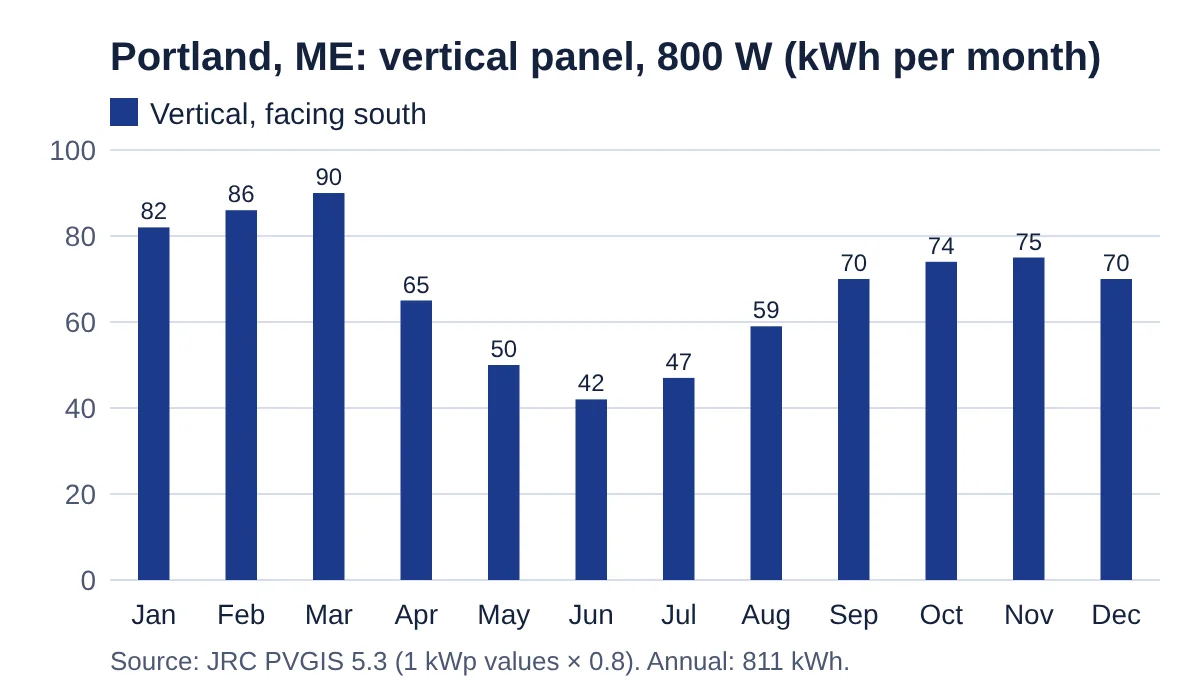
For a balcony that will feed the home’s outlets, this pattern means the winter months are not a loss. Compare the table with the monthly kWh on your own statement to see how much of your use the panel can cover.
Snow on the panel
A panel covered in snow makes little or nothing until the snow clears. The PVGIS figures assume a clean panel, so treat them as the output when the surface is clear. How long snow stays depends on the temperature and the wind, so do not count on it clearing by itself.
Clear the panel from the balcony itself:
- Use a soft broom or a brush with a long handle.
- Brush from the side or from the bottom edge, never by pulling on a cable or the frame.
- Stay on the balcony floor. Do not stand on a chair or a ladder and do not lean over the railing.
- If the balcony is icy, wait for it to clear.
Cold weather and the equipment
Before you buy, check the operating temperature range in the maker’s manual or spec sheet, and check that the mount is rated for the wind and load it will meet on your balcony. Check whether the rating covers the snow and ice load, not only wind. For mount types and what to ask a seller, see balcony solar mounts.
Is it worth it in a cold state?
Whether a winter-heavy system pays off depends on your electricity rate and on how much of the power you use while the sun is up. The savings guide explains how to run that calculation for your state.
The law is the next question. Vermont’s Act 149 took effect on July 1, 2026. It requires plug-in devices to meet UL 3700 or an equivalent certification from a recognized testing laboratory, and it sets a notice step for renters. Other cold states, including Maine, Connecticut, New Hampshire and New Jersey, have passed or are working on their own rules. See the state law guide for the current status of each.
Frequently asked questions
Does snow ruin balcony solar?
Snow on a panel stops its output until it slides off or is cleared. Brush it off from the balcony with a soft broom. Do not lean over the railing or climb to reach a panel.
Is a vertical panel better in winter?
In the PVGIS figures for Portland, Maine, Burlington, Vermont, Hartford, Connecticut and Denver, Colorado, a vertical panel facing south made more in December than the same panel tilted at 35 degrees.
How much does an 800 W panel make in December?
About 70 kWh in Portland, Maine, 50 kWh in Burlington, Vermont, 70 kWh in Hartford, Connecticut and 110 kWh in Denver, Colorado, for a vertical panel facing south with a clean surface.
Do short winter days matter?
Yes. Days are shorter and the sun is lower, so the monthly total falls. For a vertical panel in Portland, December output is still well above June output, because the lower sun meets the panel more directly.
Can I use balcony solar in a cold state?
Only where your state law and your lease or association rules allow it. The state pages list each law's status and its limits.