Plug-In Solar With a Battery: What Works and What Doesn't
Adding a battery to plug-in solar changes the system, not the wattage cap. Compare kits, built-in batteries and power stations before you buy.
Some links are affiliate links: if you buy through them we earn a small commission at no extra cost to you. It does not change our recommendations.

A plug-in solar system with a battery is still a plug-in system. The battery stores energy for later use, but the state laws limit the device’s output in watts, and a battery does not make the kit a backup power supply. Before you buy a battery-equipped product, check the output rating, the listing for the complete unit and how your state defines the device. Checked November 12, 2026.
Three product types
| Type | How it is built | What to check |
|---|---|---|
| Kit with no battery | Panels, microinverter and plug | Output cap and listing |
| Built-in battery | Battery and inverter in one product | Whole-unit listing and inverter capacity |
| Power station with solar input | A battery unit that takes panel input | Whether your state covers it as a plug-in device |
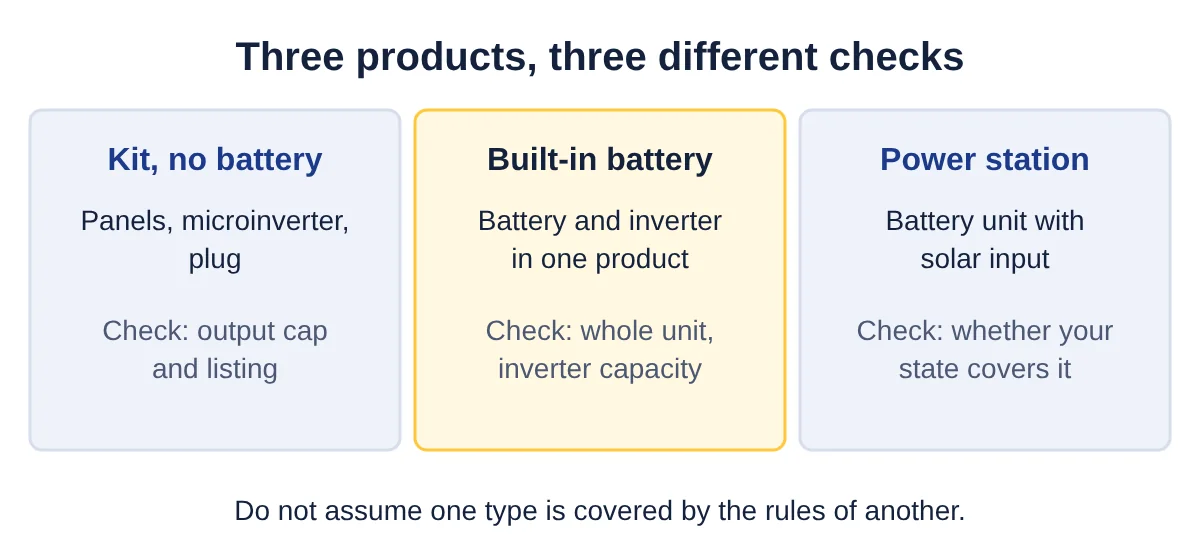
Power stations are sold for camping and backup as well as for solar input. Do not assume that a power station is covered by a plug-in solar law. Read the state text and the product’s listing before you buy. To compare models, search Amazon and check each one’s listed specs:
Search on AmazonWhat the laws say about battery systems
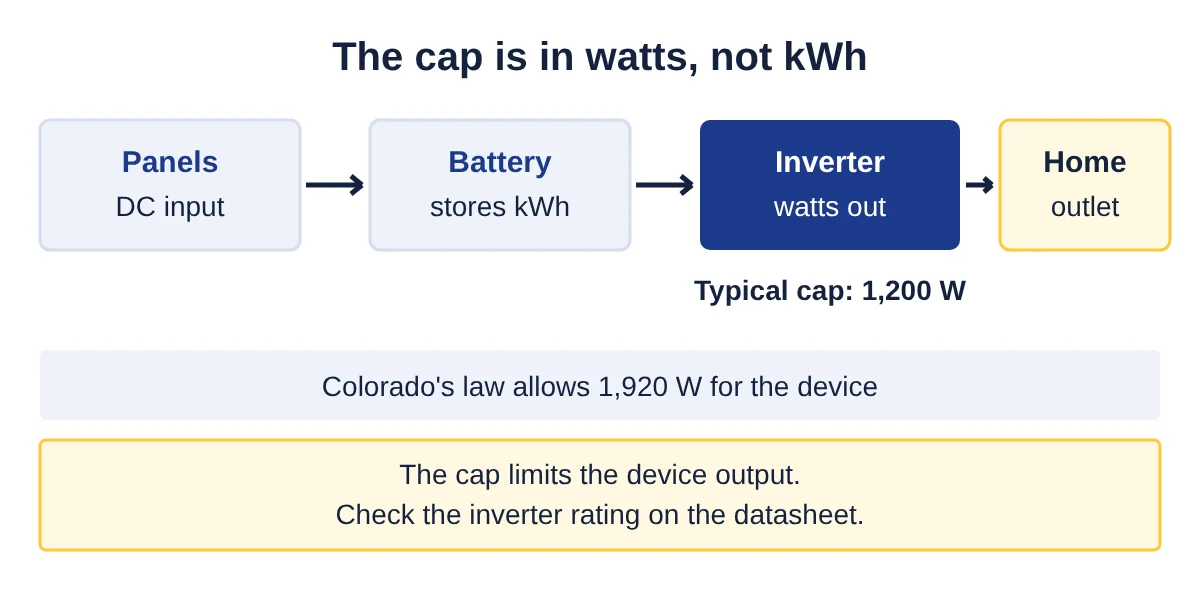
The laws covered on this site set limits in watts. Utah’s HB 340 defines a portable solar generation device with a maximum power output of 1,200 W. New Jersey’s S2368 caps maximum power output at 1,200 W. Vermont’s Act 149 caps the maximum combined inverter capacity at 1,200 W. Colorado’s HB26-1007 allows up to 1,920 W.
Battery capacity is measured in kilowatt-hours (kWh). That number tells you how much energy the battery can store. It does not replace the wattage limit. A battery that is large in kWh can still sit behind an inverter with a lower output rating, and the output rating is what the cap applies to.
Vermont’s wording matters here. It counts the combined inverter capacity, so if a system has more than one inverter, the inverter ratings add up. Check the datasheet for each inverter in the system.
What a battery does not do
A battery does not turn a plug-in kit into backup power. Utah’s law requires the device to keep the building from being energized during an outage. Because the device must not energize the building in an outage, a plug-in kit does not keep your home running in a blackout, with or without a battery.
Backup power needs a different design, installed by a licensed electrician. Read does plug-in solar work during a power outage for more detail on what a kit can and cannot do.
EcoFlow STREAM Ultra: what is confirmed
EcoFlow’s STREAM Ultra is a plug-and-play system with a 1.92 kWh battery. According to launch coverage, EcoFlow began official US sales on July 14, 2026, and at first only in Utah. Check the state where you live before you buy. A sale in one state does not show that the product meets the rules in another.
Ask the seller for the listing that covers the complete STREAM Ultra system, not only the battery.
How to size a battery
Start with the electricity you use after sunset. A battery is most useful when it covers that evening load. Compare that daily figure with the battery’s usable kWh, which is the energy you can actually draw from it. Check the inverter’s output rating too. A large battery behind a small inverter can deliver its energy only slowly, so the inverter sets the pace of use.
Safety and listing
A battery adds more parts to the system. Check the listing for the complete unit by model number, including the battery, inverter and plug. A listing for the panels alone does not cover the battery. For more on what a listing covers, read UL 3700 explained.
Read the installation rules in how to install balcony solar safely before you connect any battery system to an outlet.
Common mistakes
- Buying a battery expecting blackout backup from a plug-in kit.
- Treating a power station with solar input as a plug-in solar kit.
- Comparing products by battery kWh alone and ignoring the wattage cap.
- Assuming a listing for the panels covers the battery.
If you are still choosing a kit, see the best plug-in solar kits and what is balcony solar. For the inverter side of the system, read how to choose a microinverter for plug-in solar.
Frequently asked questions
Can I add a battery to plug-in solar?
Some plug-in products include a battery. Adding a separate battery to an existing kit creates a different system, so check the listing for the complete setup and the rules in your state first.
Do I need a battery with plug-in solar?
No. A kit without a battery uses the power the panels make while the sun is out. A battery lets you use some of that energy later, at a higher cost and with a more complex product.
Is the EcoFlow STREAM legal in my state?
That depends on your state's law. EcoFlow began selling the STREAM Ultra in the US in July 2026, starting in Utah. Read your state's law and ask the seller for the listing of that exact model.
What size battery do I need for balcony solar?
Start with the electricity you use after sunset each day, then compare it with the battery's usable kWh. A battery sized to your evening use is more useful than the largest one you can buy.
Does a plug-in solar battery work in a blackout?
No. Utah's law requires the device to keep the building from being energized during an outage. Backup power needs a separate system designed and installed by a licensed electrician.
Sources
- Bright Saver – Balcony solar kits (EcoFlow STREAM Ultra sales and launch details)
- Utah HB 340 (2025), enrolled – Utah State Legislature
- Vermont Act 149 (S.202), as enacted – Vermont General Assembly
- New Jersey S2368 (third reprint) – New Jersey Legislature
- Colorado Session Laws, Chapter 127 (HB26-1007) – Colorado General Assembly