How Much Electricity Does Balcony Solar Produce in the US? City-by-City Estimates
Yearly output of an 800-watt plug-in solar system in 11 U.S. cities, for vertical, tilted and balcony-floor mounts. Figures from JRC PVGIS 5.3.
Some links are affiliate links: if you buy through them we earn a small commission at no extra cost to you. It does not change our recommendations.
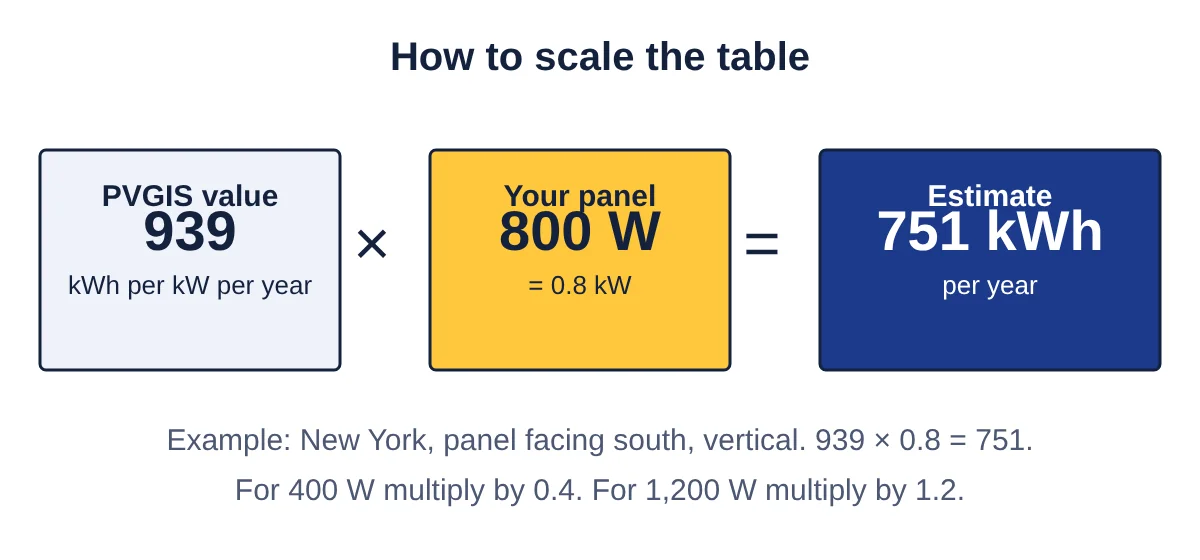
A plug-in solar system of 800 watts facing south on a vertical railing makes about 750 kilowatt-hours (kWh) a year in New York, about 810 in Portland, Maine, and about 1,000 in Denver, Colorado. The same panel tilted at 35 degrees makes more in every city in the table below. The numbers come from the JRC’s PVGIS model, which gives output per kilowatt of panel, so they scale to any wattage.
What decides the output
Five things set how much a balcony panel makes in a year:
- Rated power. A 1,200 W kit makes 1.5 times what an 800 W kit makes in the same spot.
- Compass direction. A panel facing south gets the most sun in the Northern Hemisphere.
- Tilt. The angle from flat changes how much of the sun’s light hits the panel face.
- Climate and latitude. Cloud cover, day length and the sun’s path differ by city.
- Shade. A tree, a building or the railing itself can block part of the panel for hours.
The first two you choose at purchase and installation. The city is fixed. Tilt depends on your mount, and shade depends on your balcony.
How these numbers were calculated
The figures come from JRC PVGIS 5.3, the free calculator of the European Commission’s Joint Research Centre. The calculation uses 14 percent system losses, a ventilated mount and a calculated horizon. It does not include shade from nearby buildings. The table gives output per kilowatt of panel per year. To get the 800 W column, each value is multiplied by 0.8.
For two panels, one facing east and one facing west, the estimate is the average of the east and west values. If your balcony faces another direction or uses a different tilt, the same calculator takes peak power, tilt and orientation as inputs, so you can run your own city and angle.
City table: 800 W, kWh per year
| City | 35° tilt, facing south | Vertical, facing south | Vertical, facing east | Vertical, facing west | 15° tilt (balcony floor) |
|---|---|---|---|---|---|
| Portland, ME | 1,150 | 811 | 551 | 524 | 1,060 |
| Burlington, VT | 1,030 | 714 | 506 | 476 | 962 |
| Hartford, CT | 1,102 | 764 | 534 | 490 | 1,026 |
| Newark, NJ | 1,122 | 766 | 547 | 495 | 1,047 |
| New York, NY | 1,114 | 751 | 550 | 448 | 1,043 |
| Baltimore, MD | 1,119 | 746 | 554 | 486 | 1,053 |
| Richmond, VA | 1,132 | 743 | 560 | 503 | 1,070 |
| Denver, CO | 1,453 | 1,002 | 733 | 625 | 1,346 |
| Salt Lake City, UT | 1,447 | 969 | 690 | 682 | 1,356 |
| San Francisco, CA | 1,394 | 862 | 612 | 683 | 1,330 |
| Los Angeles, CA | 1,424 | 853 | 686 | 682 | 1,371 |
Source: JRC PVGIS 5.3, values for 800 W, rounded to the nearest kWh. Tool used: JRC PVGIS.
Denver and Salt Lake City give the most energy at 35 degrees, with about 1,450 kWh each. Burlington, Vermont gives the least, at 1,030 kWh.
Estimate what your balcony solar kit produces
Output per year kWh
Output by month (kWh)
Yearly savings with these numbers
Data: JRC – PVGIS 5.3 (European Commission), with 14% system losses and no shading from nearby buildings. The result scales with panel wattage: if the panels are rated above the microinverter, output is slightly lower in the sunniest hours.
Facing matters as much as tilt
A vertical panel loses more than a tilted one, but the direction it faces changes the result a lot. In New York, a vertical panel facing east makes 550 kWh a year and one facing west makes 448. In San Francisco the order flips: west makes 683 and east makes 612. In Denver, east (733) beats west (625). In Los Angeles the two are almost equal.
That is why the same panel can perform differently a few streets apart. Check which way your balcony faces before you buy a mount.
Vertical or tilted: how big is the gap?
Across the 11 cities, a vertical panel facing south makes between 60 and 71 percent of the output of the same panel at 35 degrees. The share is lowest in the south of the set and highest in the north:
- Portland, Maine: 811 kWh vertical against 1,150 kWh at 35 degrees, about 70 percent.
- New York: 751 against 1,114, about 67 percent.
- Los Angeles: 853 against 1,424, about 60 percent.
The gap also changes with the season. In New York, a vertical panel facing south matches or beats the 35-degree tilt in November, December and January. The tilted panel pulls ahead from February to October.
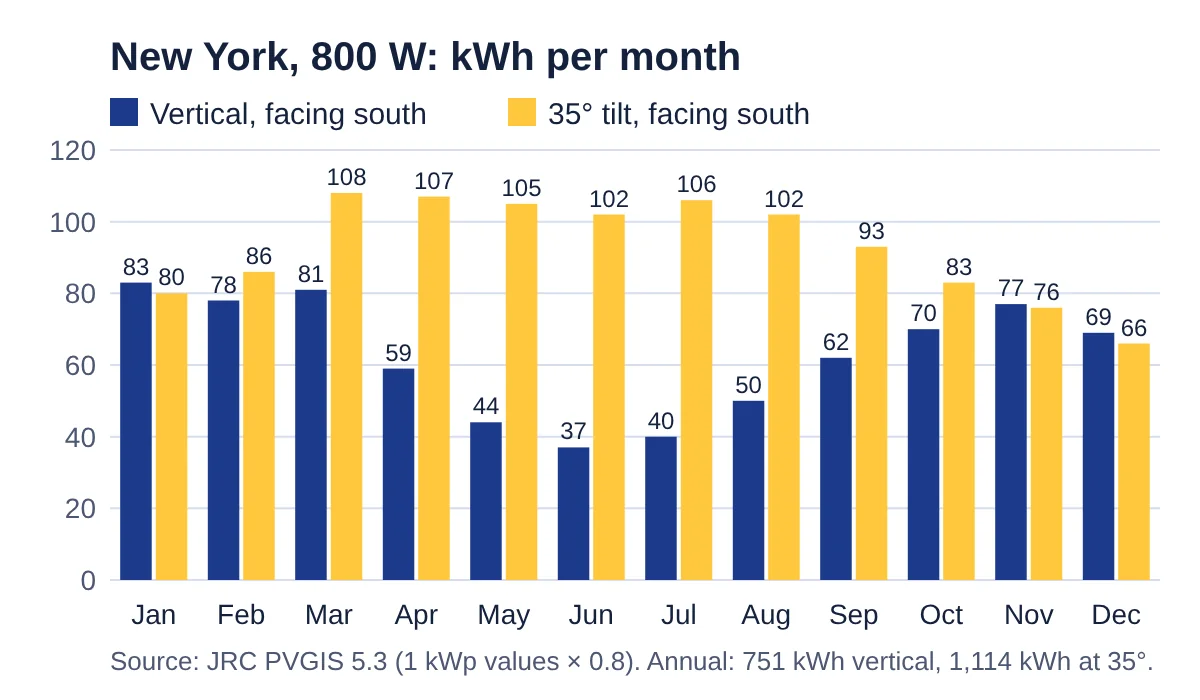
The vertical panel makes 83 kWh in January and 37 kWh in June in New York. The tilted panel makes 80 kWh in January and 102 kWh in June. Read the full seasonal pattern in the winter article.
Balcony floor: a low tilt is close to 35 degrees
A panel on the balcony floor sits at about 15 degrees and does not use the railing. In the three cities at the north, middle and south of the country, a 15-degree tilt makes between 92 and 96 percent of the 35-degree output:
- Portland, Maine: 1,060 kWh against 1,150.
- New York: 1,043 kWh against 1,114.
- Los Angeles: 1,371 kWh against 1,424.
The floor option gives up little energy, but it takes space and can be shaded by the railing above it. For the mount types, see balcony solar mounts. For the angle choice in detail, see the angle guide.
Common mistakes
- Comparing yearly and monthly figures. A yearly total hides the months when a panel makes little. Compare the monthly figure with your bill.
- Assuming the table includes shade. It does not. A railing or a neighboring building can cut output sharply.
- Reading the 1,200-watt figure as a guarantee. It is a legal cap, not an output. Actual output depends on the panel, the inverter and the sun.
- Using the numbers for north-facing balconies. The table covers south, east and west only.
What the estimates do not show
The estimates are not a forecast for any given year. Weather changes from one year to the next, and the model uses typical conditions. It applies one 14 percent system loss for the whole installation and does not show shade from your own site. The figures show how much a well-placed panel can make, which is the number to compare when you choose a mount or a kit. For the savings side, see how much balcony solar can save by state. For kits, see the best plug-in solar kits.
Frequently asked questions
How many kWh does an 800 W balcony kit make?
In the PVGIS model, an 800-watt panel facing south on a vertical railing makes about 750 kWh a year in New York and about 1,000 kWh in Denver. Tilted at 35 degrees, the same panel makes about 1,114 kWh in New York and 1,453 kWh in Denver.
Does a north-facing balcony work?
The figures here cover south, east and west only. For a north-facing balcony, run the same city on the JRC PVGIS site with a north azimuth to get its own estimate.
Does shade matter?
Yes. The figures assume no shade from nearby buildings, trees or railings. Shade on part of a panel cuts its output, so check the spot at the time of day you will use it.
How does balcony solar compare with rooftop solar?
A rooftop array can usually use more area and a better angle. Balcony solar is smaller and easier to move, and it fits a home where a roof system is not possible. The comparison article covers the trade-offs.
How big can a plug-in solar system legally be?
Most state laws cap plug-in systems at 1,200 watts. Colorado's law sets 1,920 watts. Check your state's page before you buy.