Plug-in Solar Panels UK: How They Work and What to Know
What plug-in solar panels are, how an 800 VA kit works in a British home, the rules in force since 27 August 2026 and whether one suits your house or flat.
Some links are affiliate links: if you buy through them we earn a small commission at no extra cost to you. It does not change our recommendations.

Plug-in solar panels are a ready-made kit of one or two panels and a microinverter that you plug into an ordinary three-pin socket. Your home uses the electricity as it is made. Since 27 August 2026 they have been legal in Great Britain, provided the kit meets the government’s interim product specification.
What is plug-in solar?
It is a small solar system you can set up without an installer. You fix the panels in a sunny spot, run the cable to a socket and plug in. The government says a kit can supply up to 20% of an average home’s electricity use.
People also call it “balcony solar”. It is the same thing. The name comes from Germany, where kits are common on flats. In Britain the rules are different, so a German kit with a Schuko plug is not legal here.
How do plug-in solar panels work?
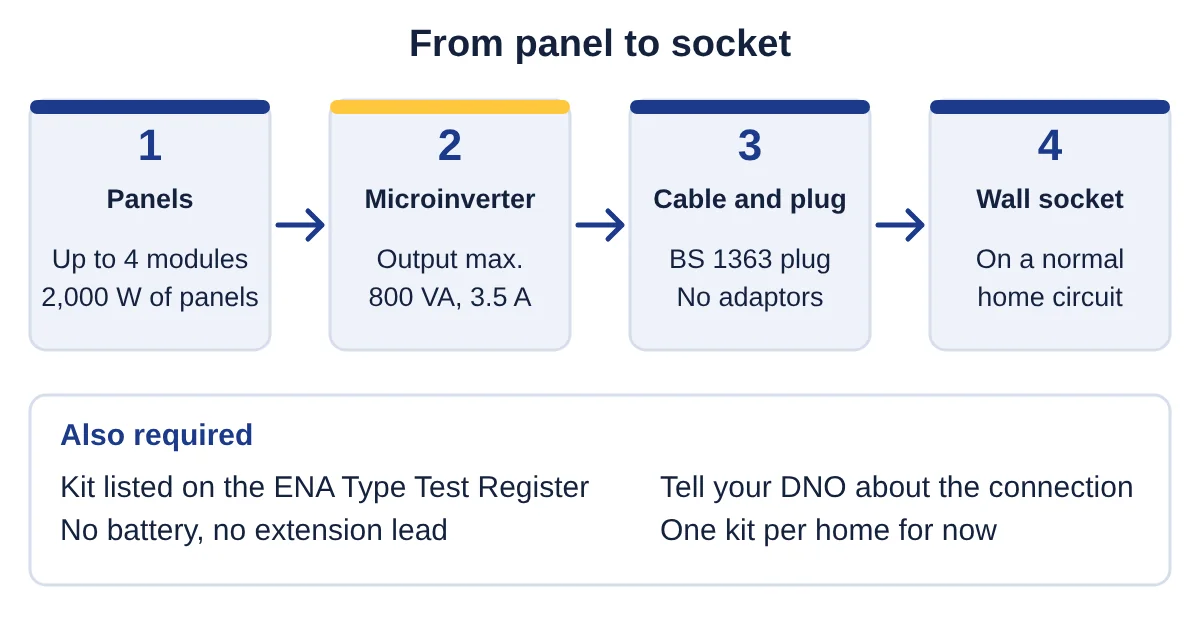
- The panels make direct current (DC) in daylight.
- The microinverter turns it into the alternating current (AC) your home uses.
- The power flows through the plug into your home’s wiring.
- Appliances running at that moment use it first, so you buy less from the grid.
Nothing is stored. Power you do not use at that moment is not banked for the evening, and these kits do not earn Smart Export Guarantee payments. Our guide to selling surplus power explains why.
What makes a kit legal in the UK?
The rules sit in the DESNZ interim specification (version 2.0, July 2026) and in a change to Ofgem’s G98 connection rules. A compliant kit must have:
- an output of no more than 800 VA and 3.5 A;
- panels totalling no more than 2,000 W, up to four modules and no more than two in series;
- a BS 1363 plug that goes straight into a BS 1363 socket;
- mounting supplied with the kit, and outdoor parts rated at least IP55;
- a listing on the ENA Type Test Register, which the specification says is not enough on its own to prove compliance;
- a durable label to fit at or near your consumer unit.
You, the owner, must also notify your DNO of the connection. For the full legal picture, read is plug-in solar legal in the UK and how to register with your DNO. To check a particular kit, use our ENA register guide.
What plug-in solar can and cannot do
- One kit per home. Current G98 rules allow one device per household. The government plans to move to one per circuit, but only after G98 is amended.
- Sockets only. It must go on a socket circuit, not a lighting circuit or a cooker spur.
- No battery. The specification excludes batteries.
- No extension leads. Fit a socket where the cable reaches, which may mean a new outdoor socket fitted by a competent person.
- Modern protection. The specification tells users to check the installation has an RCBO in good condition. Older fuse-based installations should be checked by an electrician and upgraded if needed.
Who is it for?
Houses with a garden or a sunny wall are the best fit. You have room, you control the mounting and you can usually fit a socket.
Flats and balconies need more care. The specification bans plug-in solar on timber balconies, on ACM, MCM, HPL or timber cladding, and on buildings with external wall remediation. Escape routes and shared balconies must stay clear, as the London Fire Brigade stresses. Installers also warn that output can drop sharply on a vertical railing or in shade.
Renters and leaseholders should get permission first. The government says landlords, freeholders and councils decide. Read plug-in solar for renters and leaseholders.
In England, new planning rules apply too: see planning permission for plug-in solar.
How much power should you expect?
The 800 VA cap limits what reaches your home at any moment, whatever the panels add up to. Retailers sell kits from about 340 W to over 1,000 W of panels (Homebuilding, September 2026). A bigger array helps on dull days and at the edges of the day, but the cap stops it adding more at peak.
Output also depends on where you fix the panels. A south-facing garden mount gives more than a shaded balcony. Above 960 W of panels, the specification advises a professional check of your installation, so a larger kit is not automatically better value.
How much will it save?
There is no single figure. The government says up to £110 a year. The Energy Saving Trust gives £70 to £100 and MoneySavingExpert £70 to £110. All depend on how much of the power you use as it is made.
Here is the sum. The Ofgem price cap for 1 October to 31 December 2026 is 26.32 pence per kWh (average, direct debit, excluding the standing charge). Electricity VAT is 0% until 31 March 2027.
- 400 kWh used in the home: 400 × £0.2632 = £105.28 a year.
- 200 kWh used (home empty by day, shaded spot): 200 × £0.2632 = £52.64.
The cap changes on 1 January; Ofgem announces it on 25 November 2026. See how much plug-in solar saves.
Common mistakes
- Buying a kit that is on sale but not on the ENA register.
- Using an extension lead or adaptor to reach the panels.
- Ignoring the landlord, freeholder or planning rules.
- Fitting panels in shade, then expecting the government’s savings figure.
- Planning to add a battery later.
- Forgetting to tell the DNO.
Five checks before you buy
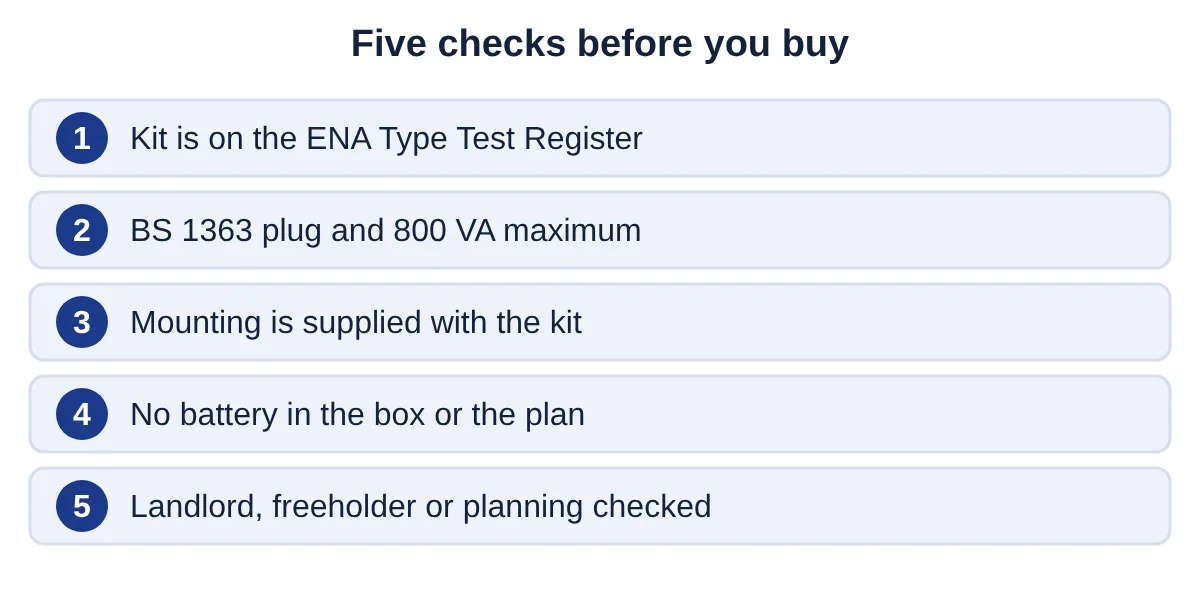
If a kit passes these, compare options in our best plug-in solar kits guide. Then follow how to install plug-in solar panels and see the full cost and payback before you order.
Frequently asked questions
What are plug-in solar panels?
A kit of one or two panels and a microinverter, with a cable and a standard three-pin plug. You plug it into a socket and your home uses the power as it is produced. It must be a kit that meets the government's interim product specification.
Can I plug solar panels into a normal socket in the UK?
Yes, since 27 August 2026 in Great Britain, but only a compliant kit with a BS 1363 plug, plugged directly into a BS 1363 socket. Adaptors, multi-way blocks and extension leads are not allowed.
Do plug-in solar panels work on a cloudy day?
They produce some power in daylight, but much less than in direct sun. Shade hurts output badly, so the position matters more than the weather.
How many watts can a plug-in solar kit produce?
The inverter output is capped at 800 VA (3.5 A). The panels themselves can add up to 2,000 W, with a maximum of four modules, but above 960 W the specification advises a professional check of your installation.
Are balcony solar panels the same as plug-in solar?
Yes, they describe the same kind of kit. In the UK 'plug-in solar' is the usual name, and the rules do not depend on whether you mount it on a balcony, a wall or the ground.
Do plug-in solar panels work in a power cut?
No. A plug-in kit has no battery and is not a backup supply, so do not expect it to keep anything running in a blackout.
Sources
- DESNZ – Plug-in Solar Device Interim Product Specification v2.0 (July 2026)
- GOV.UK – Households can save as plug-in solar panels come to market
- DESNZ – Plug-in solar: regulatory framework, government response (July 2026)
- London Fire Brigade – Plug-in solar panels: safety advice for residents and homeowners
- Solar Power Portal – Plug-in solar is legally available in major UK retail stores
- Ofgem – Price cap changes, 1 October to 31 December 2026
- Energy Saving Trust – Plug-in solar panels
- MoneySavingExpert – Plug-in solar panels