Plug-in Solar for Renters and Leaseholders: Permission Explained
Renting or leasing a flat? Find out who must agree before you fit plug-in solar, where the standard rules it out and how to ask for permission.
Some links are affiliate links: if you buy through them we earn a small commission at no extra cost to you. It does not change our recommendations.

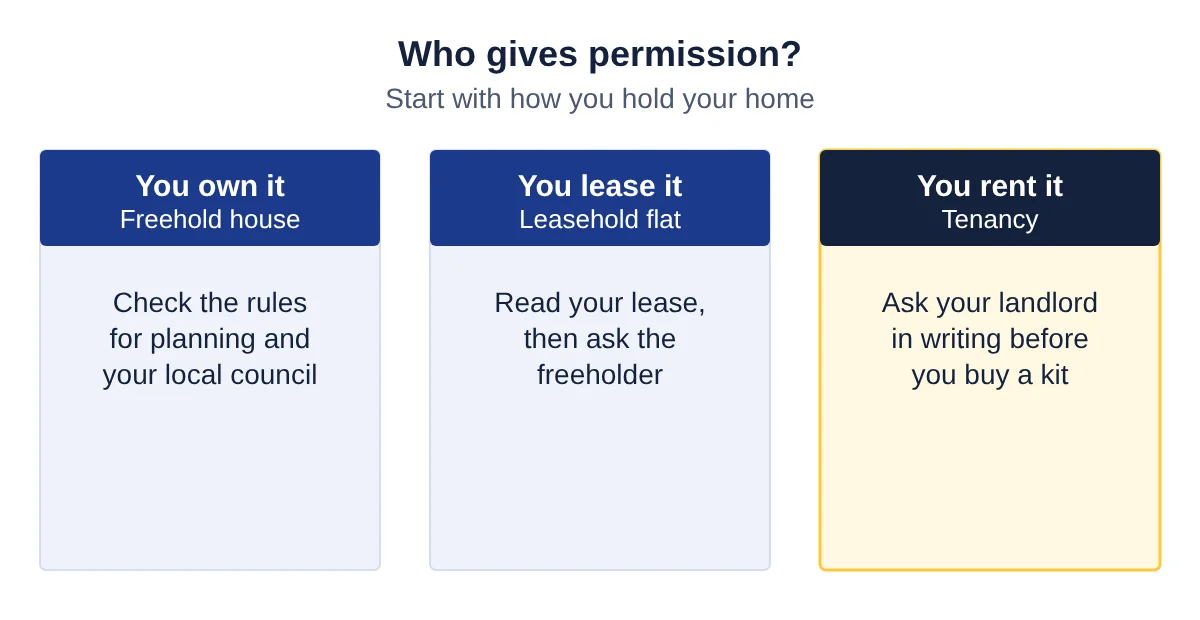
The national rules for a plug-in solar kit are the same whether you own or rent your home. What they do not cover is consent. The product specification does not deal with who may fix something to your building, so your lease or tenancy decides that. Read it first, then ask in writing before you buy.
Start with your lease or tenancy
Before you ask anyone, read the document that governs your home.
- Renters: look in the tenancy agreement for clauses on alterations, fixtures and fittings, and the outside of the building.
- Leaseholders: look in the lease for what you may alter, what needs the landlord’s or freeholder’s approval, and which parts count as common parts.
If the wording is unclear, ask your landlord or managing agent to confirm in writing what they will allow.
Where the standard rules it out
The Interim Product Specification v2.0 does not allow plug-in solar on these:
- timber balconies;
- timber cladding, timber walls or other timber surfaces;
- ACM, MCM or HPL cladding;
- buildings subject to external wall remediation or equivalent fire-safety restrictions;
- walls that form a boundary between two dwellings.

Balconies are not excluded in general. The specification lists balcony railings among the possible mounting points, so a metal or non-timber railing is the case to check.
What to ask your landlord or freeholder
A short written request gets a clearer answer than a conversation. Include:
- The kit: the manufacturer and model, and the 800 VA limit that applies to it.
- The fixing: where the panel would go, what it would attach to, and whether it would touch the structure of the building.
- The listing: a copy of the product page showing the kit is on the ENA Type Test Register. See our guide to checking a kit.
- The notification: that you will notify your network operator when the kit is installed and when it is removed.
- The reply: a request for a written answer, and for any conditions.
Dear [name], I would like to fit a plug-in solar kit on my balcony. The kit is [model], rated at 800 VA, with a mounting system supplied in the box, and it fixes to [railing or wall]. I will notify the network operator when it is installed. Could you confirm in writing whether this is acceptable under my [lease or tenancy]?
Leaseholders: balconies and communal areas
Many leases treat balconies, railings and the outside of the building differently from the flat itself. Some treat them as common parts, and some as the freeholder’s to maintain. The wording decides whether a balcony counts as yours to alter, so check the lease and the plan attached to it. Where a lease is silent, ask the freeholder before you start.
Ask your insurer before you install a kit as well. It is sensible to confirm your cover, particularly if the building has shared fire-safety arrangements.
Notify your network operator
The specification and Ofgem’s decision both make notification mandatory. Neither sets a deadline in days, so notify your network operator as soon as the kit is installed. Notification is not a permission. It does not replace the consent you need from your landlord or freeholder. Our step-by-step guide to registering plug-in solar with your DNO explains the process.
What if the answer is no?
Ask what the objection is. A concern about fixings, appearance or fire safety may be answered by a revised proposal, such as a different mounting point or a kit with its own mounting system. An objection based on a lease clause that forbids alterations usually stands unless the lease is changed.
Do not install a kit without consent. If you do, you may breach your lease or tenancy, and an insurer may question a claim. If you are also unsure whether a panel fits within the planning limits, read our guide to planning permission for plug-in solar.
Before you start
- Read the lease or tenancy and find the clauses that cover alterations and the outside of the building.
- Ask for consent in writing, and keep the reply.
- Check the kit on the register and the specification before you buy.
- Notify your network operator after installation.
- Read the wider picture in our guide to whether plug-in solar is legal in the UK.
Frequently asked questions
Can I put plug-in solar on my balcony in a rented flat?
Only with your landlord’s agreement, given in writing. The national rules for the kit apply whether you rent or own, but your tenancy decides what you may fix to the building.
Can a landlord refuse plug-in solar?
Yes, if your tenancy requires their consent. Ask for the reason in writing and keep the reply.
Do leaseholders need freeholder permission for plug-in solar?
Check your lease first. If it requires consent for alterations or fixings to the building, you need the freeholder’s permission before you install.
Can I install plug-in solar on a shared balcony?
Not without checking the lease and the building’s rules, because shared balconies and communal areas are usually controlled by the freeholder. The specification also rules out timber balconies.
Do I need permission if the panel is freestanding and removable?
Check the lease. Whether a panel can be removed does not decide whether your lease allows it to be fitted.
What if my building has cladding?
The specification excludes ACM, MCM, HPL and timber cladding, and buildings under external wall remediation. Ask the freeholder in writing what cladding the building has.