How Much Do Plug-in Solar Panels Save in the UK?
Plug-in solar saves 26.32p for every kWh you use at home at the current Ofgem rate. Here is how to work out your own saving, with worked examples.
Some links are affiliate links: if you buy through them we earn a small commission at no extra cost to you. It does not change our recommendations.

A plug-in solar kit saves you about 26 pence for every kilowatt-hour (kWh) you use at home that would otherwise come from the grid. At the Ofgem price cap for October to December 2026, which is 26.32p per kWh, a kit that covers 400 kWh of your use a year saves about £105. The government says savings of up to £110 a year are possible. Your own figure depends on how much of the power you use while it is being made.
How the saving is worked out
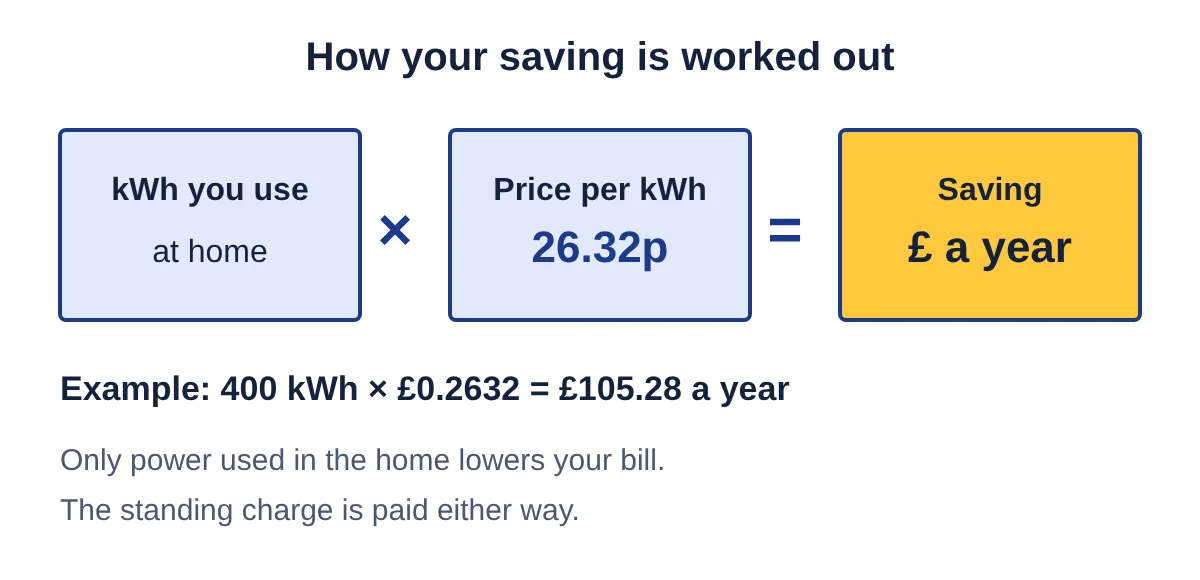
Your saving is the power you use yourself, multiplied by your unit rate. Power you do not use at that moment is not stored, because plug-in kits cannot have a battery. Power that is made while the house is empty earns you nothing.
What the current rate means
Ofgem’s price cap for 1 October to 31 December 2026 is 26.32p per kWh on average for direct debit customers. The daily standing charge is 54.83p. Ofgem’s figures do not include VAT, and electricity VAT is 0% from 1 October 2026 to 31 March 2027.
The standing charge is the same whether or not you have panels, so a kit does not reduce it. Only the unit rate is affected.
| Power you use yourself each year | Saving at 26.32p per kWh |
|---|---|
| 100 kWh | £26.32 |
| 200 kWh | £52.64 |
| 400 kWh | £105.28 |

Why the published figures differ
The estimates come from different assumptions about how much power is used at home and where the panels sit.
- Government: the Department for Energy Security and Net Zero says households could save up to £110 a year.
- MoneySavingExpert: it quotes £70 to £100 a year for a typical household with an 800 W system, which it attributes to a government figure. Its table shows £70 to £110.
- Carbon Brief: its model gives about £110 a year at 27p per kWh, with about 400 kWh used. It also allows for a balcony position, which cuts output by about 45%.
If you use more of the power at home, your saving rises. If the panels are in shade, it falls.
What decides your saving
- When you are home. A kit helps most when someone is using electricity in daylight. Running the washing machine or dishwasher while the sun is out uses more of what the panels make.
- Where the panels face. A south-facing spot with few shadows gives the most power. Our mounting guide covers balconies, gardens and walls.
- The 800 VA limit. The kit cannot push more than 800 VA into your home at any moment. Extra panels help on dull days and at the start and end of the day, but they do not raise the peak.
- Your unit rate. Your rate may be higher or lower than the cap if you are on a fixed or a different tariff. Use your own rate in the sum.
Balcony or garden: which saves more?
A garden with a sunny, unshaded spot is the best case. A balcony railing is often vertical and may be shaded by the building. Carbon Brief’s estimate allows for a 45% cut in output for a balcony position, so a balcony saving is best read as the lower end of the range. For the full list of fixing options, see how to mount plug-in solar panels.
Common mistakes
- Comparing your bill with a headline figure without checking how much power you use at home.
- Expecting the top figure in a shaded spot. Position matters more than the kit’s size.
- Counting the standing charge as saved. It is paid whatever the panels make.
- Expecting power in a cut. A kit has no battery and is not a backup supply.
- Ignoring the rate change. The saving moves with the cap, so recalculate after each announcement.
What to do when the price cap changes
Ofgem announces the levels for 1 January to 31 March 2027 on 25 November 2026. Take the new unit rate, multiply it by the kWh you use at home, and you have your new figure. Check the VAT position as well: Ofgem’s figures for this period assume 0% VAT to 31 March 2027, so the rate you pay after that date may differ.
To compare the saving with the upfront cost, read how much plug-in solar panels cost in the UK. For the rules that apply before you buy, start with the complete UK guide and our list of compliant kits.
Frequently asked questions
How much will a plug-in solar kit save per year in the UK?
At the Ofgem rate of 26.32p per kWh for October to December 2026, every kWh you use yourself saves 26.32p. The government says up to £110 a year, but your real saving depends on how much of the power you use at home.
Will plug-in solar really cut my electricity bill?
Yes, but only for the power you use in the home at the moment it is made. The standing charge stays the same, so the cut is smaller than the panels' output suggests.
Are plug-in solar panels worth it if I am out all day?
Less so. Most of the power is made when nobody is using it, and the kit has no battery to store it. Running the washing machine or dishwasher in daylight helps.
Do plug-in solar panels earn money if I export?
Plug-in kits cannot be MCS-certified, so they are not paid under the Smart Export Guarantee. Some suppliers offer their own export tariffs, so check the terms with yours.
What is the current Ofgem price cap per kWh?
For 1 October to 31 December 2026, Ofgem's average unit rate for direct debit customers is 26.32p per kWh, excluding VAT. The levels for January to March 2027 are announced on 25 November 2026.
Will savings rise if the price cap goes up in January?
Yes. Each kWh you use yourself is worth the unit rate, so a higher rate means a bigger saving. Recalculate with the new rate once Ofgem publishes it.
Sources
- GOV.UK – Households can save as plug-in solar panels come to market (26 August 2026)
- Ofgem – Changes to the energy price cap between 1 October and 31 December 2026
- MoneySavingExpert – Plug-in solar panels (updated 20 October 2026)
- Carbon Brief – How plug-in solar can save UK homes £1,100 on energy bills