How to Check a Plug-in Solar Kit Is Legal: ENA Register Guide
Check a plug-in solar kit before you buy: find the exact model on the ENA Type Test Register, then confirm the plug, power, IP rating, mounting and label.
Some links are affiliate links: if you buy through them we earn a small commission at no extra cost to you. It does not change our recommendations.
A plug-in solar kit is only compliant if the exact model is listed on the ENA Type Test Register and it meets the DESNZ Interim Product Specification. Find the model on the register first. Then check the physical points: the plug, the power rating, the outdoor rating, the mounting system and the label. If any one of these is missing, do not buy.
Why the register matters
The specification requires the manufacturer to register the device on the ENA Type Test Register, and to obtain confirmation of compliance before it goes on the market. Submitting the device is not enough. A listing therefore tells you more than a product page or a marketplace description.
The register is the only registry the specification refers to. Ofgem’s decision does not create a central list of installed devices, so the listing you check is the manufacturer’s compliance record, not a record of your installation.
The eight checks
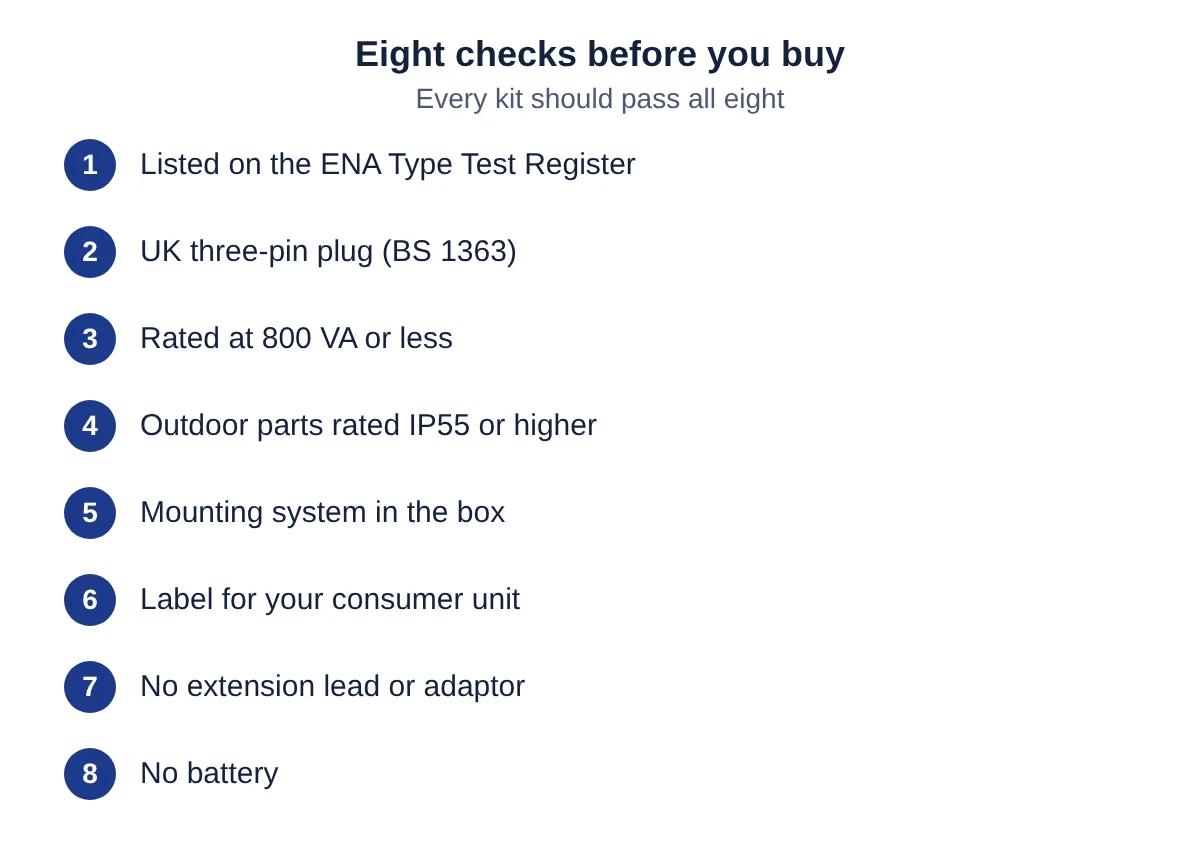
- Register. Find the exact manufacturer and model on the ENA Type Test Register. If the model is not there, do not buy it.
- Plug. The plug must be a BS 1363-1 UK three-pin plug, a non-rewireable moulded plug with a BS 1362 fuse of 5 A or less. It must be marked with the device’s rated current and a warning against extension leads.
- Power. The output must be no more than 800 VA and 3.5 A. The panels may total up to 2,000 W, with no more than four modules and two in series. Totals above 960 W should prompt a professional assessment of your installation.
- Outdoor rating. Outdoor components, their connections, and any outdoor plug or socket must be at least IP55.
- Mounting. A mounting system must come in the box. Cable ties, rope, string, adhesive tape and bungee cords are not permitted as fixings.
- Label. The kit must come with a durable label to fix at or near your consumer unit, saying a plug-in device is present.
- No adaptors. Multi-way adaptors, travel adaptors, RCD adaptors, plug converters and extension cables are not permitted.
- No battery. The device must carry a warning that it is not to be connected to a battery energy storage system.
Red flags
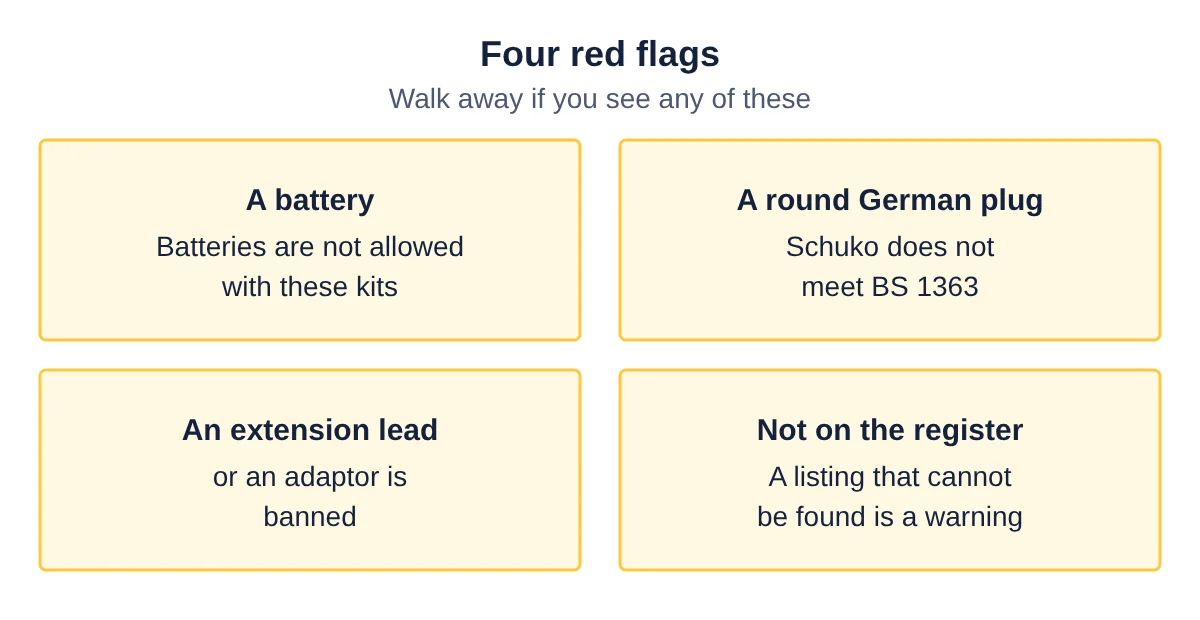
A round German Schuko plug is not a BS 1363 plug, so it does not meet the specification. An adaptor to fit it is also banned. A listing that promises battery storage fails check 8 outright.
Be careful with listings that say a kit is “for the UK” but give no model number. If you cannot match the listing to an entry on the register, treat it as unverified.
Check the install, not just the kit
The register confirms the device, not your home. Three things still apply:
- One device per household for now. The specification allows one device per household final ring circuit, but the G98 rules limit installations to one device per household until G98 is amended.
- Your wiring. Customer wiring must still conform to BS 7671, as Ofgem’s decision confirms. If your installation is old, have it checked before you connect anything.
- Notification. Notify your network operator when the kit is installed and when it is removed. The specification and Ofgem’s decision both make this mandatory. Neither sets a deadline in days. Our guide to registering with your DNO explains the steps.
What to do if you already bought a kit
If you have already bought a kit, check it against the register and the eight checks above. If the model is not listed, do not connect it.
Keep the receipt and the packaging, and ask the seller in writing to show you the register entry for the exact model. Check the seller’s returns terms. If the kit does not meet the specification, ask for a refund in writing.
Which kits to look at
Once you know what to check, compare kits that pass the register on price, rating and mounting. Our best plug-in solar kits guide compares kits with these checks in mind. If you are considering a battery, read our guide to plug-in solar batteries first, because batteries are not allowed with these kits.
Before you buy
- Find the exact model on the ENA Type Test Register.
- Check the plug is a UK three-pin BS 1363-1 plug.
- Confirm 800 VA or less, IP55 outdoor parts and a mounting system in the box.
- Check there is no battery, and no extension lead or adaptor is needed.
- Keep your receipt and the register entry.
- Notify your network operator after installation.
Frequently asked questions
How do I know if my plug-in solar kit is approved?
Find the exact model on the ENA Type Test Register. Then check the plug, the 800 VA rating, the IP55 outdoor rating and the mounting system against the DESNZ specification.
What is the ENA Type Test Register?
It is the register where a manufacturer must list a plug-in device, and obtain confirmation of compliance, before the device goes on sale.
Is a camping solar panel the same as plug-in solar?
No. A kit sold for camping does not meet the plug-in specification unless it has a BS 1363 plug, an 800 VA limit, registration and the other requirements.
What should the plug look like?
It should be a UK three-pin BS 1363-1 plug, moulded and not rewireable, with a fuse of 5 A or less. A round German Schuko plug does not meet the specification.
Do I still need to notify my network operator?
Yes. Notifying your network operator of installation and removal is mandatory under the Ofgem decision and the specification.
Can I return a non-compliant kit?
Check the seller’s returns terms and ask for a refund in writing. Do not connect a kit that is not on the register.