VAT on Plug-in Solar in the UK: When You Pay 20% and When 0%
Fit a plug-in solar kit yourself and you pay 20% VAT. An installer fitting it at your home is zero-rated until 31 March 2027, then 5%. Check your invoice.
Some links are affiliate links: if you buy through them we earn a small commission at no extra cost to you. It does not change our recommendations.

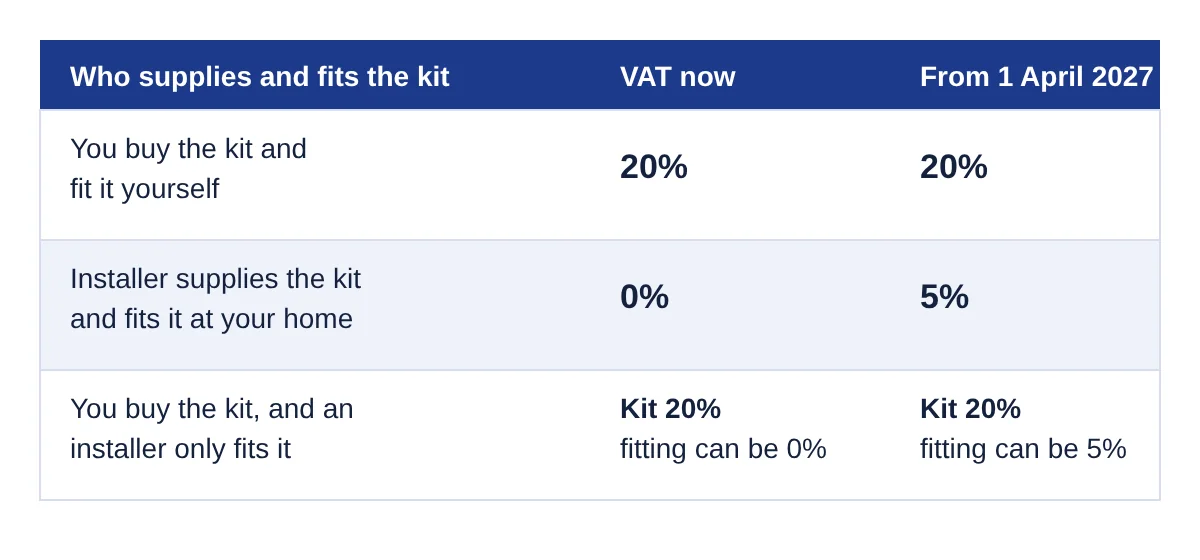
If you buy a plug-in solar kit and fit it yourself, you pay the standard rate of VAT, which is 20%. If an installer supplies the kit and fits it at your home, the work is zero-rated until 31 March 2027. From 1 April 2027 the rate goes up to 5%. These rules come from HMRC’s VAT Notice 708/6.
Buying a kit from a shop: the standard rate
A supplier who sells energy-saving materials without installing them charges the standard rate. HMRC’s notice says that if you supply energy-saving materials without installing them, your supply will be standard-rated.
So a plug-in kit that you buy from a shop or website and fit yourself is charged at 20%. The VAT should appear on the invoice, so check it before you pay.
The rate turns on two questions: who supplies the materials, and whether they are installed in a dwelling. Whether a kit is allowed to be used at all is a separate question, covered in our guide to checking a kit. If you are still choosing a kit, the guide to the best plug-in solar kits in the UK compares the options.
Supply and installation: 0% until 31 March 2027
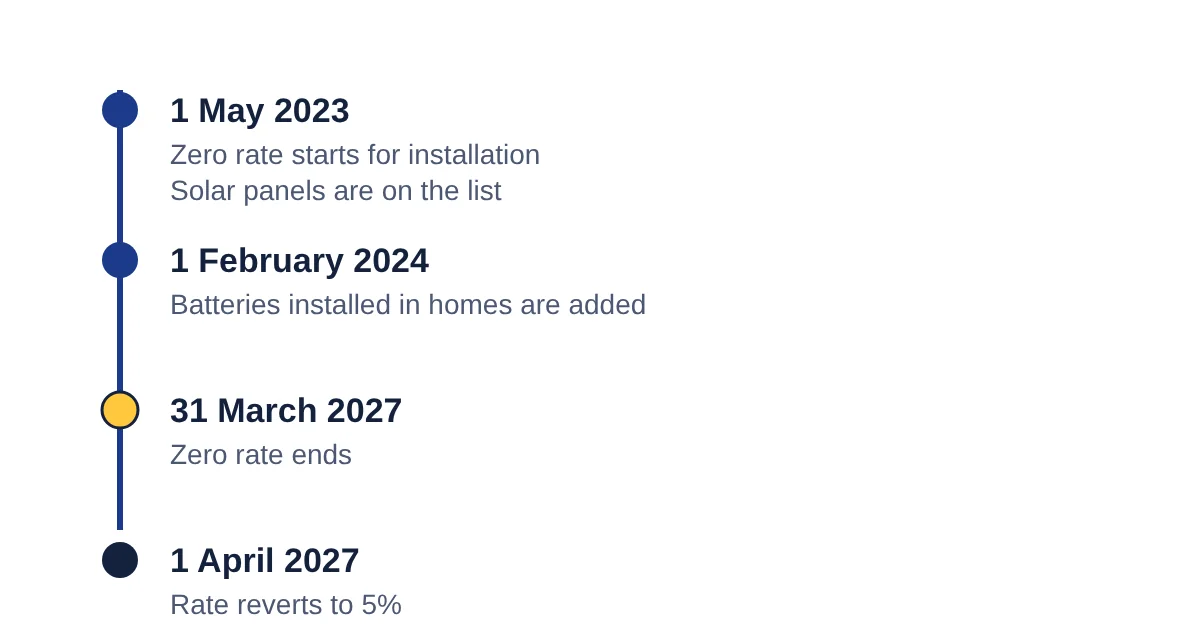
The zero rate applies to the installation of certain energy-saving materials from 1 May 2023 to 31 March 2027. Solar panels are on the list.
The relief also covers the supply of those materials by the person who installs them. An installer who supplies the kit and fits it at your home can therefore charge 0%. The notice applies this to houses, blocks of flats and other dwellings. Installation in hospitals, prisons and similar institutions is at the standard rate.
Buying the kit and paying for fitting separately
You can buy the kit from a retailer and pay an installer only for fitting. In that case the kit stays at 20%, because the retailer supplied it without fitting it. The fitting can still be zero-rated, because the installer is installing the materials in a dwelling.
Batteries
Since 1 February 2024 the notice also covers electrical storage batteries installed in residential accommodation. That includes retrofitting a battery to store electricity from a microgeneration system.
A battery bought on its own and fitted by you is charged at the standard rate. If an installer supplies and installs it at your home, the zero rate can apply until 31 March 2027.
What changes on 1 April 2027
From 1 April 2027 the zero rate ends and the work reverts to the reduced rate of 5%. The notice states this directly.
Ask your installer which rate will be on the invoice and when the work will be done. Get the VAT rate in writing before you agree to the job, and keep the quote and the invoice together, because they show the rate you were charged.
How to check your invoice
- The kit and the fitting are on separate lines.
- Each line shows its VAT rate or the amount of VAT.
- The invoice names the installer and the address where the work is done.
- If the fitting is zero-rated, the invoice says so.
Common mistakes
- Assuming the whole job is zero-rated because it saves energy. The zero rate covers only the materials listed in the notice, and the installation in a dwelling.
- Expecting 5% now. The 5% rate applies from 1 April 2027, not before.
- Buying a kit online and expecting zero VAT on it. A kit supplied without installation is charged at 20%.
For the full cost of a kit, read our plug-in solar cost guide. For running costs, see the savings guide.
Frequently asked questions
Do I pay VAT on a plug-in solar kit?
If you buy the kit and fit it yourself, you pay the standard rate of 20%. The zero rate applies when an installer supplies and fits the work at your home, until 31 March 2027.
Is solar VAT going up in April 2027?
Yes, for the work covered by the zero rate. HMRC's VAT Notice 708/6 says that from 1 April 2027 these materials revert to the reduced rate of 5%.
Are solar batteries zero-rated?
They can be. Since 1 February 2024 the list includes electrical storage batteries installed in residential accommodation. A battery you buy on its own and fit yourself is charged at the standard rate.
Does the 0% rate apply if I install the kit myself?
No. The zero rate covers installation by a person who installs the materials in a dwelling. If you fit the kit yourself, the kit you buy is charged at 20%.
Can I buy the kit from a shop and pay an installer only for fitting?
Yes, and the fitting can be zero-rated while the kit stays at 20%. Ask the installer to show the fitting as a separate line on the invoice.