Is Plug-in Solar Legal in the UK? The Rules From 27 August 2026
Plug-in solar has been legal in Great Britain since 27 August 2026. What a kit must meet, what is still banned and how the nations differ, with sources.
Some links are affiliate links: if you buy through them we earn a small commission at no extra cost to you. It does not change our recommendations.

Yes. Plug-in solar has been legal in Great Britain since 27 August 2026. You may plug a compliant kit of up to 800 VA into a standard socket without an installer, as long as it is on the ENA Type Test Register and you notify your network operator. Northern Ireland is not covered.
The rules in plain English
Three separate sets of rules make plug-in solar legal:
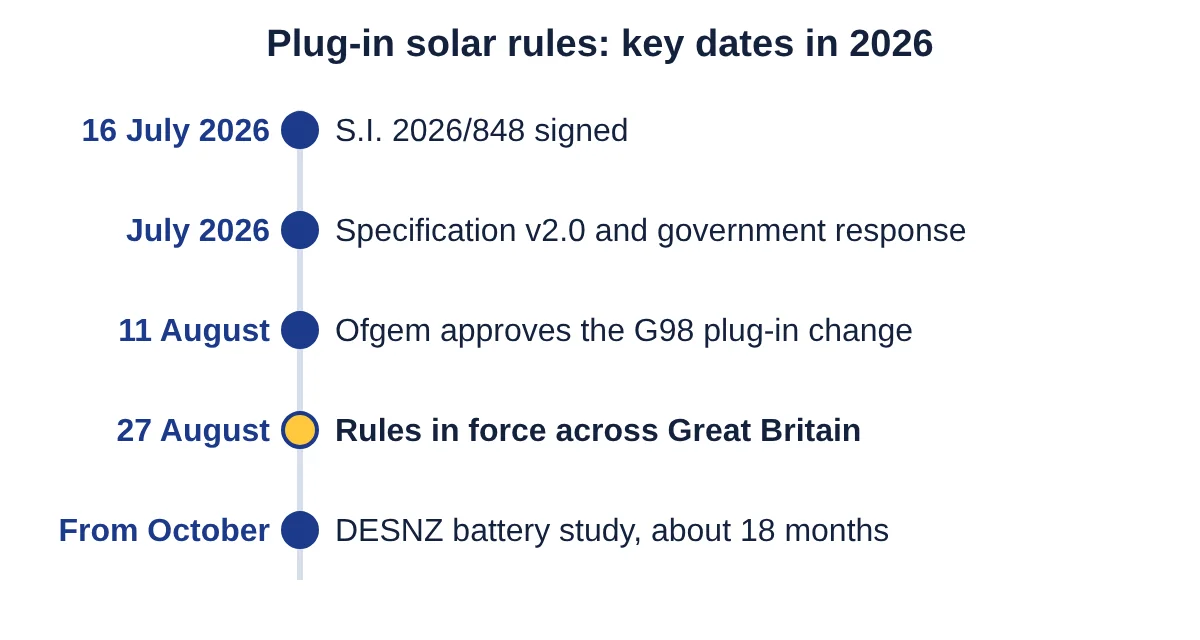
- A change to product law. The government amended the Plugs and Sockets etc. (Safety) Regulations 1994, creating a limited route for a standard plug to be used with a compliant plug-in device that has no battery. S.I. 2026/848 was signed on 16 July 2026 and came into force on 27 August. It also amends the Electricity Safety, Quality and Continuity Regulations 2002.
- The Interim Product Specification. DESNZ’s version 2.0, published in July 2026, sets the technical and safety requirements for the kit. It replaced version 1.0, which was withdrawn.
- A change to grid connection rules. On 11 August 2026 Ofgem approved a G98 change that creates a “Plug-in Micro-generator” category. The customer notifies the network operator of the installation and removal, using simplified G98 forms.
For the exact wording, read the official version of the regulations on legislation.gov.uk.
What a kit must meet
From the specification:
- output of at most 800 VA and 3.5 A;
- panels of at most 2,000 W in total, up to four modules and no more than two in series (above 960 W, the maker must advise a professional assessment of your installation);
- a BS 1363-1 plug with a fuse of 5 A or less, going straight into a BS 1363-2 socket;
- mounting supplied with the kit, and at least IP55 for outdoor parts;
- registration on the ENA Type Test Register before sale. The specification says registration alone does not demonstrate compliance;
- a durable label at or near your consumer unit.
To check a kit you are about to buy, use our ENA register guide.
What is still not allowed
- Batteries. The specification excludes plug-in battery systems and kits integrated with batteries. See plug-in solar battery rules.
- Extension leads and adaptors. Multi-way adaptors, travel adaptors, RCD adaptors, plug converters and extension cables are all banned.
- More than one device per home. The government plans to allow one per circuit, but only after G98 is amended. Until then, one per household applies.
- Lighting circuits and cooker spurs. Devices may only go on socket circuits, and two devices on the same circuit are not allowed.
- Certain buildings. No timber balconies, ACM, MCM, HPL or timber cladding, and no buildings under external wall remediation. Walls forming a boundary between dwellings are also excluded.
- Blocked escape routes. Panels must not obstruct them.
- Foreign kits. A German kit with a Schuko plug does not meet the BS 1363 requirement.
England, Scotland, Wales and Northern Ireland
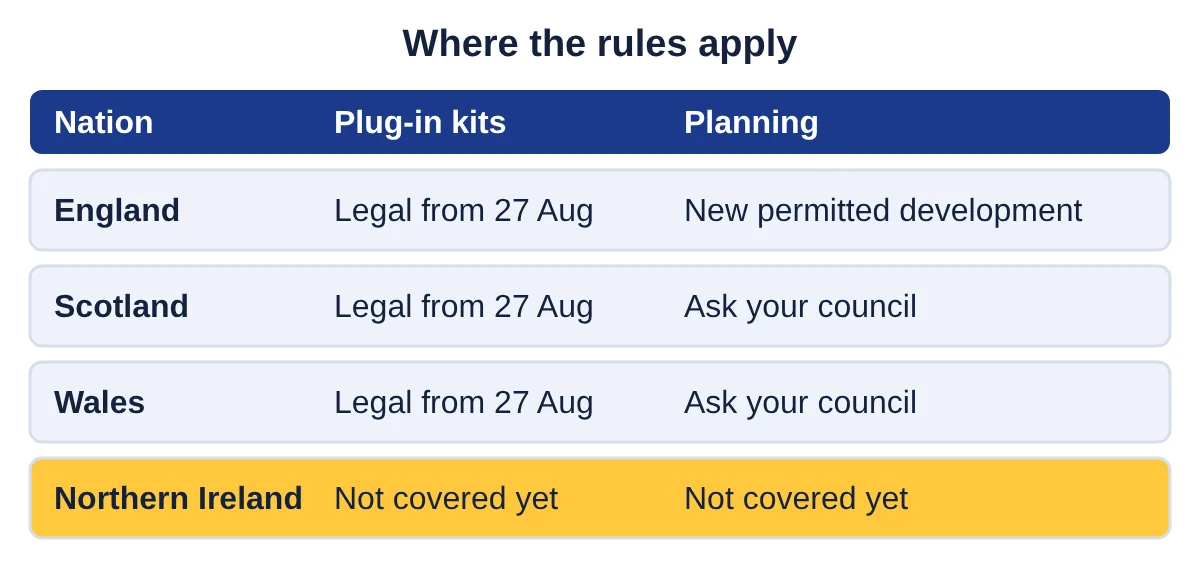
The government says plug-in solar is legal across Great Britain. The consultation response described the plug rules as UK-wide, yet its announcement covers Great Britain only, and the response left Northern Ireland questions (including the Windsor Framework) without a clear answer. Until the government says otherwise, do not assume plug-in solar is allowed there.
Planning is a separate, devolved matter. England has new permitted development rights for plug-in solar from 27 August 2026, with limits on projection and no timber structures. Scotland and Wales have no confirmed equivalent in the sources we found, so check with your council. The details are in planning permission for plug-in solar.
What you have to do
Notify your DNO. Notification of connection and removal is mandatory. The Ofgem decision and the specification give no deadline in days. The London Fire Brigade advises telling your DNO within 28 days of installation, so aim for that. Our step-by-step guide to registering with your DNO covers the process, and the ENA is building a digital notification route.
Get permission if you need it. The government says renters, leaseholders and residents of managed buildings should obtain any permission before installing, and that landlords, freeholders and councils decide. See plug-in solar for renters and leaseholders.
Check your wiring. The government did not require an electrical inspection or an installer. The specification does tell users to check for modern RCBO protection, and says older fuse-based installations should be checked and upgraded by a professional if needed.
Tell your insurer. The government response noted insurance uncertainty but took no position. The London Fire Brigade warns that an unauthorised installation could affect your insurance.
Do I need an electrician?
Not by law. The government decided professional installation is not proportionate for a product this small. It does advise seeking a qualified electrician where your circuit arrangements are uncertain, and an outdoor socket should be fitted by a competent person. Our installation guide shows what to check first.
What may change next
The specification is interim. It says it “may be modified from time to time or superseded”, and no review date is set. Watch for:
- a G98 amendment moving from one device per household to one per circuit;
- a permanent standard to follow the interim specification;
- batteries: the government says it will keep considering the evidence, and a safety study is reported to run for about 18 months from October 2026;
- Smart Export Guarantee payments, which these kits do not get today. See plug-in solar and the SEG.
We update this page when any of these change.
Common mistakes
- Assuming “legal to sell” means “on the register”. Check the model.
- Plugging in through an extension lead.
- Fixing panels to a timber balcony or a wall in a building with cladding concerns.
- Forgetting to notify the DNO.
- Assuming Scottish or Welsh planning rules match England’s.
Frequently asked questions
Is plug-in solar legal in the UK?
Yes, in Great Britain, since 27 August 2026. The kit must meet the DESNZ interim product specification, be listed on the ENA Type Test Register and be notified to your network operator. Northern Ireland is not covered by the announcement.
Is plug-in solar legal in Scotland and Wales?
Yes. The government announced that plug-in solar is legal across Great Britain, which includes Scotland and Wales. Planning rules are devolved, and we have found no confirmed change for them, so ask your council before fixing panels to a building.
Is plug-in solar legal in Northern Ireland?
The government's announcement covers Great Britain and does not mention Northern Ireland. Treat it as not covered until the government says otherwise.
Do I need an electrician to install plug-in solar?
Not by law. The government decided professional installation is not proportionate for these kits. It still advises asking an electrician if you are unsure about your circuits, and the specification says older fuse-based installations should be checked.
Can I use a plug-in solar kit from Germany in the UK?
Not as sold. The specification requires a BS 1363 plug with a BS 1362 fuse of no more than 5 A. A German Schuko plug, or an adaptor to fit it, does not meet the rules.
Can I add a battery to plug-in solar?
No. The specification excludes plug-in battery systems and kits with batteries, and tells users not to connect one. The government says it will keep looking at the evidence.
Sources
- GOV.UK – Households can save as plug-in solar panels come to market (26 August 2026)
- DESNZ – Plug-in Solar Device Interim Product Specification v2.0 (July 2026)
- DESNZ – Plug-in solar: regulatory framework, government response (July 2026)
- Ofgem – Decision DCRP/MP/26/02 (plug-in microgeneration, G98)
- S.I. 2026/848 (copy on LawPlayer; official text on legislation.gov.uk)
- LexisNexis – DESNZ publishes response on plug-in solar regulatory framework (17 July 2026)
- London Fire Brigade – Plug-in solar panels: safety advice for residents and homeowners
- Planning & Design – Permitted development rights for solar get a major update in England
- ESS News – UK explores plug-in battery regulations (27 August 2026)