How to Register Plug-in Solar With Your DNO (G98 Guide)
Plug-in solar must be notified to your network operator. Find your DNO by postcode, check the kit on the ENA register and see what the rules require.
Some links are affiliate links: if you buy through them we earn a small commission at no extra cost to you. It does not change our recommendations.

Yes, you must notify your Distribution Network Operator (DNO) when a plug-in solar device is connected and when it is removed. The DESNZ specification makes that notification mandatory, and Ofgem’s G98 decision created a route for it. Neither document sets a deadline in days. The London Fire Brigade advises telling your DNO within 28 days of installation. Find your DNO with the postcode lookup on the Energy Networks Association website, then check the kit’s model on the ENA Type Test Register.
Why you must notify your DNO
The specification says that notification to the DNO about connection and disconnection is mandatory, and the product must say so. In August 2026 Ofgem approved a G98 change that defines a “Plug-in Micro-generator” with a registered capacity of 800 W or less. The change gives customers a way to notify DNOs of installation and decommissioning, using simplified G98 forms.
Registration and notification are different steps
People often mix these two up, so it helps to separate them:
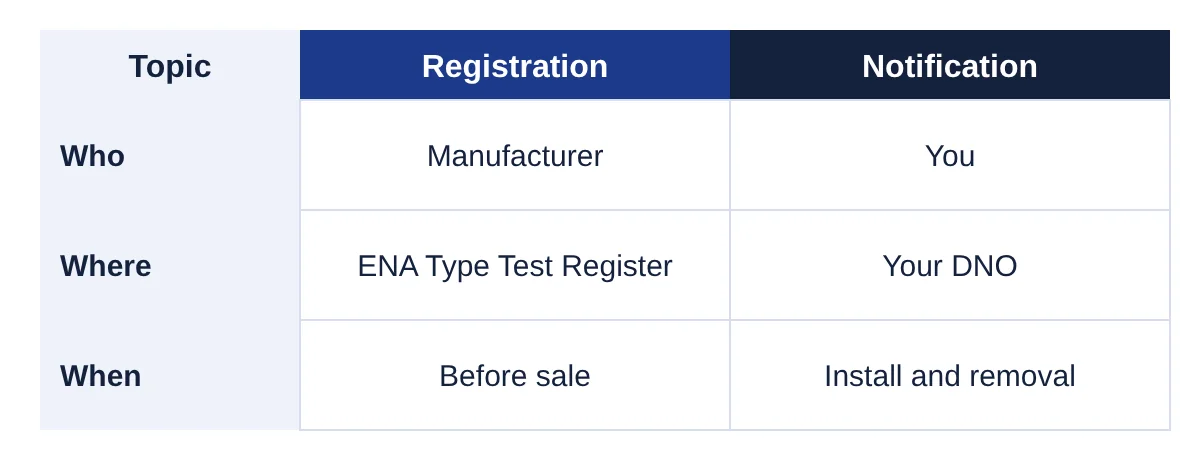
- Registration is on the ENA Type Test Register. The specification requires manufacturers to register each device before placing it on the market, and says that registration alone does not show the device complies.
- Notification is your job. You tell your DNO that the device is connected, and again when it is removed.
The Energy Saving Trust tells owners they must register a plug-in device before use, and lists the details it asks for: name, postcode, and the device’s make and model. Some guides, including MoneySavingExpert, link to a registration form at myplugin.solar. Neither the specification nor the Ofgem decision names that site, so check any form against the guidance from your DNO before you give personal details.
Step 1: Find your DNO
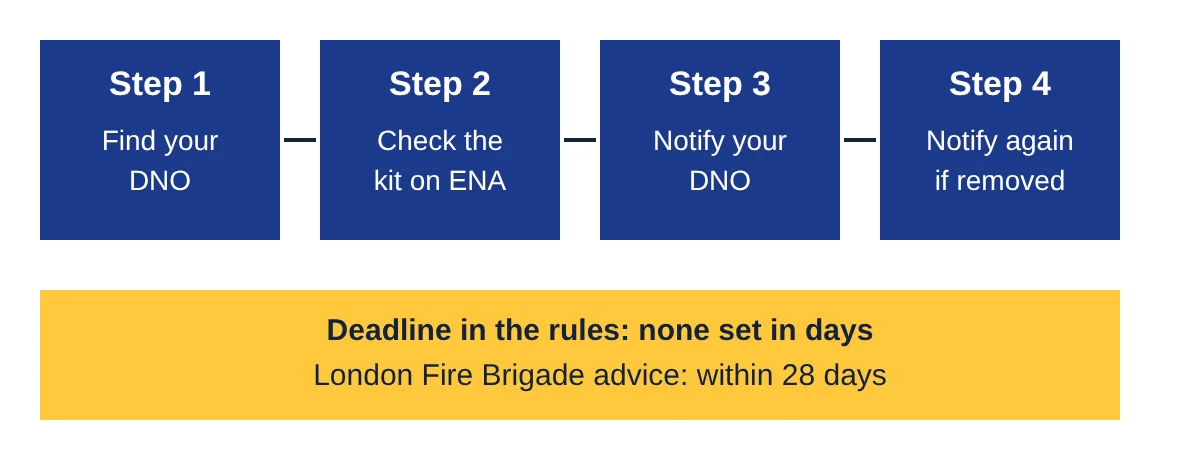
The Energy Networks Association lookup asks for your postcode and shows who runs the electricity network in your area. If you prefer not to use it, your electricity bill shows a Distributor ID. Match that number to the operator in the table on the same page. You can also call 105, which is free in England, Scotland and Wales. The London Fire Brigade names UK Power Networks as the DNO for London.
Step 2: Check the kit is on the ENA register
The specification says the device must be registered on the ENA Type Test Register before it is sold. Look up the exact make and model before you notify anyone. Our guide to checking a kit shows how to match the model. If the model is not on the register, do not connect it.
Step 3: Notify your DNO within 28 days
Neither the specification nor Ofgem sets a deadline in days, so the timing is your choice within the rules. The London Fire Brigade advises telling your DNO within 28 days of installation, and that is a sensible target. Ofgem says the ENA is developing a digital notification route for consumers. Until you see it in use, ask your DNO which form it wants. Have your name, postcode, and the device’s make and model ready, which is what the Energy Saving Trust lists.
What if you move, sell or remove the kit?
The specification requires notification of decommissioning as well as installation. When you take the kit down, tell your DNO. If you sell the kit, tell the buyer about the notification and about the 800 VA limit, so they can notify the DNO for their own installation.
Common mistakes
- Treating the ENA register as the same thing as notifying your DNO.
- Buying a kit whose exact model is not on the register.
- Waiting for a perfect digital form before you notify.
- Forgetting to notify when you move house or stop using the kit.
- Giving personal details to a form that the official rules do not name.
Why it matters for your home and insurance
The London Fire Brigade warns that unauthorised installations could affect building safety and insurance arrangements. Keep a copy of your notification with your paperwork. If you rent or lease your home, get your landlord’s or freeholder’s permission before you start. Our guide to renters and leaseholders explains how the permission works. For the wider rules, read whether plug-in solar is legal in the UK and our plug-in solar guide.
Frequently asked questions
Do I have to register plug-in solar panels?
Yes. The DESNZ specification makes notification to your DNO mandatory for connection and disconnection. The device also has to be on the ENA Type Test Register before it is sold.
How long do I have to notify my DNO?
Neither the specification nor the Ofgem decision sets a number of days. The London Fire Brigade advises telling your DNO within 28 days of installation.
What happens if I don't notify?
Notification is mandatory under the specification, so skipping it means the installation does not follow the rules. The London Fire Brigade also warns that unauthorised installations could affect insurance arrangements.
Who is my DNO?
Your DNO is the company that runs the electricity wires in your area. Enter your postcode in the Energy Networks Association lookup, or match the Distributor ID on your electricity bill.
Does buying a kit online mean it is registered?
No. Check the exact model on the ENA Type Test Register before you notify your DNO. Buying from a shop or a marketplace does not replace that check.
Do I need to notify when I move house?
Yes. The specification requires notification of decommissioning as well as installation, so tell your DNO when you remove or sell the kit.
Sources
- Ofgem – Decision DCRP/MP/26/02 (plug-in microgeneration, G98)
- DESNZ – Plug-in Solar Device Interim Product Specification v2.0 (July 2026)
- Energy Saving Trust – Plug-in solar panels
- MoneySavingExpert – Plug-in solar panels
- Energy Networks Association – Who is my network operator?
- London Fire Brigade – Plug-in solar panels: safety advice for residents and homeowners