Moving House With Plug-in Solar: Removing It and Notifying Your DNO
Moving with a plug-in solar kit? Notify your DNO when you disconnect it, check its model on the ENA register and notify again at your new home.
Some links are affiliate links: if you buy through them we earn a small commission at no extra cost to you. It does not change our recommendations.

Yes, you can take a plug-in solar kit with you when you move. Before you unplug it, tell your distribution network operator (DNO) that the connection is ending. The DESNZ specification makes notification of connection and disconnection mandatory. When the kit goes back up at your new home, it is a new connection, so the same notification applies at that address.
Tell your DNO before you disconnect
The DESNZ Interim Product Specification, version 2.0 from July 2026, makes notification to the DNO about connection and disconnection mandatory. It also requires the manufacturer to give instructions for notifying the network operator of installation and decommissioning, and documentation that explains the procedure for decommissioning and disposal. Read the instructions that came with your kit before you start, and keep them with your paperwork.
Ofgem’s decision on DCRP/MP/26/02 approved a G98 category for a “Plug-in Micro-generator” of up to 800 W. It requires customers to notify their DNO of installation and decommissioning using simplified G98 forms. Our guide to registering with your DNO explains how to find your operator and what to send.
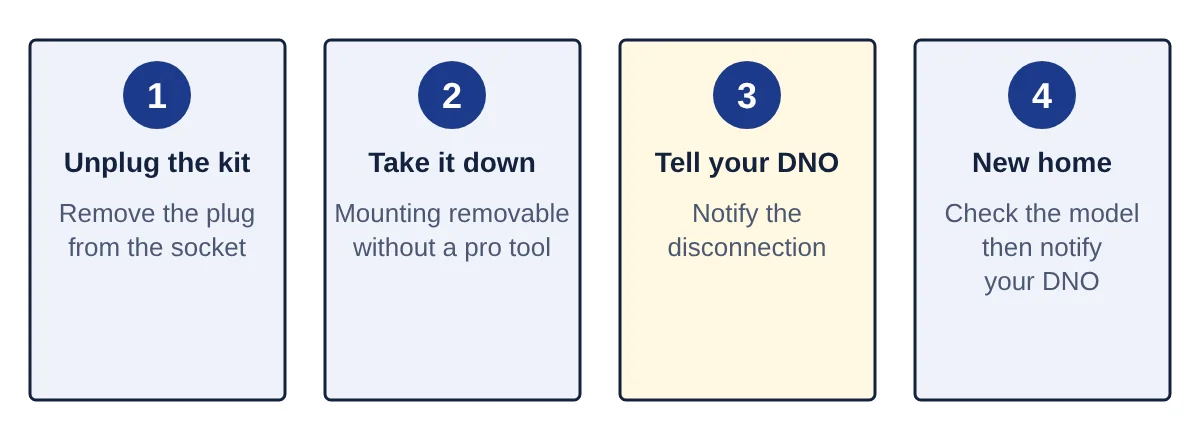
Taking the kit down safely
The specification requires the module to be removable from the mounting system the manufacturer provides, without a professional tool. It also requires the mounting to be supplied with the kit. Keep the brackets, fixings and cable with the panels so nothing is lost in the move.
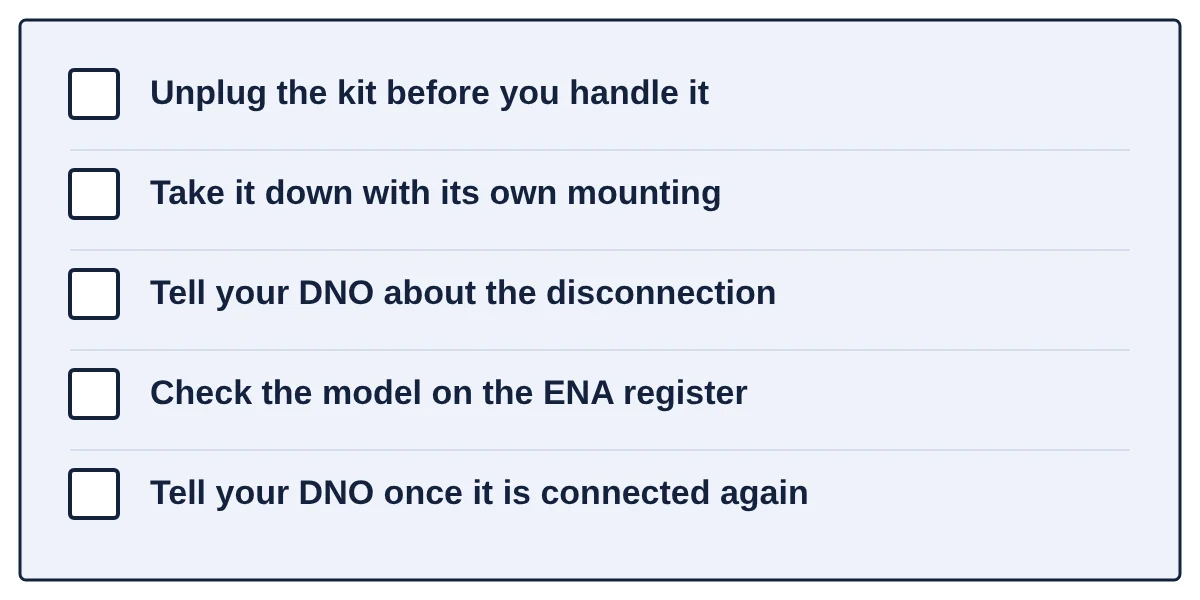
- Unplug the kit from the socket before you touch the panels, the cable or the microinverter.
- Remove the panels from the mounting, following the order in the manufacturer’s instructions.
- Store the parts somewhere dry, with the cable coiled.
- Tell your DNO that the kit has been disconnected.
Note the date you disconnected the kit, and keep a copy of your notification with your paperwork, as you would for any installation record.
Making good the fixings
Once the kit is off, you are left with holes and marks on the wall, the railing or the balcony. Fill the fixing holes with a filler suited to the surface, and check the fixing points for damage before you leave. If you rent, check your tenancy terms before you make any repair, and read our guide to renters and leaseholders to see how permission works.
If an outdoor socket was fitted for the kit, leave its removal or any change to a qualified electrician. Our outdoor socket guide explains the IP rating and the fitting rules.
Setting it up at your new home
- Check the model. Look up the exact make and model on the ENA Type Test Register. A device must be on that register before it is sold. The register changes often, so check it on the day you reconnect.
- Plug it in directly. The specification requires a BS 1363 plug that goes straight into a BS 1363 socket. Extension leads and adaptors are not allowed.
- Check the wiring. Read our guide to electrical checks for plug-in solar before you connect the kit to a home with older wiring.
- Notify your DNO. Tell your DNO about the new connection, using the address where the kit is now installed.
The Ofgem decision allows one plug-in device per customer installation. If the new home already has a kit, a second device falls outside those rules.
Common mistakes
- Forgetting to notify your DNO when the kit comes off.
- Assuming the notification from your old address covers the new one.
- Reconnecting a kit without checking its model on the ENA register.
- Using an extension lead or adaptor at the new home.
- Leaving the kit partly fixed to the building after it has been disconnected.
Where to go next
Whether you move or stay, the basics do not change: one compliant device, a standard socket, and notification at every connection and disconnection. For the wider picture, read whether plug-in solar is legal in the UK and our plug-in solar guide. If you are still choosing a kit, our guide to checking a kit is legal shows how to match the model to the register.
Frequently asked questions
Can I take plug-in solar with me when I move?
Yes. The DESNZ specification requires the module to come off the mounting system supplied with the kit without a professional tool, so the kit is built to be moved.
Do I need to tell my DNO when I take the kit down?
Yes. The specification makes notification to the distribution network operator mandatory for disconnection as well as connection, so tell your DNO when the kit comes off.
Do I need to notify my DNO again at my new home?
Yes. Connecting the kit at a new address is a new connection, and the same mandatory notification applies. Check the exact model on the ENA Type Test Register before you reconnect it.
How long do I have to notify my DNO after I move?
The Ofgem decision does not set a deadline in days. The London Fire Brigade advises telling your DNO within 28 days of installation.
Can I use the kit at my new home with an extension lead?
No. The specification does not allow extension leads or adaptors, so the kit must plug directly into a standard socket.
Does the 800 VA limit still apply at my new home?
Yes. The specification sets an output limit of 800 VA, and the Ofgem decision allows one plug-in device per customer installation, which in practice means one per household.