Plug-in Solar Landlord Permission: Email Template and Checklist
Ask your landlord or freeholder for plug-in solar permission with a ready email template and a checklist of documents to attach. Get the answer in writing.
Some links are affiliate links: if you buy through them we earn a small commission at no extra cost to you. It does not change our recommendations.

Ask your landlord or freeholder for written permission before you buy a plug-in solar kit. The kit rules cover the product, but they do not give you the right to fix anything to the building. Send a short email that names the kit and the fixing, attach the documents they will want, and keep the written reply.
What you are asking for, and why
You are asking the person who controls the building for consent to fit a device to it. The GOV.UK guidance on plug-in solar says landlords, freeholders and other parties may need to give permission. The London Fire Brigade also advises that renters contact their landlord, housing provider, freeholder or property management company before buying or installing any plug-in solar equipment.
Your request should answer three questions for them: what the device is, where it would go, and what happens when it is removed.
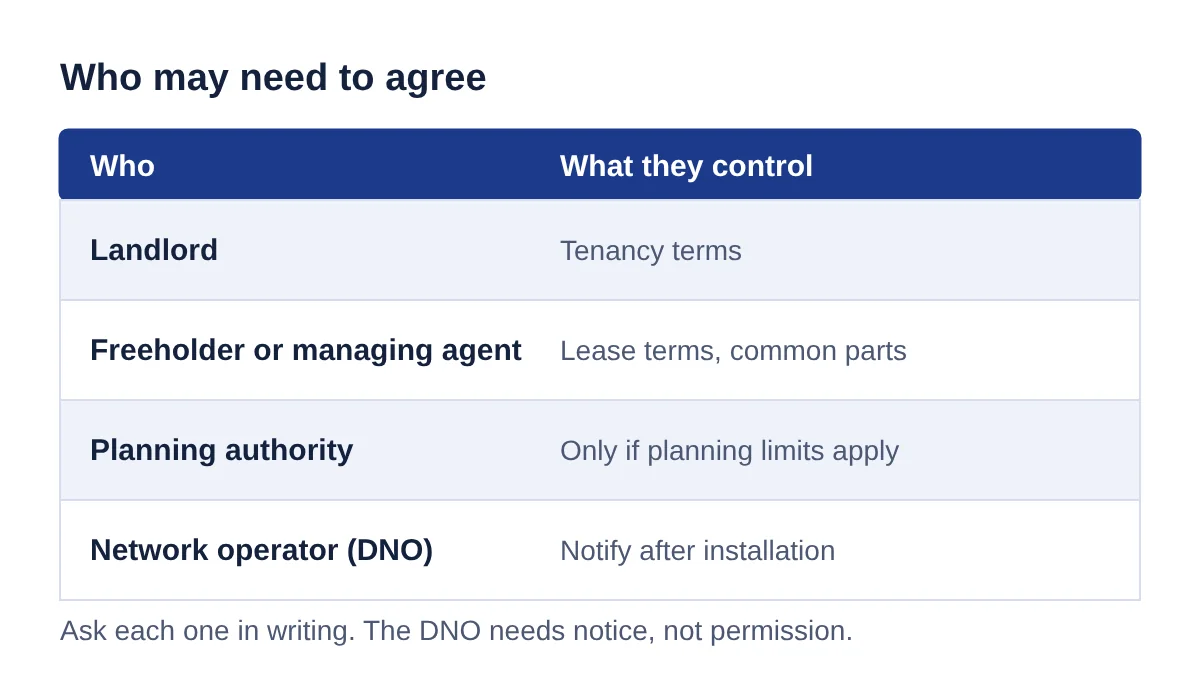
What a landlord or freeholder will worry about
Most objections are about the same few things:
- Fixings. Will the kit or bracket damage the wall, railing or balcony?
- Fire safety. Will the panel block an escape route or sit on a wall that divides two homes?
- Insurance. Will the building’s insurance still apply?
- Removal. Who takes the kit down, and who repairs any damage?
A written answer to each of these makes a yes easier.
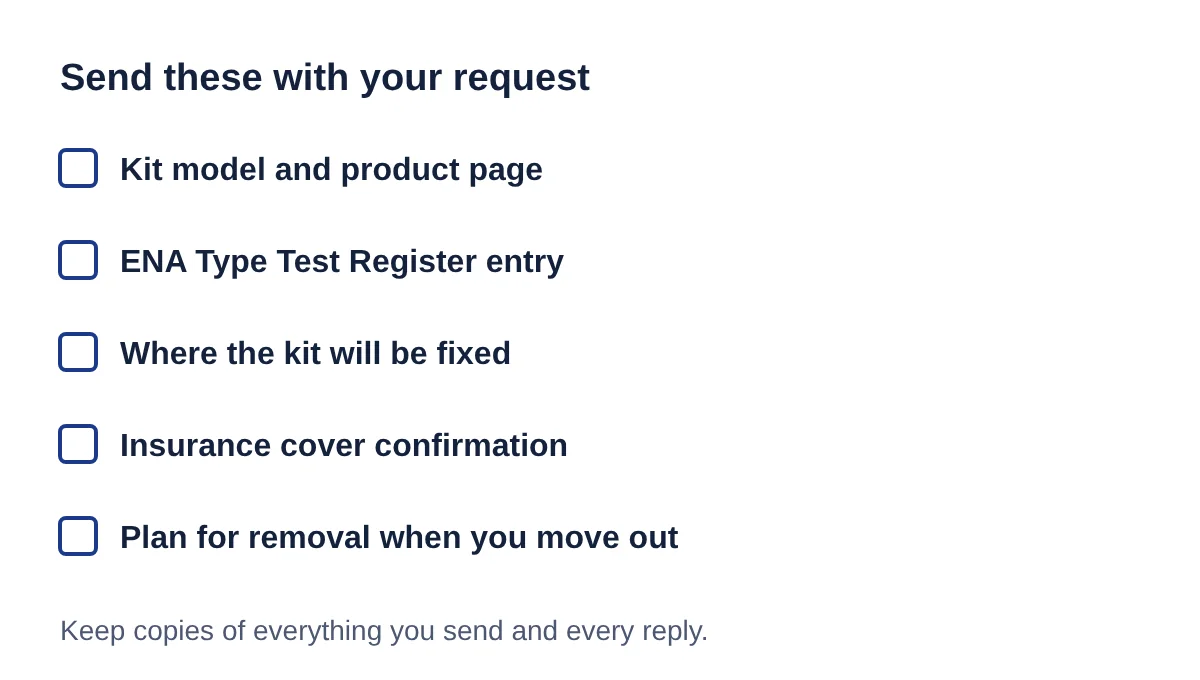
Attach these documents
Include these with the email:
- The product page, showing the manufacturer, model and rated output.
- The ENA Type Test Register entry for that exact model. See our guide to checking a kit is legal.
- A description of the fixing, with a photo of where it would go.
- Your planning position, if any planning limits apply. The General Permitted Development (England) Amendment Order 2026 (S.I. 2026/896) sets projection limits for walls and balconies, and bars plug-in solar on certain listed or timber surfaces. Our planning permission guide explains the limits.
- Confirmation of your insurance, or a note that you will check it. Read our guide to plug-in solar and home insurance.
- A removal plan: who takes the kit down when you move out, and how any damage is repaired.
Email template
Copy and adapt this text. Replace the square brackets.
Subject: Request for permission to fit a plug-in solar kit
Dear [name],
I would like to fit a plug-in solar kit at [address]. The kit is the [manufacturer and model], which is listed on the ENA Type Test Register. It would be fixed to [railing, wall or balcony] using the mounting set recommended by the manufacturer, and it would plug into a standard socket inside the flat.
I have attached the product page, the register entry, and a description and photo of the fixing. I will remove the kit at the end of my tenancy, at my own cost, and I will repair any damage. I will also notify the network operator after installation.
Could you confirm in writing whether this is acceptable under [my tenancy agreement / the lease]? If you have any conditions, please let me know.
Kind regards, [your name]
Change the removal sentence if your agreement already sets out who pays. Keep the reply.
If they say no, or do not reply
Ask for the reason in writing. A concern about fixings or appearance can sometimes be answered with a different mounting point or a revised proposal. A clause in a lease that forbids alterations usually stands unless the lease is changed.
Do not install the kit without the consent you need. Doing so may breach your tenancy or lease, and it may affect how your insurer treats a claim.
When the lease needs a licence for alterations
Leaseholders often need the freeholder’s consent for any alteration to the outside of the building, including balconies and railings. Some leases also require a licence for alterations. Read the lease first, then send the request to the freeholder or managing agent in writing.
For the wider rules on tenancies and leases, read our guide to plug-in solar for renters and leaseholders. If you are unsure whether the kit is legal to use at all, see whether plug-in solar is legal in the UK.
Frequently asked questions
Can my landlord refuse plug-in solar?
Yes. The kit rules do not decide consent. Your tenancy or lease does, so a landlord who says no to fixings on the building can refuse. Ask for the reason in writing.
Do I need permission to install plug-in solar in a rented flat?
Check your tenancy first. If it covers alterations, fixtures or the outside of the building, get your landlord's written agreement before you buy or install.
What if my freeholder says no?
Ask what the objection is and whether a different fixing would be acceptable. If the lease forbids alterations, the freeholder's answer usually stands unless the lease is changed.
Do I need to tell my insurer?
Check your policy wording and ask your insurer in writing before you install. Keep the reply with your other documents.
Who pays for removal when I move out?
Your agreement should say. The kit rules do not set this, so agree it in writing before installation and keep the reply.