Plug-in Solar Battery UK: Can You Add One? Rules and Outlook
You cannot add a battery to a UK plug-in solar kit under the current rules. What the specification says, what DESNZ is studying and your options today.
Some links are affiliate links: if you buy through them we earn a small commission at no extra cost to you. It does not change our recommendations.
No. Under the rules that have applied in Great Britain since 27 August 2026, you cannot add a battery to a plug-in solar kit. The change that made plug-in solar legal leaves battery storage out, and the specification says the device is not meant to be used with a battery. The government has put out a tender for a safety study of plug-in batteries, but no decision on battery rules has been made.
What the rules say about batteries
The specification sets out what a plug-in kit must meet. It answers the battery question in two places:
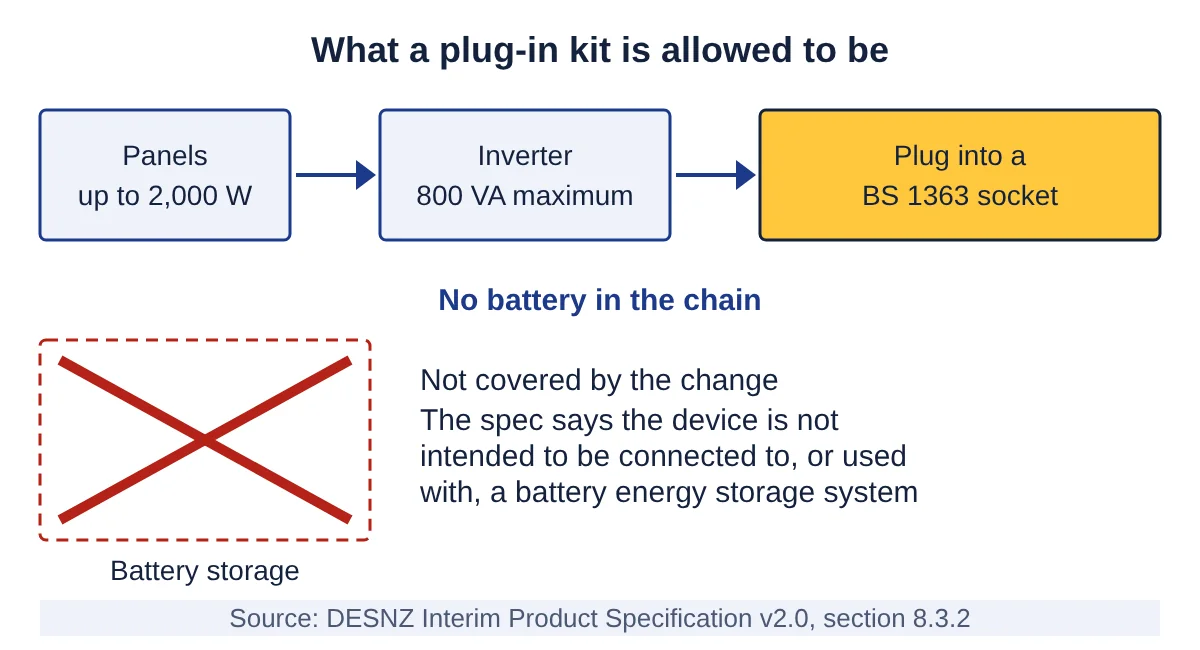
- Scope. Section 1 excludes “plug-in solar PV devices integrated with battery systems” from the specification.
- Warning. Section 8.3.2 requires a prominent warning that the device “is not intended to be connected to, operated with, or used in conjunction with a battery energy storage system.”
The London Fire Brigade gives the same practical advice: it recommends that you do not connect plug-in solar panels to batteries to store energy for later use.
Why batteries are left out for now
The plug-in route works because a small kit feeds a standard socket, with its output capped at 800 VA. A battery adds stored energy, charging and discharging inside the home, and that brings a different set of risks.
ESS News reports that battery storage missed out on the regulation change for 800 W kits, and that Great Britain’s electricity rules set high standards for battery installations. The London Fire Brigade also advises keeping combustible materials away from panels, batteries, inverters and electrical connections. Those two points explain why batteries are treated as a separate question.
What DESNZ is studying
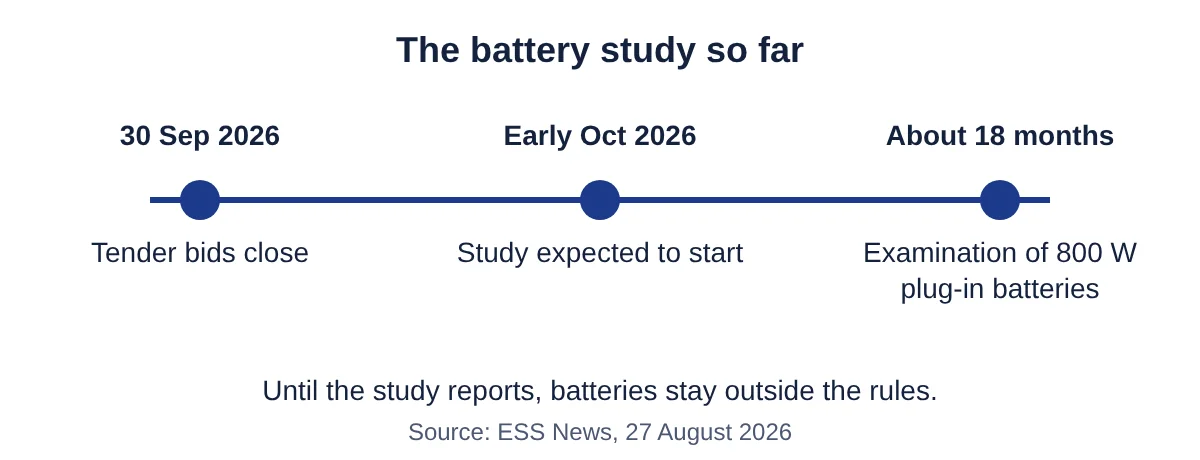
According to ESS News, the tender covers:
- A safety and risk assessment for deploying 800 W AC mains output plug-in batteries.
- Plug-in, self-installed batteries that are already on the market worldwide. Germany’s VDE standards are cited as a reference point.
- A timetable in which bids were due by 30 September 2026, the study was expected to start in early October 2026, and the examination runs for about 18 months.
- Recommendations for technical and regulatory adaptations, if the study supports them.
ESS News says battery regulations “may follow, however”. It does not give a date, so do not plan around one.
What you can do today
- Use the kit without storage. The panels feed the household wiring while they produce power. Running higher-use appliances during sunny hours is the simplest way to get more from them.
- Check the kit before you buy. A compliant kit needs an 800 VA limit, a BS 1363 plug and a listing on the ENA Type Test Register. Our ENA register guide explains how to check.
- Consider a fixed system if you want storage. The Energy Saving Trust describes rooftop systems as professionally installed, permanent and more expensive, but able to generate more energy. Compare the two routes in plug-in solar vs rooftop solar.
Common mistakes
- Buying a battery kit from abroad. Kits sold in other countries may include a battery or a plug that does not meet the UK rules. Read whether plug-in solar is legal in the UK before you buy.
- Using an adaptor to make a battery fit. The specification bans extension leads, multi-way adaptors and travel adaptors, so this does not solve anything.
- Buying a battery now to save time later. Nothing in the current rules lets you connect one, and no date has been set for a change.
For the full picture of what a legal kit looks like, start with our plug-in solar guide and the best plug-in solar kits.
Frequently asked questions
Can I add a battery to plug-in solar in the UK?
Not under the current rules. The change that made plug-in solar legal in Great Britain from 27 August 2026 does not cover battery storage, and the specification says the device is not intended to be used with a battery energy storage system.
When will plug-in solar batteries be legal?
No date has been set. DESNZ has tendered a safety study of 800 W plug-in batteries, expected to take about 18 months from early October 2026. Battery rules may follow, but nothing has been decided.
Can I buy a kit with a battery from abroad?
Not for use under these rules. A kit with a built-in battery is outside the plug-in rules, and kits sold abroad often have a plug that does not meet the BS 1363 requirement.
What happens if I connect a battery anyway?
Do not do it. The London Fire Brigade advises against connecting plug-in panels to batteries to store energy, and the specification says the device is not intended to be used with battery storage.
Is a fixed solar system with a battery allowed?
That is a different route from plug-in solar. A permanent, professionally installed system is not covered by the plug-in rules, and the Energy Saving Trust says rooftop systems are professionally installed, permanent and more expensive.
Should I wait for battery rules before buying a kit?
You can buy a compliant kit today without a battery. Check that it is on the ENA Type Test Register and that it has no battery, and plan storage only if the rules change.
Sources
- DESNZ – Plug-in Solar Device Interim Product Specification v2.0 (July 2026)
- ESS News – UK explores plug-in battery regulations following balcony solar launch (27 August 2026)
- London Fire Brigade – Plug-in solar panels: safety advice for residents and homeowners
- Energy Saving Trust – Plug-in solar panels