How to Choose a Plug-In Solar Kit in the U.S. (2026 Checklist)
No single kit suits everyone. Use this 2026 U.S. checklist to compare plug-in solar kits by output cap, UL listing, state law and mounting.
Some links are affiliate links: if you buy through them we earn a small commission at no extra cost to you. It does not change our recommendations.

No single plug-in solar kit is the best for everyone. The right one has an output at or below 1,200 watts, carries a UL or equivalent listing, is legal where you live and fits your mounting space. Start with that checklist, then compare the kits you can find on those points.
What to check before you buy
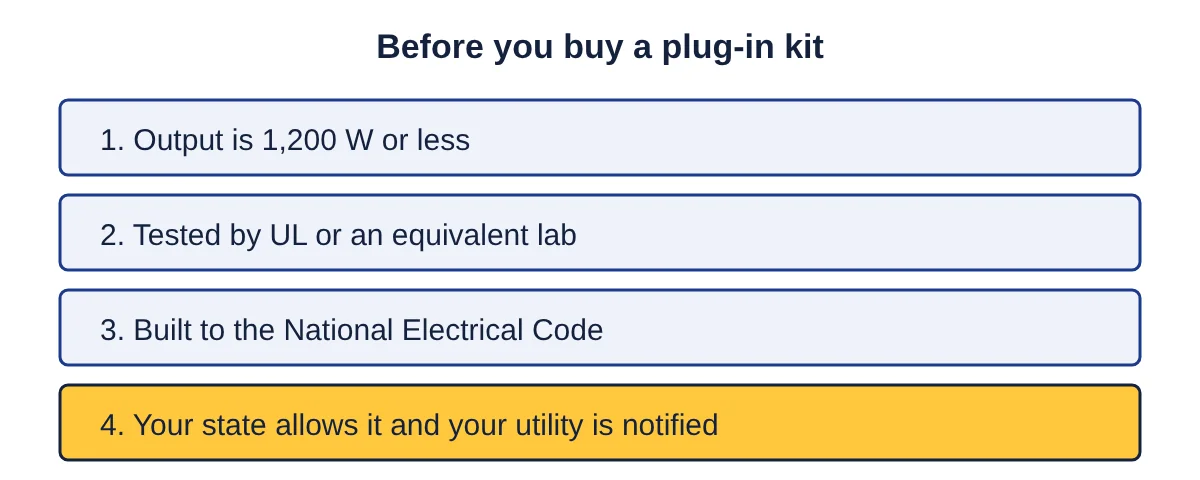
Use this list for every kit you consider:
- Output cap. The kit should be rated at 1,200 W or less, the limit in the Utah and Maryland laws.
- Safety listing. Look for UL or an equivalent nationally recognized testing laboratory.
- Code compliance. Utah’s law requires a portable solar generation device to meet the most recent version of the National Electrical Code.
- State and utility. Confirm your state’s rules, and in Maryland notify your electric company before installation.
- Mounting. Check whether the kit’s mounts suit your railing, wall or ground space, and whether the maker’s instructions cover your setup.
The Maryland 391 W exemption
Maryland exempts devices with a maximum output of 391 W or less from listing requirements that would change a building’s wiring or electrical panel. A kit above that figure falls under the full rules.

Why headline wattage can mislead
A kit with panels rated above 1,200 W may still have an inverter output that is limited to 1,200 W. The state laws cap the device’s output, not the panel rating alone, so read the output specification on the product page and in the manual. If the kit’s output is above the cap, it is not a qualifying device in Utah or Maryland.
Where to look for kits
Plug-in kits are sold by manufacturers and retailers, and some are listed on Amazon. Use this search link as a starting point, then check the listing and output rating on each product page:
Search on AmazonPrices change often, so check the seller’s page for the current price before you decide.
Battery add-ons
A battery is a separate question from the output cap and listing. Read plug-in solar with a battery before you consider one, and check your state’s rules for any battery-linked device.
Mistakes to avoid
- Buying on headline wattage without checking the output cap.
- Skipping the safety listing check.
- Buying a kit designed for another country’s plug and voltage.
- Installing in Maryland without notifying your electric company.
- Choosing a kit that does not suit your railing, wall or ground space.
Sizing a kit to your use
Start with your own use, not the kit’s rating. Your electricity bill shows how much you use each month in kilowatt-hours, and daylight use is the part a balcony kit is most likely to offset. Compare the kit’s output in watts with the daytime load you want to cover, such as a refrigerator or a router during the day.
A kit is a supplement. It will not cover a home’s full load, so choose the size that suits your space, your lease and your state’s cap, rather than the largest kit you can mount.

Trade-offs between kits
A smaller kit near the cap is easier to mount and move, but it produces less power. A larger kit close to 1,200 W can cover more of your use on a sunny day, but it needs a stronger mount and more careful placement. Renters often choose the smaller option for flexibility. Neither choice removes the need for a listing and a state check.
What the listing should show
A complete listing shows the output in watts, the certifying laboratory, the state or states of sale and the warranty. If one of these is missing from the product page, look for it in the manual or the certificate before you buy. A listing that names a standard without naming the laboratory is not enough to check.
Maintenance over time
Check the mounts after strong wind, keep the panels clear of debris and inspect the cable for wear regularly. If the cable or the outlet gets hot, unplug the kit and have a licensed electrician check it before you use it again.
Before you commit
Once you have a short list of two or three kits, check each one against your state’s law and your utility’s rules again on the day you buy. A kit that qualified last year may not match a law that has since changed. Keep the listing, the specification sheet and the seller’s answers together in one folder, so you can show them to your utility or your landlord if they ask.
Questions to ask the seller
Before you buy, ask the seller or check the product page for these answers:
- What is the maximum output in watts, and is it at or below 1,200 W?
- Which testing laboratory certified the product, and under what listing?
- Which states is the kit sold in, and does its documentation mention your state’s law?
- What does the warranty cover, and who handles returns if the kit fails a check?
- Does the kit come with mounts for your railing, wall or ground space?
If a seller cannot answer these questions in writing, treat that as a reason to look at another kit.
How to compare two kits
Put the two kits side by side and answer the same five questions for each: the output cap, the listing, the state where it is sold, the mounting method and the manufacturer’s warranty terms. The kit that answers all five clearly is usually the safer choice.
For the safety standard behind the listing, read UL 3700 explained. For the basics, see what balcony solar is and the state laws.
Frequently asked questions
What is the best plug-in solar kit?
The best kit is the one that stays within your state's output cap, carries a UL or equivalent listing and suits your mounting space. No single kit fits every home, and prices change, so this page does not name a winner.
Which plug-in solar kits are UL certified?
Check the certification on the product itself or in the maker's listing records. A claim on a product page is not enough on its own, so look for the testing laboratory and the listing number.
Can I buy plug-in solar on Amazon?
Some kits are sold on Amazon. Use the search link in this guide, then confirm the listing and output rating on the product page before you buy.
Is a 1,200 W kit allowed everywhere?
No. Utah and Maryland allow up to 1,200 watts. Other states may have different rules or no rule yet, so check your state first.
What is the Maryland 391 W exemption?
In Maryland, a device with a maximum output of 391 watts or less is exempt from listing requirements that would change the building's wiring or electrical panel. Larger devices follow the full rules.
Do I need an electrician to install a plug-in kit?
Check your state's rules and your electric company's requirements. In Maryland you must notify the electric company before installation. For questions about your home's wiring, ask a licensed electrician.