Balcony Solar vs a Solar Generator (Power Station): Which Fits Your Home?
A plug-in kit feeds your home wiring and must shut off in an outage. A power station stores energy for its own outlets. Compare them before you buy.
Some links are affiliate links: if you buy through them we earn a small commission at no extra cost to you. It does not change our recommendations.

A plug-in solar kit and a solar generator (power station) look alike, but they do different jobs. A kit feeds the wiring of your home so that daytime appliance use is covered by solar power. A power station stores energy in a battery and gives you outlets of its own. Choose the kit to lower your daytime bill, and the power station for outages and portable use.
Two products that look alike
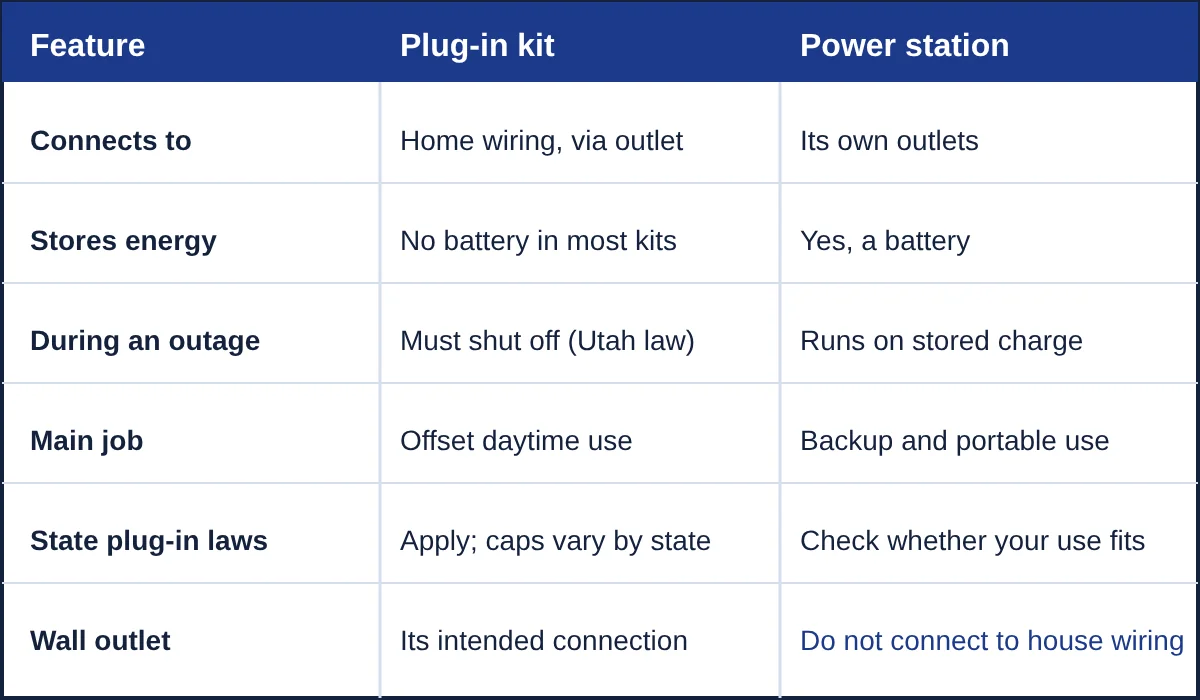
A plug-in kit has one or more panels, a microinverter and a plug. Its output goes into the house wiring, where your appliances draw it. It has no battery in most kits.
A power station is a battery with inverters and outlets built in. It can take charge from a wall socket or from solar panels, and it powers devices from its own outlets. Its output does not need to enter your home wiring.
How each one saves money
The kit saves money on what your home uses while the panels produce. The savings depend on how much your home uses in daylight, and the extra power does not earn a net metering credit under the laws covered in our net metering article. For the numbers, read how much balcony solar can save by state.
A power station reduces your grid use only when you use its stored energy in place of grid power. It does not feed your house circuits, so you have to plug devices into it directly.
Blackout use
This is the clearest difference. Utah’s law requires a qualifying device to prevent energizing the building’s electrical system during a power outage. A plug-in kit therefore does not keep your home running when the grid is down. For the details, read does plug-in solar work during a power outage.
A power station works without the grid, as long as it has charge. Its stored energy is limited, so plan the devices you need and the hours you need them.
Legal status
The state laws described in the state guides describe a device that connects to a building’s electrical system through a standard 120-volt outlet, with caps that vary by state: 1,200 watts in Utah, Vermont and New Jersey, and 1,920 watts in Colorado. Utah’s definition is the clearest example. A power station used through its own outlets is a different product from the one these laws describe. Check your state’s rules for the way you plan to use it. The map of state laws is in is balcony solar legal in your state.
How to compare the cost
Prices vary too much to compare here. Use a simple method instead: divide the price of each product by the energy you expect it to deliver over its life, then compare the result with what you pay your utility for the same energy. Then add what matters to you: outage power, portability and the state rules that apply.
Who should buy which
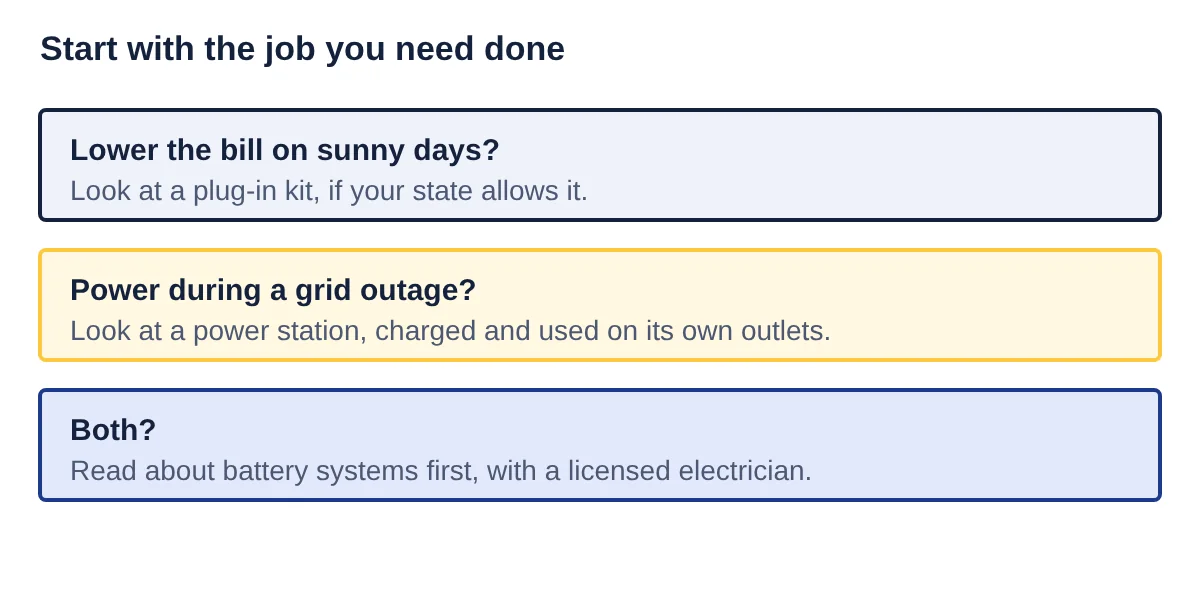
- A plug-in kit fits a renter or homeowner who wants to offset daytime use, lives in a state with a plug-in law, and does not need power in an outage.
- A power station fits anyone who wants outage power, camping or a portable supply, and who does not need the device to feed the wiring.
- A battery system is the choice when you want both. Read plug-in solar with a battery before you decide, and ask a licensed electrician about any connection to your home.
Common mistakes
- Plugging a power station into a wall outlet to feed the house. Do not do it. Power flowing back through an outlet is the risk UL and IAEI describe.
- Expecting a kit to work in an outage. Under Utah’s law, the device must shut off.
- Comparing watts with watt-hours. Watts describe how fast power flows. Watt-hours describe how much energy is stored or produced.
- Buying a kit for backup. A kit depends on the grid. A power station keeps working on its battery.
If you want to see what kinds of power stations are sold, search the U.S. store for Search on Amazon. Check the manufacturer’s specifications before you buy, because the listing title and the spec sheet can differ.
Frequently asked questions
Can I plug a solar generator into a wall outlet?
Do not connect a power station to your home's wiring to feed the house. Feeding power back through an outlet is the risk UL and IAEI describe for plug-in equipment. Use the power station's own outlets for your devices.
Is a power station better for an apartment?
It depends on the job. A power station works on its own, without a grid connection, and suits outages and portable use. A plug-in kit is built to offset daytime use, and its use is governed by state laws.
Which works in a blackout?
A power station can run devices from its stored charge. A plug-in kit must shut off during an outage under Utah's law, so it does not power the home when the grid is down.
Do I need a law to use a portable solar panel?
Plug-in solar laws describe devices designed to connect to a building's electrical system through a standard 120-volt outlet. A panel that charges a power station on its own is a different use. Check your state's rules for the way you plan to use it.
Which one saves more on my bill?
A plug-in kit saves on daytime use that would otherwise come from the utility. A power station saves only when you use its stored energy in place of grid power.
Does a power station work during a blackout?
Yes, while its battery holds a charge, because it does not depend on the grid. How long it runs depends on its capacity and on the devices you connect.