Buying a Plug-In Solar Kit on Amazon: 9 Red Flags Before You Click
Before you buy a plug-in solar kit on Amazon, check the inverter's AC output, your state's watt cap, a UL listing you can look up and the plug type.
Some links are affiliate links: if you buy through them we earn a small commission at no extra cost to you. It does not change our recommendations.

Some plug-in solar kits sold on Amazon may be well built, but a listing alone does not show that a kit is legal in your state or certified. Before you compare prices, check the inverter’s AC output against your state’s cap, look for a UL listing you can find yourself, and confirm the plug fits a 120-volt U.S. outlet.
Why listings need extra checks
A product page is written to sell. Its headline may show the panel total, a generic safety claim or a reference to a utility that a state law does not require. None of that tells you whether the device meets the law where you live. The checks below are the ones the laws and safety guidance name.
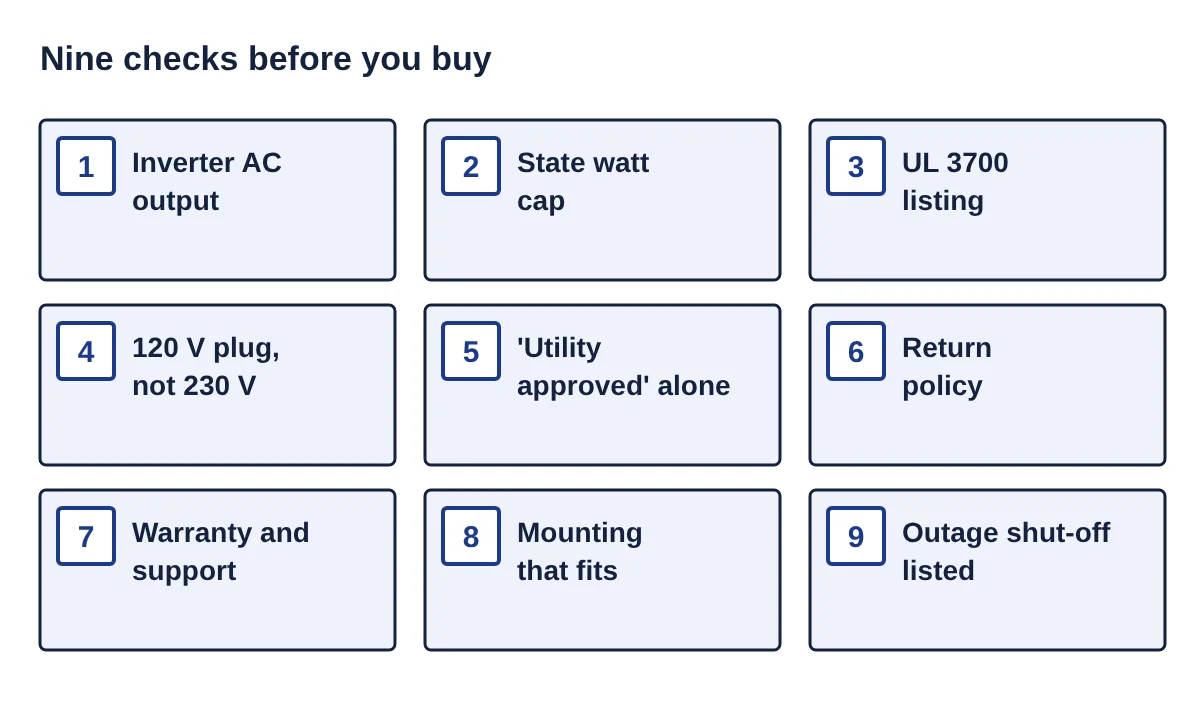
The nine red flags
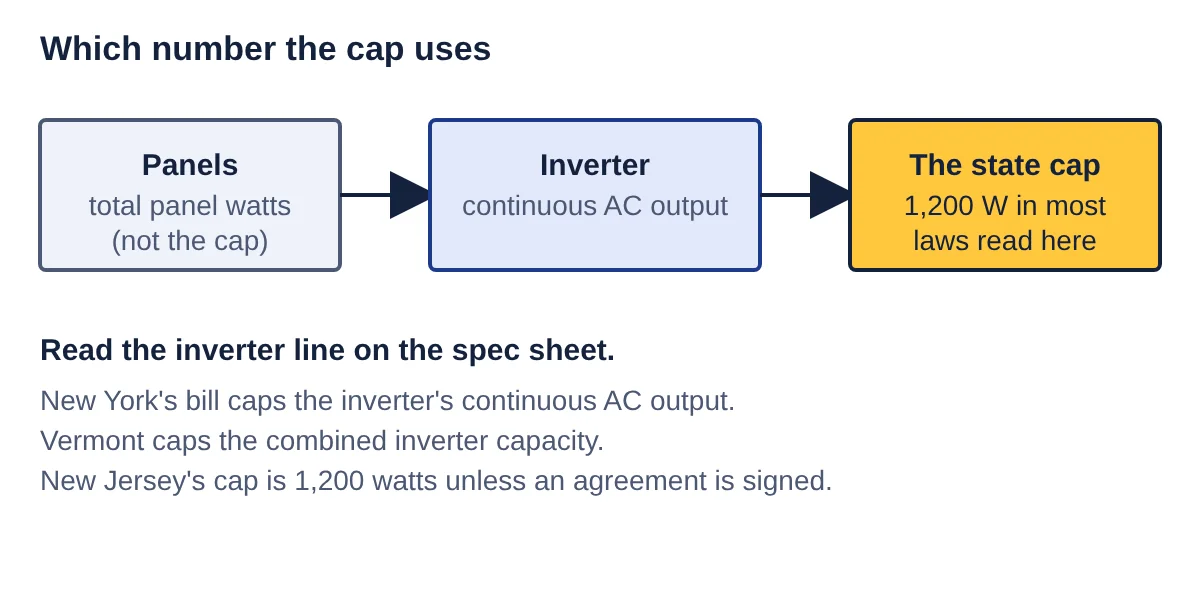
- Panel watts shown as system watts. The cap is set on the inverter’s output. The New York bill limits the “aggregate continuous AC inverter nameplate output,” and Vermont’s act limits the “combined inverter capacity.” A large panel total with a small inverter is not a problem by itself, but the inverter line is the number to compare.
- More than your state’s limit. Utah, Vermont and New Jersey set 1,200 watts, and the New York bill does the same. Colorado’s law sets 1,920 watts. New Jersey allows more only with an interconnection agreement. A kit above the cap for your state is a red flag.
- No listing you can check. UL 3700 is an Outline of Investigation, and UL lists products under a category of its own. If the page only says “compliant,” ask the seller for the listing of that exact model.
- 230-volt or European plugs. Schuko-style plugs with round pins are made for 230-volt grids. Utah’s law describes a device for a standard 120-volt outlet. A kit built for 230 volts does not match that outlet.
- “Utility approved” as proof. In Utah, a utility may not require approval before you install a qualifying device. A “utility approved” badge therefore proves nothing about the device.
- No clear return policy. If you cannot return a kit that fails a check, do not buy it.
- Thin warranty or support. Look for a named warranty period and a way to reach the maker. Without either, you have little recourse if the kit fails.
- Mounting parts that do not fit. Check the railing or wall mount before you click. See balcony solar mounts for the options.
- No outage shut-off in the documentation. Utah’s law requires the device to prevent energizing the building during an outage. The manual should say how the product does that.
How to find a UL listing
UL Solutions lists plug-in PV products under the category “Plug-In Photovoltaic – PIPV – Equipment and Systems,” with the code ODCZ. The IAEI column says the category is in UL’s Product iQ database.
- Open UL’s Product iQ database and search the category above.
- Find the manufacturer, then the model number, and match it to the kit’s label or manual.
- If the model is not there, the kit is not listed. Do not rely on the seller’s word.
UL 3700 is the outline that UL uses to test these products. As UL announced in January 2026, its framework covers testing and certification for plug-in solar. A model that is not listed yet may be listed later, so check again before you buy.
Black Friday and the deals
A deal does not change the checks. Run the nine checks first, then compare prices only among kits that pass. A low price on a kit that fails check 2 or 3 is not a saving.
For the kinds of products that fit the law, read the best plug-in solar kits. For the safety rules, read is plug-in solar safe.
Common mistakes
- Buying on the panel total. Compare the inverter’s AC output.
- Believing a badge. “Compliant,” “approved” and “certified” are not the same as a listing you can look up.
- Skipping the state check. The same kit can be fine in one state and not in another. Check your state’s rules first, with the map in is balcony solar legal in your state.
- Buying a European kit. Its plug and voltage are for another grid.
If you want to see what plug-in kits are sold, search the U.S. store for Search on Amazon, and run the checks above before you buy.
Frequently asked questions
Are Amazon plug-in solar kits legal?
The listing does not make a kit legal. Legal use depends on your state's law, the kit's output and its certification. Check the state rules and the listing of that exact model before you buy.
How do I know a kit is UL certified?
Search UL's Product iQ database for the product under the category Plug-In Photovoltaic, PIPV, Equipment and Systems, ODCZ. A claim such as UL 3700 compliant on a page is not a listing.
Can I use a European balcony kit in the U.S.?
Not as sold for Europe. European kits use 230-volt plugs and grids, and U.S. outlets are 120 volts. Look for a kit made for 120 volts with a plug that fits a U.S. outlet.
Is a cheap kit worth it?
Only if it passes the checks. A low price on a kit with an inverter above your state's cap, no listing or a 230-volt plug is not a saving you can use.
Which watt cap applies to my kit?
Use the law of the state where you live. The state laws described here set 1,200 watts in Utah, Vermont and New Jersey, and 1,920 watts in Colorado. The New York bill sets 1,200 watts and is not yet law.
What should I ask the seller before I buy?
Ask in writing for the model's UL listing, the inverter's AC output rating, the plug type and how the product shuts off during a grid outage. A seller who cannot answer these questions is a red flag.
Sources
- IAEI Magazine – UL Question Corner: Safety considerations for plug-in PV systems (July 1, 2026)
- UL Solutions – testing and certification framework for plug-in solar (January 8, 2026)
- Utah Legislature – HB 340 (2025), enrolled copy
- New Jersey Legislature – S2368, third reprint
- Vermont General Assembly – Act 149 (S.202), as enacted, 2026