Plug-in Solar vs Portable Power Station: Which Is Legal to Use?
Plug-in solar and a portable power station are different products. Learn which one suits a blackout, a bill or a campsite, and what the UK rules say.
Some links are affiliate links: if you buy through them we earn a small commission at no extra cost to you. It does not change our recommendations.

A plug-in solar kit and a portable power station are different products. A plug-in kit is a grid-connected device that feeds solar power into a socket circuit. A power station is a battery that you charge and use away from the mains. The interim specification covers the first; the second is not a plug-in device, and it should never be plugged into a wall socket to feed your home.
Two products with the same word “solar”
The confusion starts with the name. Both products are sold online as “solar”, and both can be used outdoors. Their rules are different because one is connected to your home wiring and the other is not.
A plug-in kit is designed to run alongside your supply. A portable power station stores energy and supplies its own sockets. Mixing the two through a wall socket is the mistake to avoid.
The grid-connected plug-in kit
The Interim Product Specification v2.0 sets the rules for a plug-in device. It must be used on a socket circuit, with a maximum of one inverter of up to 800 VA per household circuit. The inverter disconnects from the mains within 100 ms if the supply is lost. That is why a plug-in kit does not keep your lights or sockets on in a cut.
The specification also says a plug-in device is not intended to be connected to, operated with, or used in conjunction with a battery energy storage system. A kit that pairs solar with a battery is therefore outside what the specification describes.

The portable power station
A portable power station is a battery with its own outlets. You can charge it from a socket or from another source, then use it for devices away from the mains. It does not connect to your home circuit, so the plug-in device rules for grid-connected kits do not describe it.
It is still a battery, so use it as the manufacturer says. Keep it dry, ventilated and away from heat. Do not plug its output into a wall socket to feed the house, and do not treat it as a substitute for a properly wired supply.
Which suits which job
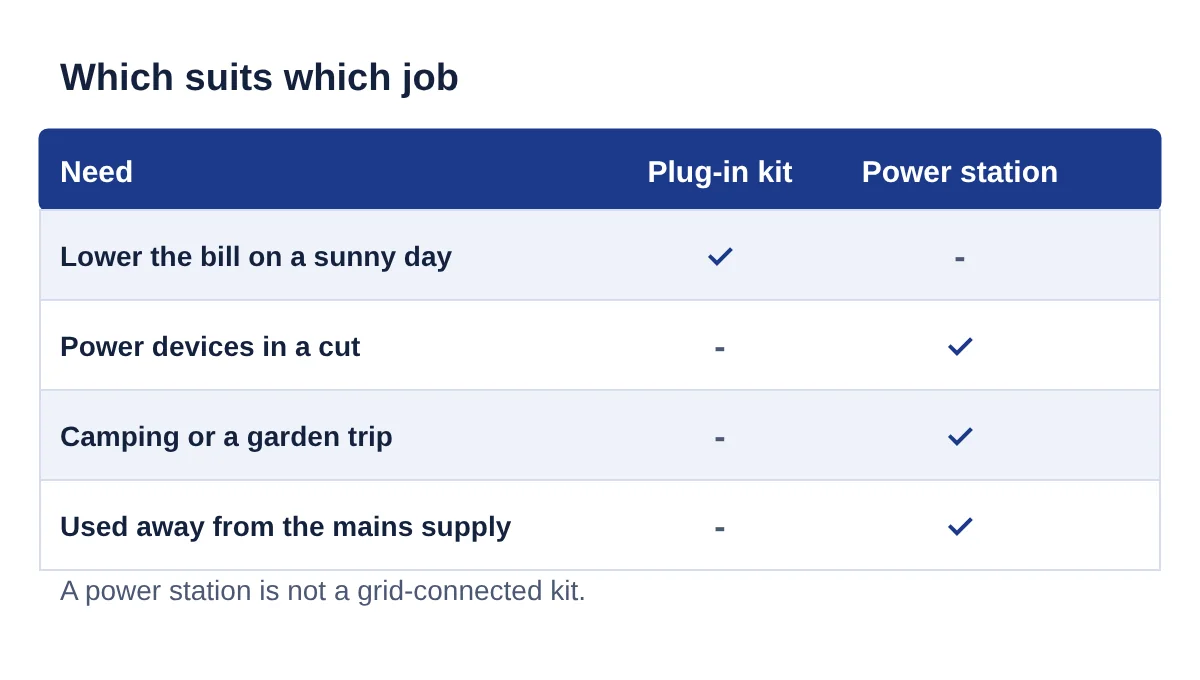
Use the table to match the product to the job. The plug-in kit is for lowering what you pay for electricity on a sunny day. The power station is for power that does not depend on the grid.
If you want to know what a plug-in kit saves, see our guide to how much plug-in solar saves in the UK. For the blackout question, read whether plug-in solar works in a power cut.
Common mistakes
- Plugging a power station into a wall socket. Its output is not a mains supply, and connecting it this way can be dangerous.
- Buying a battery kit as a plug-in solar kit. A product that pairs solar with a battery is outside the plug-in device rules.
- Expecting a plug-in kit to run the fridge in a cut. It stops when the supply stops.
- Comparing prices alone. The two products do different jobs, so compare them by use.
Can you add a battery to a plug-in kit?
The specification does not allow a plug-in device to be connected to a battery energy storage system. If you are considering a battery, read our guide to plug-in solar battery rules in the UK before you buy.
To see which kits are listed for the UK, read our guide to the best plug-in solar kits, and check the register entry for the exact model you want.
Frequently asked questions
Can I plug a portable power station into a wall socket?
Use a socket to charge it, not to feed the house. Do not connect the power station's output to a wall socket, because that is dangerous for you and for anyone working on the supply.
Is EcoFlow plug-in solar legal in the UK?
Check the register entry and the manufacturer's UK documents for the exact model. The interim specification does not allow a plug-in device to be connected to a battery energy storage system, so a product that pairs solar with a battery is outside that category.
Can I run my fridge in a blackout with a power station?
It depends on the power station's usable capacity and the fridge's consumption, which are both on their labels. Compare them before you rely on it.
Is a portable power station covered by the plug-in solar rules?
No. The interim specification covers plug-in devices that connect to the home through a socket. A standalone battery product is outside it, and still needs to be used as the manufacturer says.
Which is better value, a power station or a plug-in kit?
They do different jobs. A plug-in kit reduces the electricity you buy from the grid on a sunny day. A power station gives you power away from the grid, but it does not feed the house wiring.