Does Plug-in Solar Work in a Power Cut? What Happens
No. A UK plug-in solar kit shuts down within 100 ms when the grid fails, by design. What that means at home and why a battery add-on is not allowed.
Some links are affiliate links: if you buy through them we earn a small commission at no extra cost to you. It does not change our recommendations.

No. A plug-in solar kit shuts itself down when the mains supply fails, so it cannot keep your appliances running during a cut, even on a sunny day. The DESNZ interim specification requires the inverter to disconnect from the mains within 100 ms, and the voltage at the plug pins to fall below 34 V within the same time.
What happens when the power fails
- The mains supply stops.
- The inverter detects the loss and disconnects. The specification sets the limit at 100 ms.
- The voltage at the plug pins falls below 34 V within the same 100 ms.
- The kit produces no power until the mains returns.
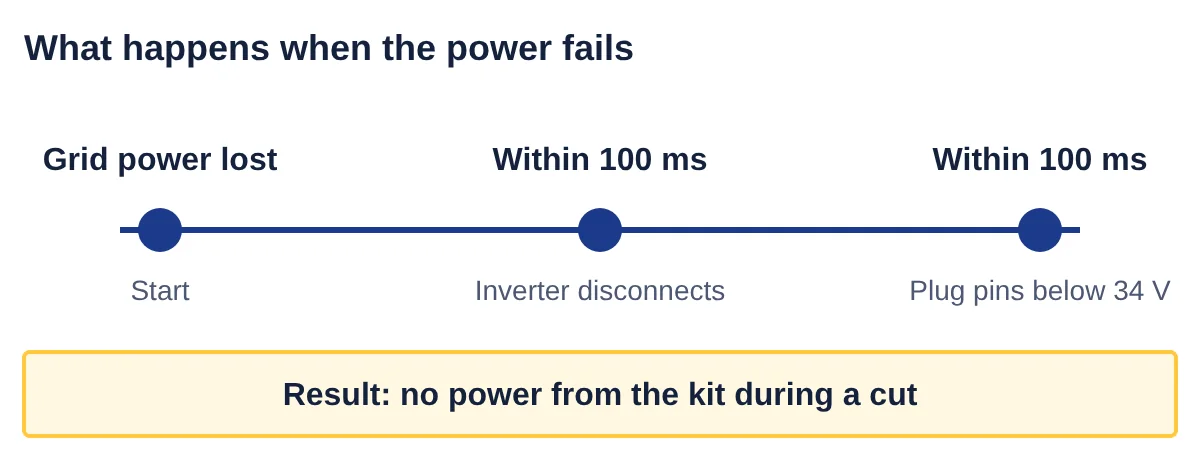
The rule is an anti-islanding requirement. It means the kit must not carry on feeding the circuit on its own once the grid has gone, which is why it cannot act as a backup supply. The safety guide explains the other limits the specification sets.
Why you cannot add a battery
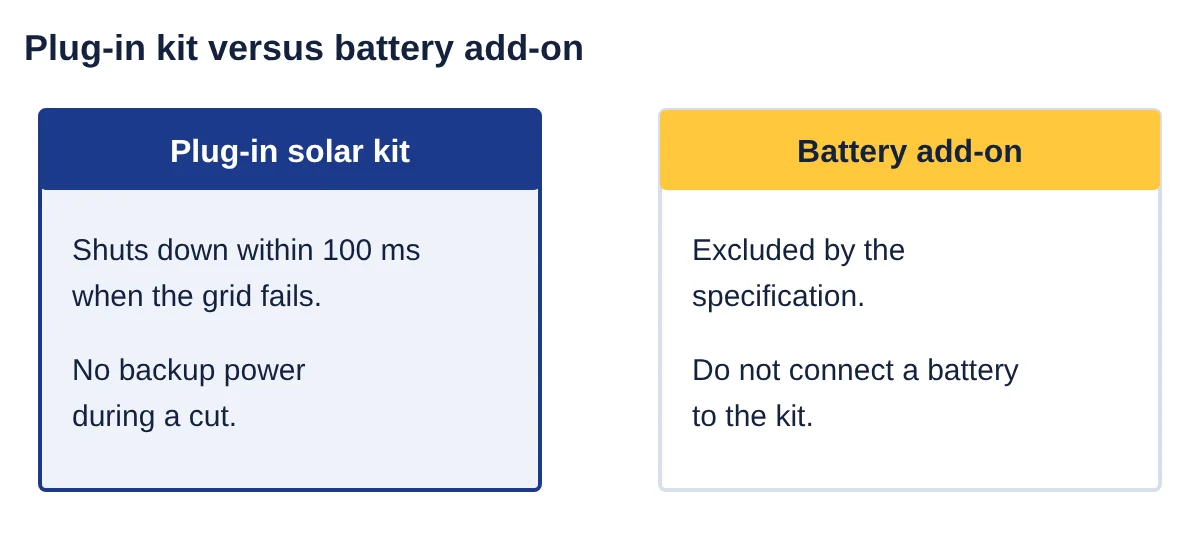
The specification excludes plug-in battery systems and plug-in solar devices integrated with battery systems. Its instructions must also carry a prominent warning that the device is not intended to be connected to, operated with, or used in conjunction with a battery energy storage system.
The government has said it will keep looking at the evidence. ESS News reported that DESNZ has put out to tender a safety study of plug-in batteries, expected to run for about 18 months from October 2026. Until the rules change, a battery is not part of a legal kit. The battery rules set out the details.
What gives you backup power
A portable power station is a battery product. Battery systems sit outside the plug-in specification, so keep the station separate from your kit, and do not connect one to it or to its socket. The 800 W guide shows what the kit can run when the grid is working. For what your home needs during a cut, speak to a qualified electrician.
After the power returns
Check the kit’s status lights or app before you use it again. The London Fire Brigade lists repeated electrical tripping, a burning smell, overheating and buzzing as reasons to stop using the kit. If any of these appear after a cut, switch the kit off and have a qualified electrician check it.
Planning for the next cut
A cut is not a reason to change how the kit is wired. Keep to these habits:
- Check whether the cut affects only your home or the whole street before you contact anyone. Ask your neighbours, and look at whether the lights are off across the road.
- Keep the kit’s cable and plug clear of standing water during storms, and make sure any outdoor socket cover is closed.
- Do not use an extension lead or adaptor to move the kit to a different socket after a cut.
- Keep your fridge and freezer on the normal supply. The kit does not replace it, and it will not keep it running.
Common mistakes
- Expecting the kit to run the fridge or the router during a cut.
- Adding a battery so the kit works at night or in a power cut.
- Plugging an extension lead into the kit to reach another socket.
- Restarting the kit again and again after it trips.
For the legal position on the whole kit, read is plug-in solar legal in the UK.
Frequently asked questions
Will plug-in solar power my fridge in a blackout?
No. The kit disconnects when the grid fails, so it cannot power a fridge or any other appliance during a cut. A fridge needs a supply that stays on during the cut, which a plug-in kit cannot provide.
Why does my solar panel stop when the grid goes down?
The inverter must switch off when it loses the mains supply. The DESNZ interim specification requires it to disconnect within 100 ms, which is an anti-islanding rule.
Can I use plug-in solar with a portable power station for blackouts?
Keep them separate. The specification excludes battery systems, and the instructions must warn against connecting a battery to the kit. Do not connect a portable power station to the kit or its socket.
Is it dangerous if the kit keeps feeding the socket during a power cut?
It should not. The specification requires the plug pins to fall below 34 V within 100 ms of the mains disconnecting, so the socket should not stay live from the kit.
What do I do when the power comes back?
Check the kit's status lights or app before you use it again. If it keeps tripping, shows a fault or smells of burning, stop using it and call a qualified electrician.