Can You Build Your Own Plug-in Solar Kit? What the UK Allows
Can you buy panels and an inverter separately? Learn why a plug-in solar combination must be a listed device on the ENA register, and how to check.
Some links are affiliate links: if you buy through them we earn a small commission at no extra cost to you. It does not change our recommendations.
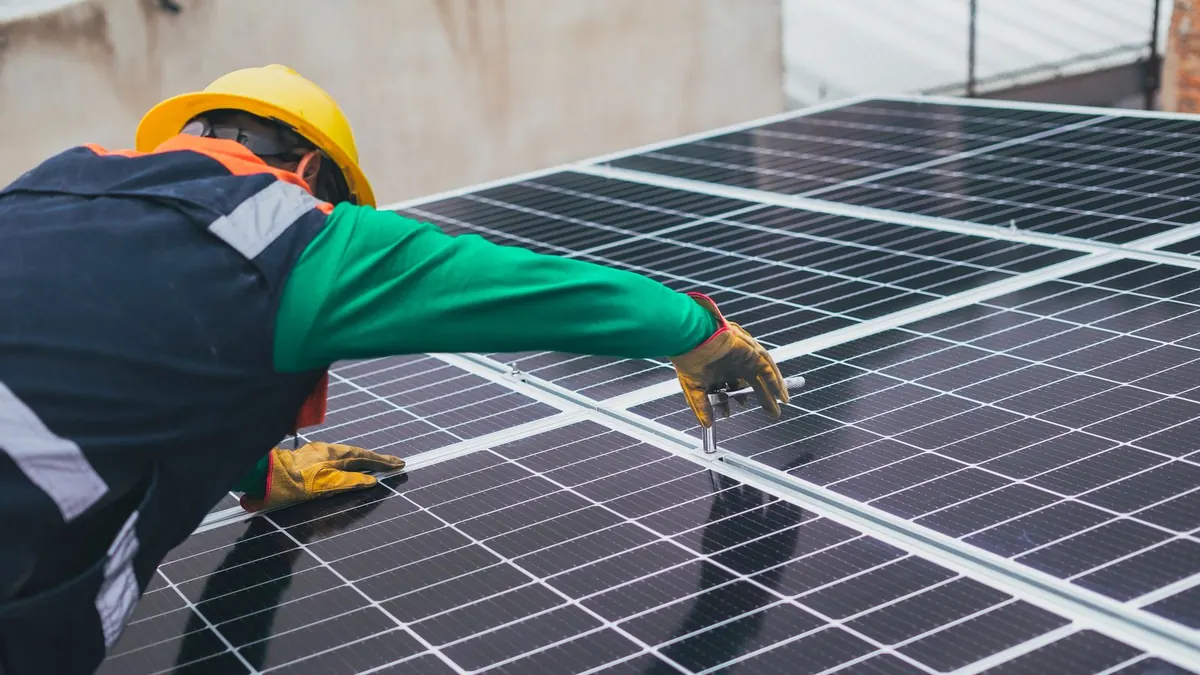
A plug-in solar kit put together from separate parts is only covered when that exact combination is a device registered on the ENA Type Test Register. Buying a panel and a microinverter separately is not the same as buying a listed kit. Before you buy anything, find the register entry for the complete device and check that the model matches.
Why “build your own” is not the same as a listed kit
The Interim Product Specification v2.0 recognises kits made of a PV module and an inverter. It also allows devices with more than one component, where the user makes the DC connections between them. What it does not allow is treating those parts as compliant just because each one is sold separately.
Manufacturers must register devices on the ENA Type Test Register. The specification says that submitting a device for registration does not in itself demonstrate compliance. So a register entry is the thing to check, and it has to describe the exact device you would plug in.
What a register row actually covers
A register entry names a manufacturer, a model and a configuration. Read it as a description of one product. If the entry lists one panel model with one inverter model, a different panel or a different inverter is a different device, even if the labels look similar.
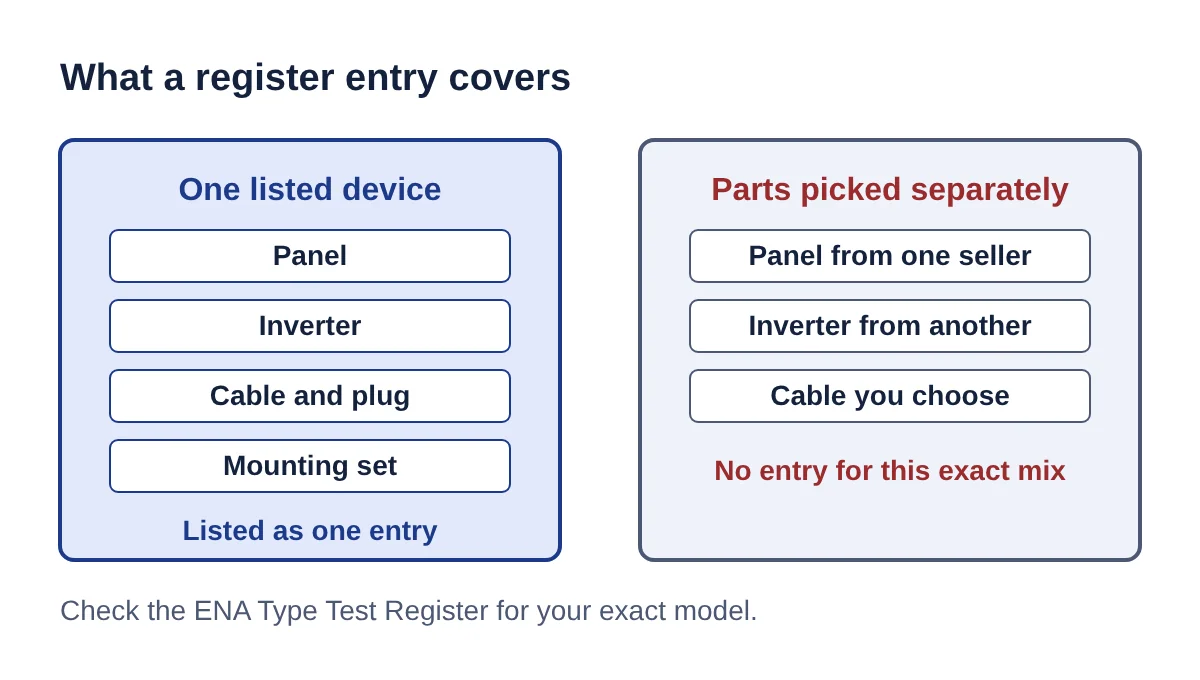
Check these points on the entry:
- the manufacturer and model of the inverter;
- the panel model and the configuration the entry describes;
- whether the cable and plug are part of the listed device;
- the date the entry was made, and whether the model is still listed.
Plug, cable and mounting must be part of the device
A plug-in kit is more than a panel and an inverter. The plug and cable are what connects the device to the socket, so they belong to the listed product. A homemade lead, a different plug or an unlisted cable changes the device, and that change can take it outside what was registered.
Mounting follows the same rule. The London Fire Brigade advises using only mounting brackets, fixings and accessories recommended by the manufacturer, because temporary or unsuitable fixings may fail over time.
Where DIY can still save money
Building your own kit can look cheaper on paper, but the saving only counts if the finished device is one that is listed and matches the register. A complete listed kit avoids the problem of buying a combination that has no entry.
If you are working out how many panels suit your flat, our guide to how many panels you need explains the size limit that applies to a plug-in device. For a shortlist of kits, see our guide to the best plug-in solar kits in the UK.
Common mistakes
- Buying panels and an inverter from different sellers. The combination may have no register entry at all.
- Choosing a component because it is “G98 certified” on the title. Check the register, not the listing.
- Changing the lead or plug. Any change to the tested device needs to be considered again.
- Using a microinverter on its own as a plug-in kit. An inverter alone is not a complete device.
How to check before you buy
Start with the model number on the product you want, then search the ENA Type Test Register for the same model. If the entry matches, read the manufacturer’s instructions for the kit as sold. If it does not match, choose another device or wait until the manufacturer registers the one you want.
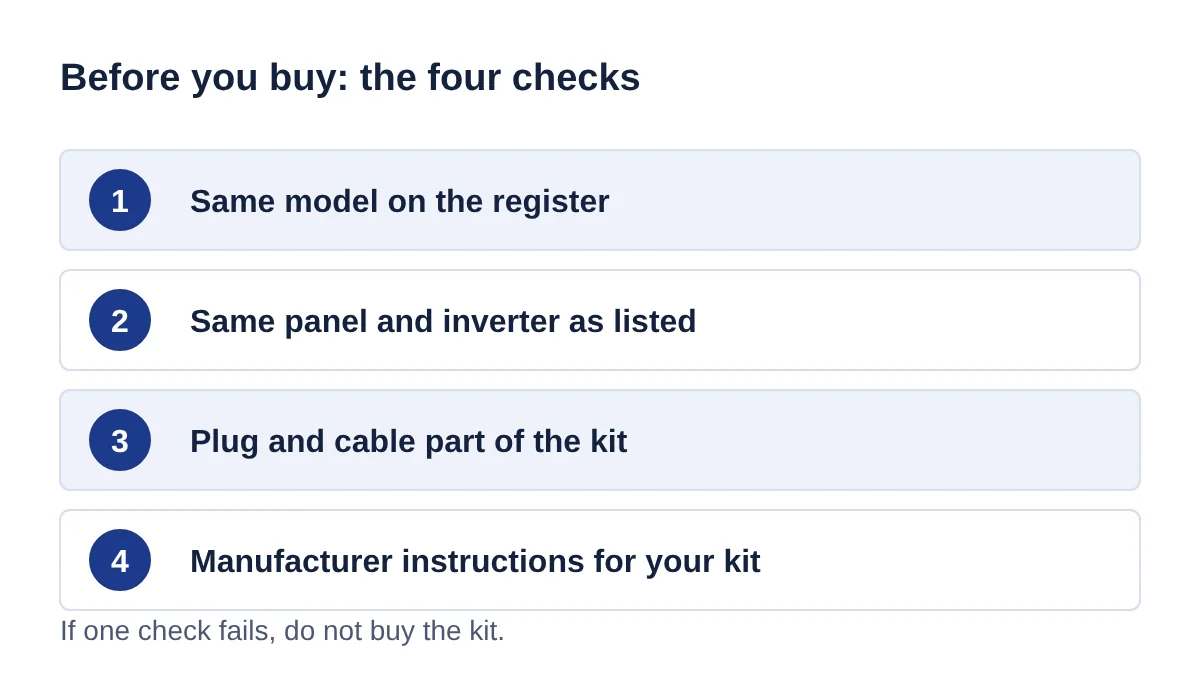
Our guide to checking a plug-in solar kit is legal walks through the register step by step. For what to ask a seller, see how to spot a non-compliant kit on Amazon UK.
Frequently asked questions
Can I buy panels and a microinverter separately for plug-in solar?
Only if that exact combination is registered on the ENA Type Test Register as a device. Buying the parts separately does not make the combination compliant.
Can I use a microinverter with a UK plug?
Only as part of a device that is registered. A microinverter on its own is not a plug-in solar kit, and its plug and cable must be part of the device as listed.
Does the whole kit have to be on the register?
The device has to be registered. Manufacturers register devices, and registration does not by itself prove compliance, so check the entry for your exact model.
Do I need to register my own kit with the register myself?
The register holds entries from manufacturers, so you check that a device is listed rather than registering it yourself. If the combination you want is not listed, it is not a registered device.
Can I make my own plug-in solar lead?
No, not if the device is registered with that plug and cable. Changing them yourself means the kit may no longer match its register entry.