How Many Panels Do You Need? Plug-in Solar Size and the 800 VA Cap
Plug-in kits output at most 800 VA, but the rules allow up to 2,000 W of panels. Here is what one or two panels really add, with the UK limits.
Some links are affiliate links: if you buy through them we earn a small commission at no extra cost to you. It does not change our recommendations.
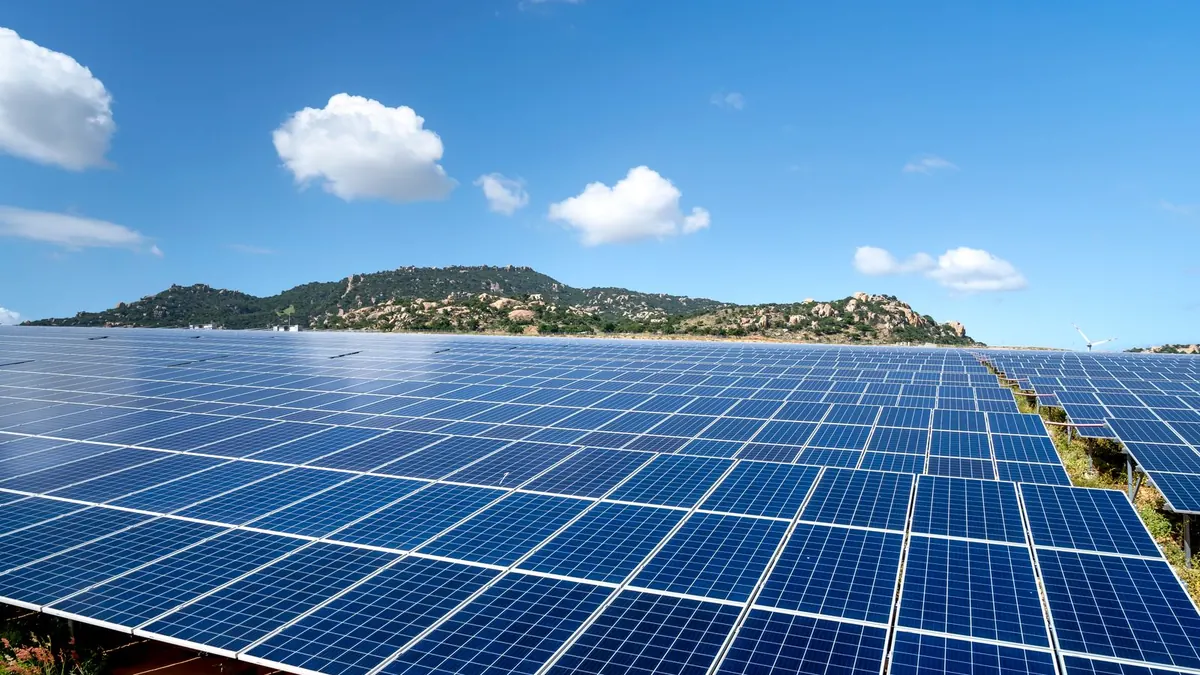
Most UK plug-in kits pair one or two panels with an inverter that supplies at most 800 VA to your home. The rules allow up to 2,000 W of panel power, so the panels can be larger than the output. More panel power does not raise the output above 800 VA. It mainly helps on dull days and at the start and end of the day.
Why the output cap is not the panel rating
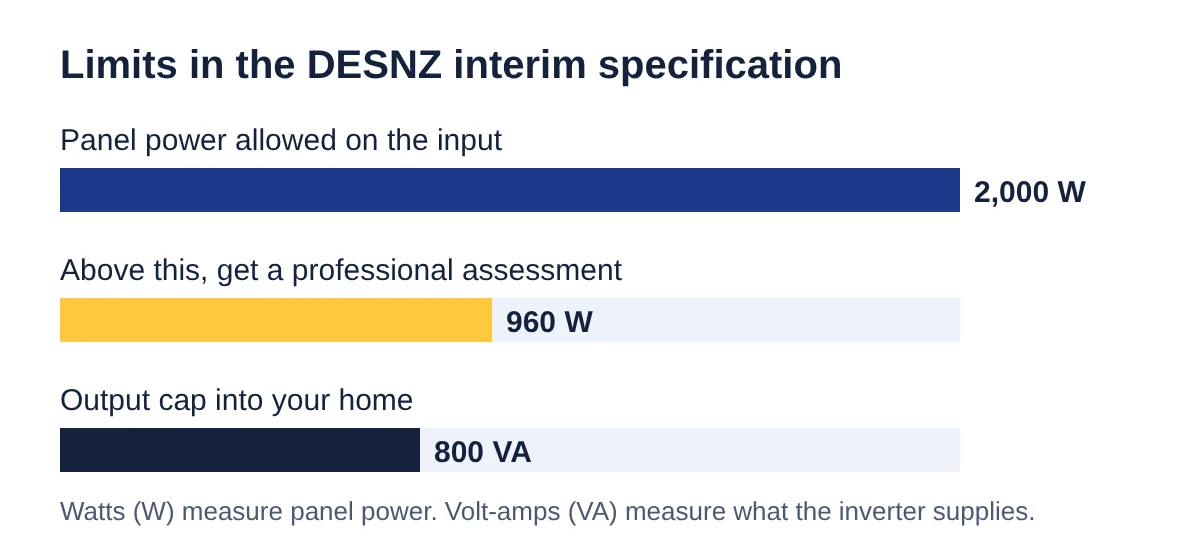
A panel rating is the power it can make in full sun. The output limit is what reaches your home. The specification sets the limit as 800 VA (volt-amps) and 3.5 A. At a supply of 230 V, 800 VA is about 3.5 A, so the two figures describe the same cap.
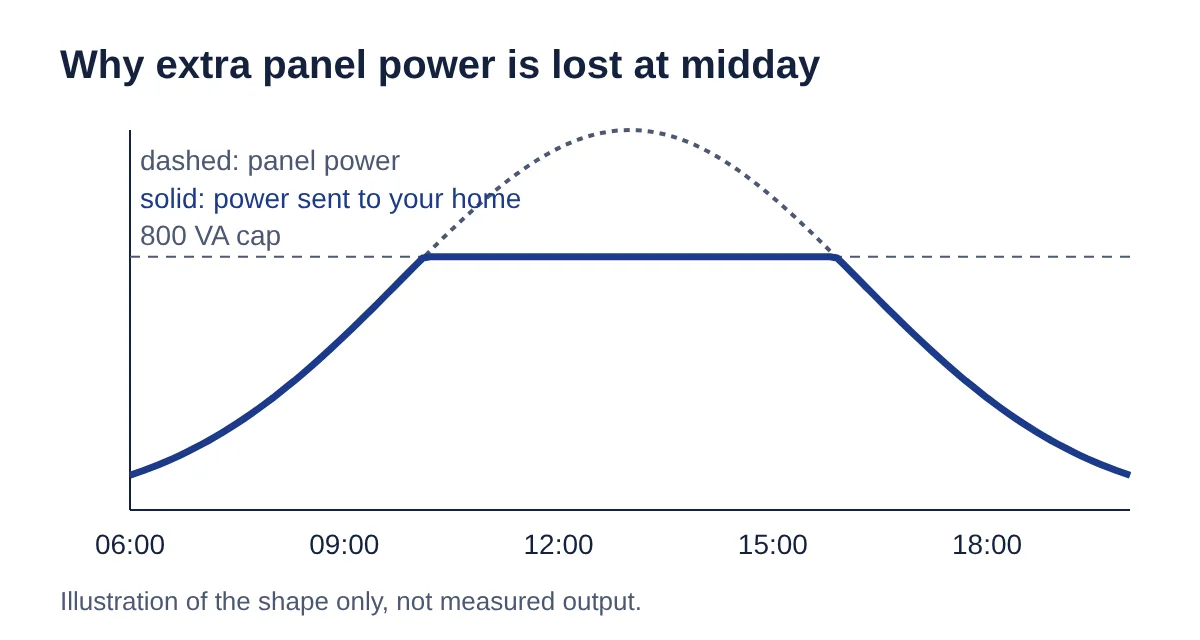
When the sun is strong, two panels can make more than the inverter can pass on. The inverter holds its output at 800 VA, so the surplus panel power is not used. The shape of that day is shown below. It is an illustration, not measured data.
What the rules allow on the panel side
The DESNZ interim specification, version 2.0 (July 2026), sets these limits for the panels:
- Up to 2,000 W of total panel power (DC) on the input side.
- Up to four PV modules connected to the inverter.
- No more than two modules in series within any string.
- Open-circuit voltage at the inverter inputs not above 120 V DC.
- Above 960 W of total panel power, the manufacturer must advise you to consider a professional assessment of the existing installation before you install.
One panel or two
A single panel is easier to fit on a balcony rail, a fence or a small garden wall. It makes less power, so the output reaches the cap only in strong sun.
Two panels give more area and more power early and late in the day. Placing one panel facing east and one facing west spreads the output across the day, but the total is lower than one south-facing panel. PVGIS 5.3 gives, for London, a vertical east panel of 400 Wp at about 208 kWh a year and a vertical west panel of 400 Wp at about 200 kWh a year. Together that is about 408 kWh, against about 594 kWh for an 800 Wp vertical south panel. The figures are estimates, scaled from 1 kWp. For the wider picture, see direction, tilt and shade.
What your space allows
| Space | What to check | Note |
|---|---|---|
| Balcony rail | Room for one panel and whether the balcony qualifies | Read the flat balcony guide first |
| Yard or small garden | Room for one or two panels on a fence or wall | Shade from walls and trees matters most |
| Sunny south wall | Room for two panels side by side | The vertical south figures apply |
Common mistakes
- Buying the biggest panel set you can fit. Above the cap, the extra power is not used at the peak.
- Confusing VA with W. Panel ratings are in watts; the output limit is in volt-amps.
- Going past 960 W without a check. Ask for the professional assessment the rules describe.
- Adding panels after installation without checking the kit’s manual and register entry.
For the full kit comparison, read the best plug-in solar kits for the UK. For the basics of how a kit works, read the UK plug-in solar guide.
Frequently asked questions
Can I connect more than 800 W of panels to a plug-in inverter?
Yes. The DESNZ interim specification allows up to 2,000 W of panel power on the input side. The inverter still supplies at most 800 VA to your home.
Is one panel enough for a plug-in kit?
It can be, if one panel fits your space. A single panel makes less than two, and the 800 VA cap still applies.
Why do panel ratings add up to more than the kit's output?
Panel ratings are the power in full sun. The inverter limits what it sends into your home to 800 VA, so the extra is not used in strong sun.
Can I add a third or fourth panel later?
Only within the rules. The specification allows up to four modules on one inverter, with no more than two in series in any string. Check the kit's manual and register entry before you change it.
What if my panels total more than 960 W?
The rules say you should have a professional assess your existing electrical installation before you install. Arrange that before you buy more panels.
Does a bigger panel array mean bigger savings?
Only up to the 800 VA cap. Extra panel power helps on dull days and early or late in the day. For the saving in pounds, see our savings guide.