Are Plug-in Solar Panels Safe? Fire Risk and Safety Rules UK
Plug-in solar is safe when the exact kit is on the ENA register and used as the rules say. The fire risks, the limits and the signs to stop, explained.
Some links are affiliate links: if you buy through them we earn a small commission at no extra cost to you. It does not change our recommendations.
Yes, if the kit is on the ENA Type Test Register, you use it as the specification intends, and a qualified electrician has checked any wiring concern. Plug-in solar has been legal in Great Britain since 27 August 2026. The DESNZ interim specification sets electrical limits that cut much of the fire risk. What remains comes mostly from misuse: extension leads, batteries, a socket that is not weatherproof and an old consumer unit.
What the specification builds in
The DESNZ interim specification, version 2.0, sets the safety limits for every legal kit. The main ones are:
- Power limits. Output must not exceed 800 VA or 3.5 A. Panels must not exceed 2,000 W in total. Above 960 W of panels, the manufacturer must advise a professional assessment of your installation.
- Shut-down rule. If the mains supply fails, the inverter must disconnect within 100 ms, and the voltage at the plug pins must fall below 34 V within the same time.
- Plug and fuse. A moulded, non-rewireable BS 1363-1 plug with a BS 1362 fuse of 5 A or less, going straight into a BS 1363-2 socket. A German Schuko plug does not meet this.
- Label. A durable label at or near the consumer unit shows that a plug-in device is present.
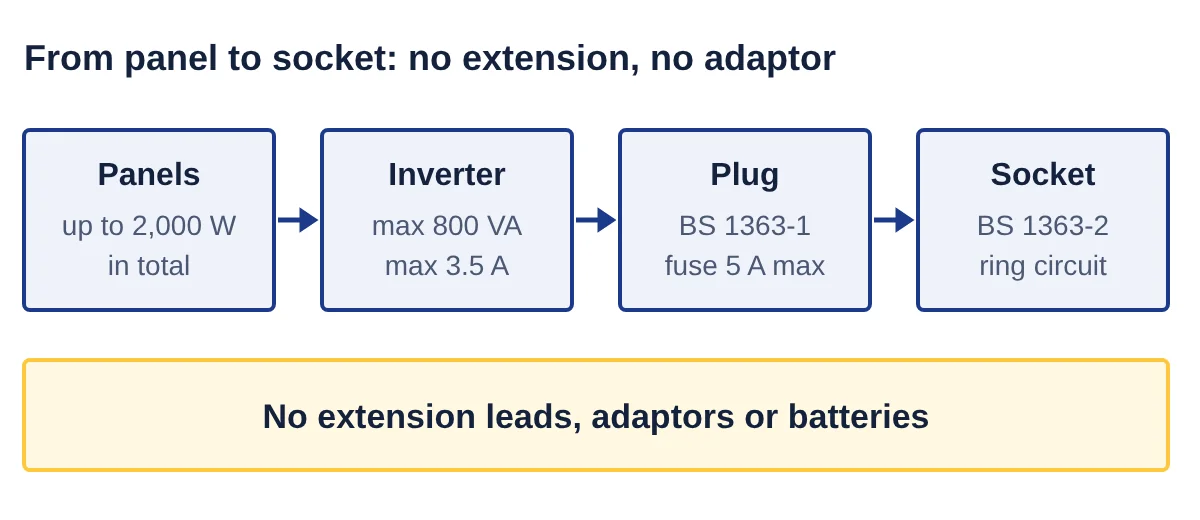
These limits only work if the kit is used as the specification describes.
Where the fire risk comes from
The London Fire Brigade names three everyday causes:
- Extension leads, adaptors and overloaded sockets. They can overheat and cause fires. The specification bans extension cables, multi-way adaptors, RCD adaptors, travel adaptors and plug converters.
- Damaged cables. Do not trap cables in doors or windows, run them under carpets, or let them touch sharp edges.
- Batteries. The fire service advises against connecting plug-in panels to batteries for storing energy for later use. The battery rules explain why.
The fire service also advises against fitting kits on shared balconies, walkways, windows and escape routes.
Outdoor sockets and water
If the kit plugs into an outdoor socket, the specification requires at least IP55 for outdoor plugs and socket-outlets. The London Fire Brigade advises at least IP65, fitted by a competent person. A socket that is not weatherproof can let in water, which the fire service links to electrical faults, shocks, short circuits and fire. Where you can, buy and fit to the higher rating. The outdoor socket guide explains the ratings.
What an electrician should check
The specification says that where the consumer unit is unlabelled, of unknown condition, or lacks modern protective devices, users should have a qualified electrician inspect the installation before fitting the product. Electrical Safety First points out that standard AC RCDs are not designed for residual direct current, and that load on a ring circuit may not share evenly. The installation guide shows what to check first, and the EICR guide explains when an inspection is worth paying for.
What the 2026 study tested
A DESNZ/Arceio study published in June 2026 tested six devices rated between 400 W and 800 W. It found:
- casings reached 45.1 to 54.2 °C in normal use;
- anti-islanding disconnection took 7 to 68 ms, against a G98 limit of 500 ms;
- conducted emissions exceeded class B limits at maximum export.
The study excluded performance and tariffs. Six devices is a small sample, so read these figures as indicative rather than as a rating for every kit.
If something goes wrong
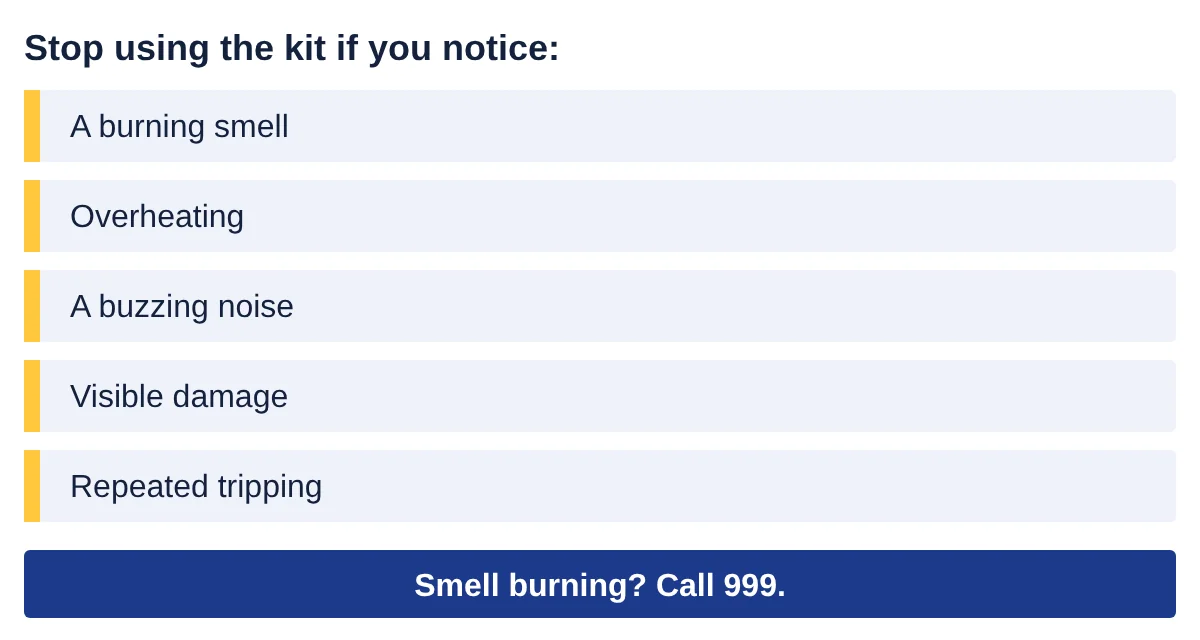
Stop using the kit straight away. The fire service lists these signs, and the figure below shows them together.
Common mistakes
- Using an extension lead because the socket is too far away.
- Adding a battery to store daytime power.
- Leaving a damaged cable in place.
- Buying a kit with a non-UK plug.
- Resetting the kit again and again after it trips.
For the wider rules, read is plug-in solar legal in the UK. For what happens in a cut, read does plug-in solar work in a power cut.
Frequently asked questions
Can plug-in solar panels catch fire?
A kit can overheat if it is misused, plugged into an extension lead or an overloaded socket, or connected to a battery. The London Fire Brigade warns against all three. A compliant kit used as the specification describes is designed with electrical limits, but no electrical product is risk-free.
Is it safe to leave plug-in solar running overnight?
Leave it running only while it works normally. Stop using it at once if you notice a burning smell, overheating, buzzing, visible damage or repeated tripping, and have it checked before you restart it.
Can I use an extension lead with plug-in solar?
No. The specification bans extension cables, multi-way adaptors, RCD adaptors, travel adaptors and plug converters. The London Fire Brigade also warns against extension leads and overloaded sockets.
Is plug-in solar safe in a flat?
It can be, but check the rules for your building first. The England planning rules do not allow plug-in solar on timber balconies or on timber-clad buildings, and the London Fire Brigade advises against fitting on shared balconies, walkways, windows and escape routes.
What do I do if my plug-in solar keeps tripping the power?
Switch the kit off and do not keep resetting it. Repeated electrical tripping is one of the warning signs the London Fire Brigade lists. Have a qualified electrician check the circuit and the kit before you use it again.
Sources
- DESNZ – Plug-in Solar Device Interim Product Specification v2.0 (July 2026)
- London Fire Brigade – Plug-in solar panels: safety advice for residents and homeowners
- DESNZ/Arceio – Plug-in solar PV study (June 2026)
- Electrical Safety First – Plug-in solar PV: considerations (2026)
- GOV.UK – Households can save as plug-in solar panels come to market (26 August 2026)