Plug-in Solar Mounting UK: Balcony, Garden, Wall and Fence
Where UK plug-in solar panels can be mounted, what the specification bans on balconies and walls, which fixings are allowed and how wind and snow are handled.
Some links are affiliate links: if you buy through them we earn a small commission at no extra cost to you. It does not change our recommendations.

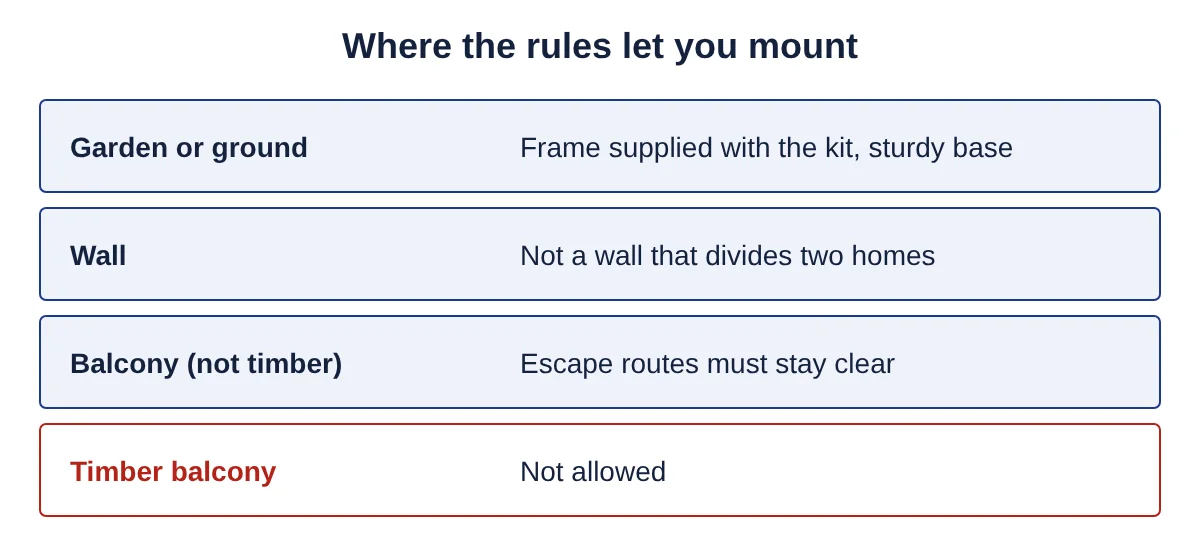
For most homes, the garden is the easiest place to mount a plug-in kit. A balcony can work too, but only if it is not timber, the building is not under external wall remediation, the panels do not block escape routes and you have permission if you live in a flat. Use the mounting system that comes with the kit, and fix it with reversible fixings.
Which mount fits your home?
The Energy Saving Trust says that if your roof is unsuitable for solar, plug-in panels in the garden could be a good alternative. It also says current UK devices are more suitable for gardens than for balconies. That matters when you choose a mount: a garden layout gives you more room to fix the frame and to position the panels for sun.
Ground and garden mounts
A ground mount is the simplest option. Use the frame supplied with the kit, fix it to a sturdy base and follow the manufacturer’s instructions. The Energy Saving Trust advises fixing the panels securely to a safe and sturdy surface, and using an appropriate frame or mounting.
Keep the panels clear of anything that could block them. Check the position for shade from trees, fences and sheds during the day, and note that the specification requires the maximum installation height to be stated by the manufacturer. Stay within that height.
Walls
A wall mount can work on an outside wall of your home, but the specification sets two limits:
- the panels must not be installed on or fixed to walls or other parts of the building that form a property boundary between dwellings;
- the installation must not increase the risk of fire spreading along external walls or balconies.
If you live in a terraced house or a flat, a shared wall between two homes falls under the first rule. Check with your landlord, freeholder or property manager before you fix anything to a shared wall.
Balconies
Balcony mounting is where the rules are strictest. The specification says installations are not permitted on:
- timber balconies;
- high pressure laminate (HPL) cladding systems.
It also says a device must not be installed on a building that is subject to external wall remediation works. The London Fire Brigade adds that if cladding works or remediation are underway or planned, you should not install plug-in solar until the work is complete.
Before you fix anything to a balcony, check the following:
- Permission. The Energy Saving Trust says you will need permission before installing on the balcony of a flat, and the specification requires permission from the owner, landlord or freeholder.
- Escape routes. Panels and equipment must not block shared balconies, walkways, windows or fire escape routes. Keep combustible materials away from panels and connections.
- Fixings. The Energy Saving Trust notes that you also need an appropriate frame, fixing or anchors. The kit’s supplied mounting is the starting point.
Our planning permission guide explains the separate planning rules for England, Scotland and Wales.
Fixings: what is allowed
The specification is clear about fixings:
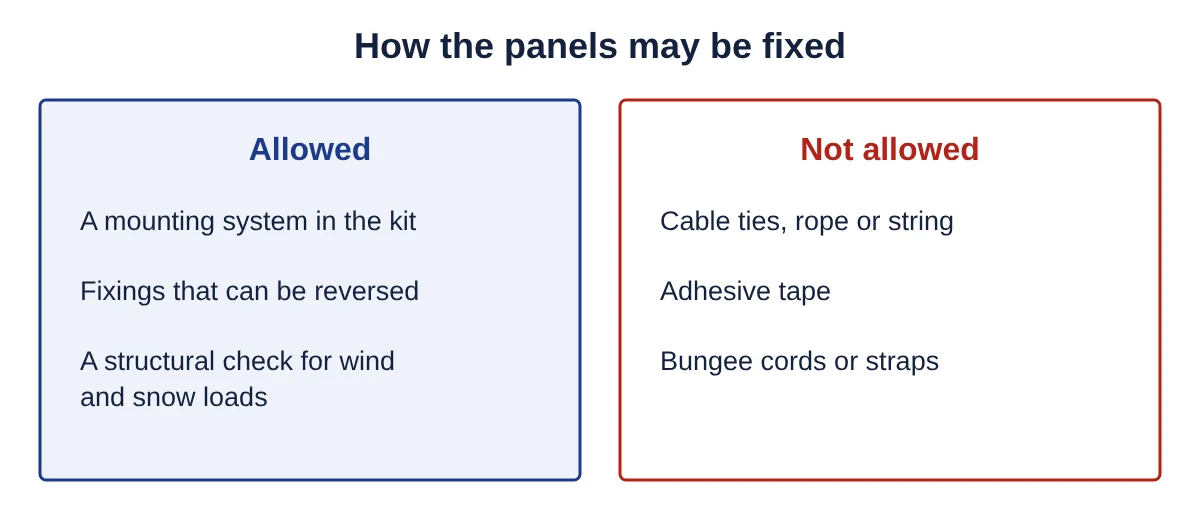
- A mounting system must be supplied as part of the complete kit.
- Cable ties, rope, string, adhesive tape, bungee cords and straps are not permitted.
- Any attachment method must be reversible and non-permanent.
- Fixings must not compromise the structural integrity, fire performance or weatherproofing of the building.
The London Fire Brigade advises using only the brackets and fixings the manufacturer recommends, because temporary or unsuitable fixings may fail. In practice, that means you should not swap in a bracket from another product, even if it looks stronger.
Wind and snow
Wind and snow are the main structural risks. The specification says the mounting system must be demonstrated, through structural analysis, to meet the load requirements for all intended configurations. It refers to the British Standards for wind loads (BS EN 1991-1-4) and, where appropriate, for snow loads (BS EN 1991-1-3).
For you, the practical point is that the mounting is designed with the panels. Do not change the layout, add weight or fit a different frame, because the analysis is for the kit as the manufacturer supplies it. The specification says a device must not be modified or installed in a way the manufacturer has not specified.
Tilt and angle
The specification does not set a tilt angle for every home. Where the manufacturer needs the panels to be angled to get adequate ventilation, the manual must say so. The specification’s definition of a mounting system refers to adjusting the tilt angle of the modules. Set the angle the manual gives, rather than copying a figure from a blog.
What not to use
Avoid anything that is not part of the kit:
- cable ties, rope or string;
- adhesive tape;
- bungee cords or straps;
- a bracket from a different product, unless the manufacturer recommends it.
The specification bans these methods, and they are not designed to hold a panel in wind.
Before you fix anything
Check the mounting once the kit is up, and again after a storm. Look for loose fixings, cracks in the frame and any movement in the panels. If anything has shifted, stop using the kit and have a professional check it before it goes back into use. For the electrical side of the job, read our installation guide and the outdoor socket guide.
For the basics of the kit itself, see our plug-in solar guide, and check the kit against the register with our ENA register guide.
Frequently asked questions
Can I mount plug-in solar on a balcony railing?
Only if the balcony is not timber, the building is not under external wall remediation and the panels do not block escape routes. If you live in a flat, get the owner's or freeholder's permission first, and use the mounting supplied with the kit.
Can I put plug-in solar on a timber balcony?
No. The specification does not permit installation on timber balconies or on HPL cladding systems.
What angle is best for plug-in solar in the UK?
The specification does not set a tilt angle. Where ventilation needs one, the manufacturer states the angle, so follow the manual for your kit.
Can I use my own mounting bracket?
Use only the mounting system supplied with the kit, or the brackets the manufacturer recommends. Cable ties, rope, tape, bungee cords and straps are not permitted.
Will wind blow the panels off?
The specification requires the mounting to be shown, by structural analysis, to handle wind and snow loads, so that foreseeable loading does not cause detachment or falling components. Fit the mounting exactly as the manual says.