Is Plug-in Solar Worth It in Winter? UK Output From November to February
An 800 W plug-in kit facing south makes about 120 to 160 kWh from November to February in UK cities. Monthly PVGIS figures for four cities.
Some links are affiliate links: if you buy through them we earn a small commission at no extra cost to you. It does not change our recommendations.

Yes, but winter adds little. An 800 W plug-in kit facing south on a vertical wall makes about 120 to 160 kWh between November and February, depending on the city. That is roughly a quarter of its output for the year. Treat winter as a bonus, not as the way the kit pays for itself.
What the monthly figures show
The figures come from JRC PVGIS 5.3, the solar output tool of the European Commission. They are scaled from 1 kWp to an 800 W kit (0.8 times the PVGIS value). The model assumes a south-facing panel on a vertical wall, such as a balcony railing, with 14% system losses and no shade from nearby buildings. For other cities, see plug-in solar output by region.
| City | Nov (kWh) | Dec (kWh) | Jan (kWh) | Feb (kWh) | Nov to Feb | Full year |
|---|---|---|---|---|---|---|
| Edinburgh | 35.2 | 22.4 | 28.0 | 39.2 | 125 | 546 |
| Manchester | 33.6 | 27.2 | 24.0 | 36.0 | 121 | 517 |
| London | 42.4 | 34.4 | 36.8 | 42.4 | 156 | 594 |
| Plymouth | 41.6 | 33.6 | 36.8 | 46.4 | 158 | 636 |
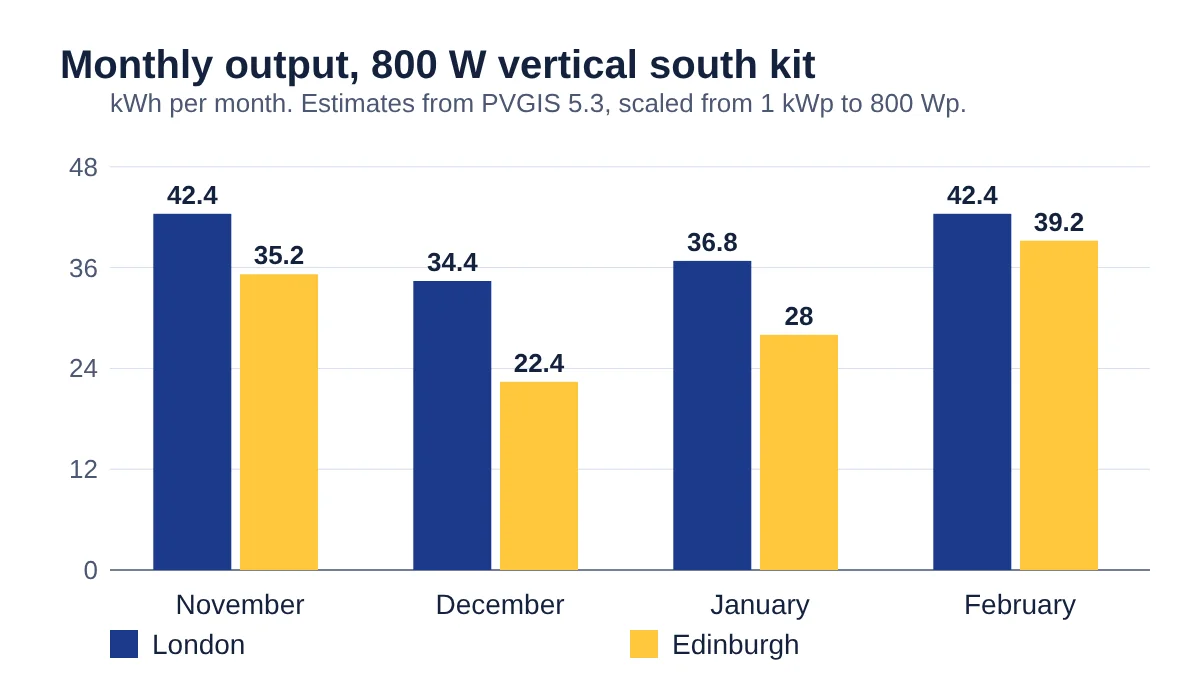
Edinburgh makes about a fifth less than London over the four months. The gap between the months is larger than the gap between the regions. In all four cities, December and January are the two lowest months.
Vertical or tilted in winter
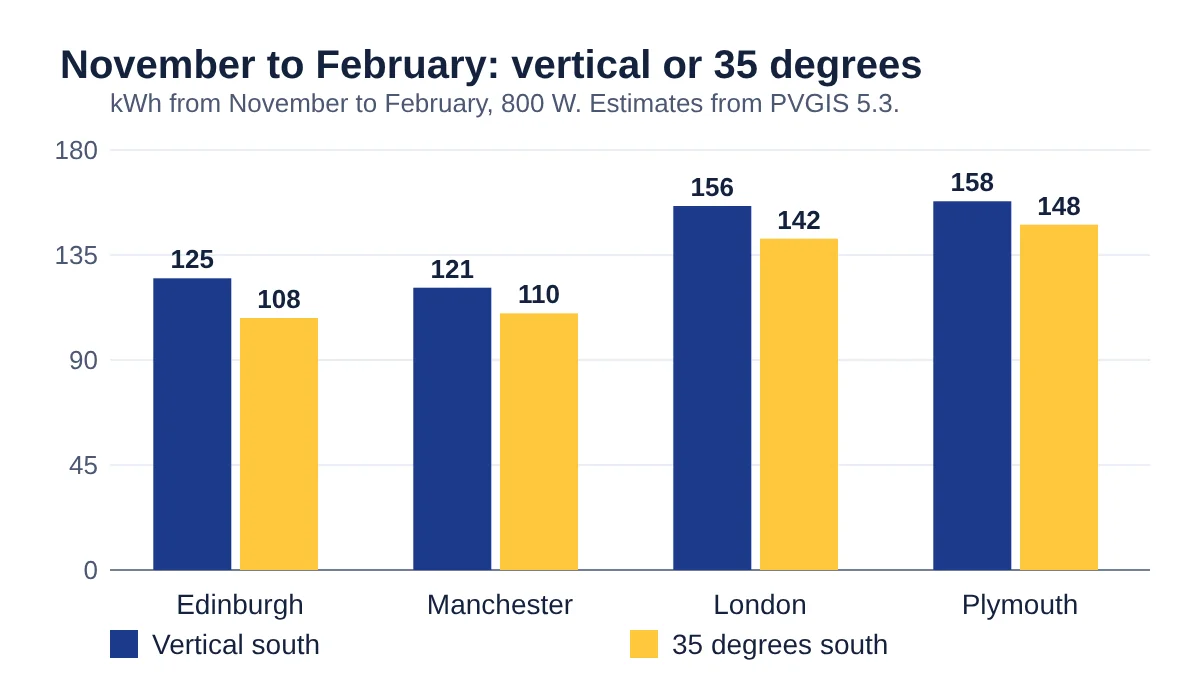
A panel tilted at 35 degrees gives more power in spring and summer. From November to February, the vertical panel gives more in every city in the table:
- Edinburgh: 125 kWh vertical, 108 kWh at 35 degrees.
- Manchester: 121 kWh vertical, 110 kWh at 35 degrees.
- London: 156 kWh vertical, 142 kWh at 35 degrees.
- Plymouth: 158 kWh vertical, 148 kWh at 35 degrees.
If your only sunny spot is a garden or roof, the tilted figures apply and winter output is lower. Our guide to direction, tilt and shade explains how to pick a spot.
Cloud, low sun and snow
Cloud cuts output for the day, sometimes to a small fraction of a clear day. In December and January the sun is low, so a panel gets less light even on a clear day. Shade matters more too: a building, tree or fence that casts no shadow in July can cover part of a balcony or garden panel in December. Check the spot at midday in winter before you buy.
Snow that lies on a panel blocks the light, so output drops until it clears. Brush it off from the ground with a soft brush, and follow the manufacturer’s manual for cleaning. Do not climb onto a roof or a ledge to clear snow.
Is winter output enough to pay the kit off?
No. The winter months give about a quarter of a vertical panel’s output, so they cannot pay back the kit alone. In London, 156 kWh over the four months is worth about £41 at the cap, if every unit is used at home. Most of the year’s saving comes from spring and summer. For the full-year picture, read how much plug-in solar panels save and what plug-in solar costs in the UK.
The rate and the VAT in winter
Ofgem’s price cap for 1 October to 31 December 2026 is 26.32p per kWh for direct debit customers, excluding VAT. Electricity VAT is 0% until 31 March 2027. Ofgem announces the rate for 1 January to 31 March 2027 on 25 November 2026. Recalculate your figure with that rate when it is published.
Common mistakes
- Judging by a summer day. A bright July afternoon says little about January.
- Tilting the panel for winter. For November to February, vertical beats 35 degrees in these figures.
- Counting winter as the payback. Most of the output comes from March to September.
- Ignoring shade. Winter sun is lower, so a nearby building blocks more of it.
- Buying without checking the register. Winter output does not help if the model is not on the ENA Type Test Register. See how to check a kit is legal.
Frequently asked questions
Does plug-in solar work in winter in the UK?
Yes, at a lower level. An 800 W kit facing south on a vertical wall makes about 120 to 160 kWh from November to February, depending on the city, according to PVGIS estimates.
Do plug-in solar panels work when it is cloudy?
They work on cloudy days at a much lower output than on a clear day. The monthly figures are estimates, not a forecast for a particular week.
Do plug-in solar panels work in snow?
Snow lying on a panel blocks the light, so output drops while it covers the panel. Clear it as the manufacturer's manual describes, from the ground.
Is a vertical panel better than a tilted one in winter?
Yes, in these figures. In all four cities in the table, a vertical south panel makes more from November to February than one tilted at 35 degrees.
Should I wait until spring to buy plug-in solar?
You can buy in winter and fit the kit when the weather allows. Check the rules and the ENA Type Test Register entry for the model before you pay.
Will the winter electricity rate change?
Ofgem's cap for October to December 2026 is 26.32p per kWh, excluding VAT. Ofgem announces the rate for January to March 2027 on 25 November 2026.